 KEMAJUAN
Q235B Carbon Steel Rectangular Tube
Cold-formed welded rectangular hollow section from 20×10 mm to 400×200 mm, 6 m dan 12 m panjang.
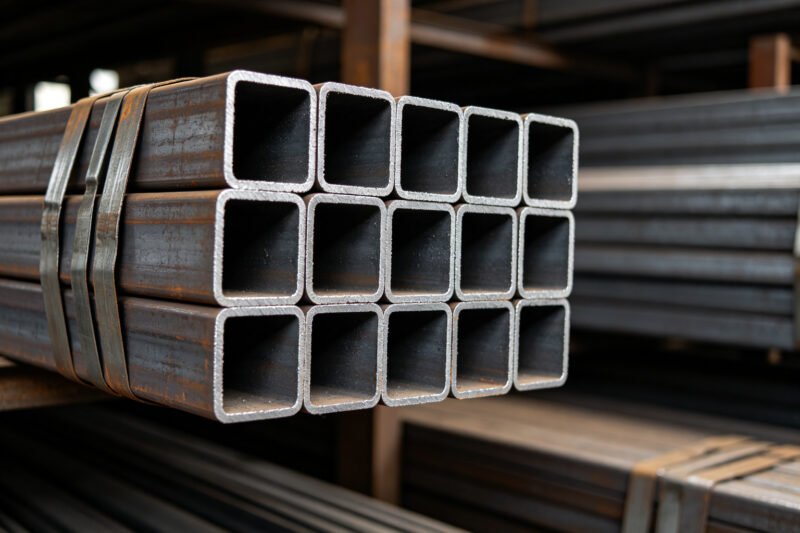
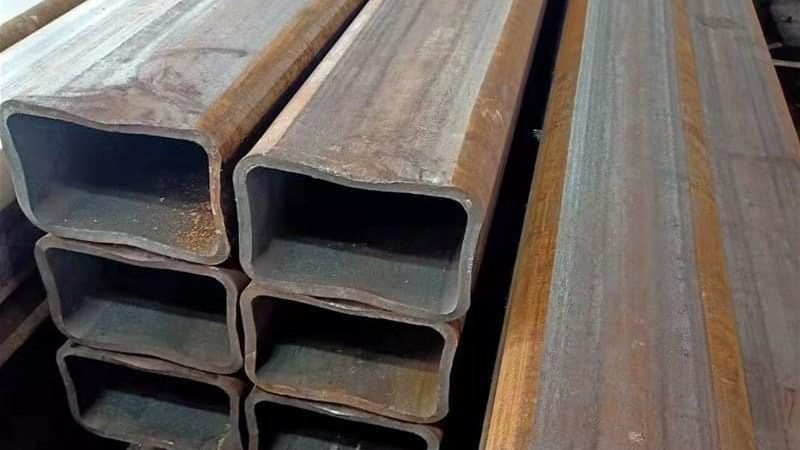
A Q235B rectangular tube is a cold-formed, electric-resistance-welded hollow section with a rectangular outside profile. It carries bending load in two directions more efficiently than a round pipe of the same weight, which is why it dominates frames, mengarut, pengawal, bingkai pintu gerbang, greenhouse structures and light vehicle bodies. QIDAMT supplies RHS in Q235B to GB/T 6728, with square, rectangular and custom lengths, and can galvanize or prime on request.
The section looks simple, but most quality problems start before the tube reaches the welder: wall thickness below the tolerance, corner radius out of spec, twist in a long length, or a weld seam that opens when the tube is bent. This page sets out the grade, the size range, the tolerances that matter and the rules for selecting and installing RHS.
What a Q235B Rectangular Tube Is and Where It Is Used
Rectangular hollow section (RHS) is produced from steel strip that is slit to width, roll-formed into a rectangular profile, welded along the seam by high-frequency resistance welding, then sized and straightened. Q235B is the Chinese carbon structural steel grade most commonly used for this product; it is readily welded, formed and cut, and it accepts paint, powder coating and hot-dip galvanizing.
- Bingkai mesin, pengawal, enclosures and conveyor supports
- Warehouse racking, mezzanine floors and shelving uprights
- Gate frames, fence panels, carport and greenhouse structures
- Trailer bodies, agricultural implements and light vehicle chassis
- Sign supports, susur tangan, balustrades and architectural frames
- Temporary structures, staging and exhibition build systems
The rectangular shape is chosen when a flat face is useful for mounting, when the section must fit a shallow depth, or when the designer wants different stiffness about the two axes. A square section is better when the load direction is unknown; a round tube is better for fluid service and for uniform wind loading.
Steel Grade and Chemical Composition
Q235B ditakrifkan oleh GB/T 700. The table gives the heat-analysis limits; product analysis tolerances apply.
| unsur | Limit (%) | Effect on the tube |
|---|---|---|
| Karbon (C) | 0.20 maks | Weldability and strength |
| silikon (Dan) | 0.35 maks | Penyahoksidaan; affects galvanizing |
| Mangan (Mn) | 1.40 maks | Strength and hardenability |
| Fosforus (P) | 0.045 maks | Too high reduces ductility |
| Sulfur (S) | 0.045 maks | Too high promotes weld cracking |
Because the tube is made from strip, the strip grade and the tube standard both matter. A tube marked Q235B should be made from Q235B strip; re-rolled or unknown strip with a similar analysis is not the same product and will not carry the same certificate. Ask for the strip heat number and the tube mill certificate, not just a grade stamp on the bundle.
Sifat Mekanikal
| Harta benda | Keperluan | Thickness note |
|---|---|---|
| Kekuatan hasil | ≥235 MPa | For thickness ≤16 mm |
| Kekuatan hasil | ≥225 MPa | For thickness 16 – 40 mm |
| Kekuatan tegangan | 370 – 500 MPa | All common wall thicknesses |
| Pemanjangan | ≥26% | For thickness ≤16 mm, tolok 50 mm |
| Pemanjangan | ≥25% | For thickness 16 – 40 mm |
| Ketumpatan | 7.85 g/cm³ | Used for weight per metre |
Ketebalan dinding, not the grade, usually decides whether a tube survives. A 2.0 mm nominal wall rolled at the lower tolerance limit can be 1.8 mm, which cuts the section modulus by roughly 10%. On a long span that is the difference between a stiff frame and a sagging one.
Size Range and Weight per Metre
The sizes below are representative of what is produced to GB/T 6728. Weight is calculated for nominal dimensions at 7.85 g/cm³; actual weight follows the actual wall thickness.
| Saiz (mm) | dinding (mm) | Berat badan (kg/m) | Penggunaan biasa |
|---|---|---|---|
| 40 × 20 | 2.0 | 1.76 | Guards, bingkai, light shelving |
| 50 × 25 | 2.0 | 2.23 | Gate frames, tanda sokongan |
| 60 × 40 | 2.5 | 3.73 | Racking, bingkai mesin |
| 80 × 40 | 3.0 | 5.37 | Conveyor supports, mezzanine |
| 100 × 50 | 3.0 | 6.78 | Bingkai struktur, trailer bodies |
| 120 × 60 | 4.0 | 10.80 | Heavy frames, crane rails |
| 150 × 75 | 4.5 | 15.26 | Lajur, long-span beams |
| 200 × 100 | 5.0 | 22.77 | Portal frames, heavy structures |
| 250 × 150 | 6.0 | 36.55 | Industrial structures |
| 300 × 200 | 8.0 | 60.79 | Heavy fabrication, temporary works |
Standard delivery length is 6 m or 12 m, with cut-to-length supplied against a cutting list. For long spans, remember that transport length, not mill capability, is usually the limit: a 12 m bundle needs a suitable trailer and unloading space.
Tolerances That Matter
GB/T 6728 sets the dimensional tolerances for cold-formed hollow sections. The values below are typical and should be confirmed against the edition cited on your purchase order.
| Ciri | Toleransi tipikal | Mengapa ia penting |
|---|---|---|
| Outside dimension (H, B) | ±1% | Affects fit into frames and brackets |
| Ketebalan dinding | ±10% | Directly changes strength and weight |
| Panjang | 0 / +30 mm | Cutting list allowance |
| Kelurusan | ≤1.5 mm/m | Visible bow on long rails |
| Pusing | ≤1.5 mm/m | Prevents flat mounting of frames |
| Squareness of corners | 90° ±1° | Welded joints gap or close |
| Jejari sudut | Tentang 2 – 3 times wall | Affects bending and fit |
Twist is the least visible and most expensive tolerance failure. A bundle can look straight on the truck and still show a propeller twist when the tubes are laid on a flat floor. Check by sighting along the tube from one end and by measuring the height of both corners at the far end.
How the Tube Is Made
The process runs from coil to finished bundle in one line: strip uncoiling, slitting to the developed width, edge preparation, roll forming through a series of stands, high-frequency welding of the seam, removal of the external weld flash, sizing, meluruskan, cutting to length and bundling.
Three process details control quality. Pertama, the strip width determines the finished dimensions and wall; a narrow strip gives an undersize tube. Kedua, the welding power and speed determine whether the seam is fully fused; a cold weld can pass a visual check and fail under bending. Ketiga, the sizing and straightening rolls determine straightness and twist. A tube that is dimensionally correct but poorly straightened will not fabricate well.
Optional processes include hot-dip galvanizing, pre-galvanizing from zinc-coated strip, primer coating, and hydrostatic testing for pressure applications. If the tube will be galvanized after fabrication, specify vent and drain holes in the design; sealed sections can burst or distort in the zinc bath.
Peraturan Pemilihan
RHS, SHS or round pipe
Use RHS when one face must be flat for mounting or when depth is restricted. Use square hollow section when the load direction is uncertain or when the section must look symmetrical. Use round pipe for fluid service, for uniform wind or impact loading, and where the connection is by saddle or sleeve.
Wall thickness and span
For a first pass, size the tube by deflection rather than by stress. A common limit is L/250 for general frames and L/360 for structures that carry equipment or glazing. Then check bending stress, shear at supports and local crushing at bolted connections. If the tube is drilled or slotted, subtract the lost section at that point.
Corner radius and connections
RHS has a defined outside corner radius, typically two to three times the wall thickness. Bolted connections through the flat face need washers large enough to span the corner; welded connections need the joint detailed so the weld does not sit in the radius. If the tube is to be bent, specify a bend radius large enough to avoid seam opening and wall thinning.
Fabrication and Installation Notes
- Cut with a cold saw or abrasive saw for clean square ends; a band saw is slower but gives a better weld fit-up.
- Remove the internal weld flash if a sleeve or insert must slide inside the tube.
- For Q235B, E43 series electrodes (J422/E6013 type) suit general work; use E50 series for higher-strength joints or heavier sections.
- No preheat is normally needed below 20 dinding mm, but dry the surface and avoid welding at temperatures below 0 °C without protection.
- Drill with sharp HSS bits at moderate speed; the weld seam is harder than the parent strip and will deflect a dull bit.
- When hot-dip galvanizing after fabrication, drill vent holes at both ends of each sealed compartment and drain holes at low points.
- Do not lift bundles by the tube faces with fork tines; use slings and timber spreaders to avoid denting and permanent set.
- Store bundles on timber bearers, clear of standing water, and remove strapping only when the tubes are on a flat surface.
Kesilapan Biasa
- Specifying nominal wall thickness without stating the acceptance limit, then receiving tube at the lower tolerance.
- Using RHS as a column without checking local buckling and the effective length.
- Welding a sealed section and then galvanizing it without vent holes.
- Assuming a rectangular tube and a round pipe of the same weight have the same stiffness. They do not.
- Buying by outside dimension only and forgetting that corner radius reduces the clear internal space.
- Mixing Q235B tube with Q345B fittings and expecting the joint to develop the higher grade.
- Accepting a bundle with visible twist because the tubes are going to be cut short anyway — the twist remains in every piece.
Packing and Delivery
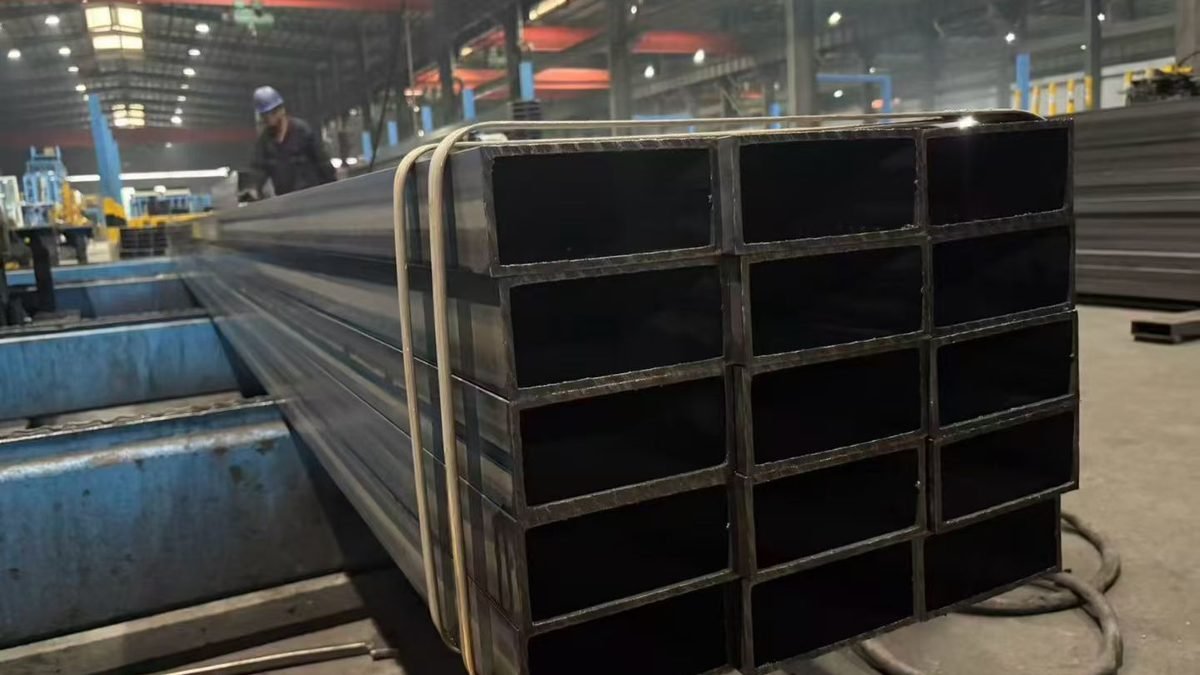
Tubes are bundled in hexagonal or square stacks, diikat dengan jalur keluli, with timber or plastic edge protection under the straps. Bundles are marked with size, dinding, gred, panjang, heat number and quantity. A 20 ft container typically takes 20 – 25 tonnes of 6 m tube; 12 m tube needs a 40 ft container or a flat rack.
For export, we can supply mill test certificates, packing lists with bundle weights and pre-shipment photos. If the tubes will be galvanized after arrival, tell us so the bundle can be packed to drain and ventilate.
Soalan Lazim
What does Q235B mean on a rectangular tube?
Q235B is the steel grade: a carbon structural steel with a minimum yield strength of 235 MPa and controlled carbon, mangan, phosphorus and sulphur. The B suffix denotes the quality class with a specified impact test at +20 °C.
Can you supply non-standard lengths?
ya. We cut to length against a cutting list, typically with a tolerance of 0 / +30 mm. Very short pieces and mitred ends are available on request.
Is the tube suitable for hot-dip galvanizing?
ya, provided the silicon content is controlled and the fabrication includes vent and drain holes. Very high silicon can produce a thick, salutan rapuh; mention galvanizing at the enquiry stage.
What is the difference between RHS and SHS?
RHS has a rectangular outside profile, SHS has a square one. Both are cold-formed welded hollow sections and share the same grade and tolerance framework; the difference is the shape and the stiffness about each axis.
Do you provide test certificates?
ya. Mill test certificates with chemistry, mechanical properties and heat number traceability are standard; DALAM 10204 3.1 and third-party inspection are available on request.
Produk Berkaitan
Hantar saiz, ketebalan dinding, panjang, quantity and finish (hitam, primed or galvanized). We confirm weight, price and lead time within 24 jam.
MINTA SEBUT HARGA