 KEMAJUAN
Lead-Lined Door for X-Ray and CT Rooms: Plumbum Setara, Frame and Interlock
A lead-lined door is the movable part of a radiation-shielding envelope. Its job is to provide the same lead equivalent as the wall it sits in, at every point, including the frame, the hinges, the vision panel and the joint it closes against. This guide covers the lead grades, the thickness calculation, the door construction, the tolerance that decides whether it shields, and the installation checks a physicist will ask for.
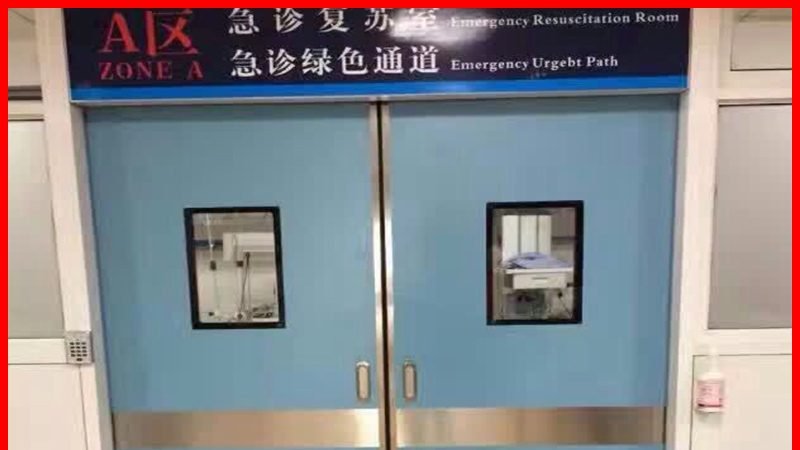
What a Lead-Lined Door Is
A lead-lined door is a normal door carcass with a specified thickness of lead sheet bonded inside it, a lead-lined frame, and usually a lead-glass vision panel. It is used wherever a room has to be shielded against ionising radiation but people still need to walk in and out: X-ray and CT rooms, fluoroscopy suites, dental and mammography rooms, radiotherapy bunkers, nuclear medicine hot rooms and industrial radiography cells.
The door is only one element of the barrier. The wall may be lined with 2 mm lead, the ceiling with 2 mm, and the door must deliver the same 2 mm lead equivalent across its whole opening. A door that is correct in the middle of the leaf and thin at the frame is a leak, and a leak is what the shielding survey measures.
Door types
- Swing doors, single or double leaf — the default for X-ray rooms. Heavy but simple, with a lead-lined frame and a hospital-grade door closer.
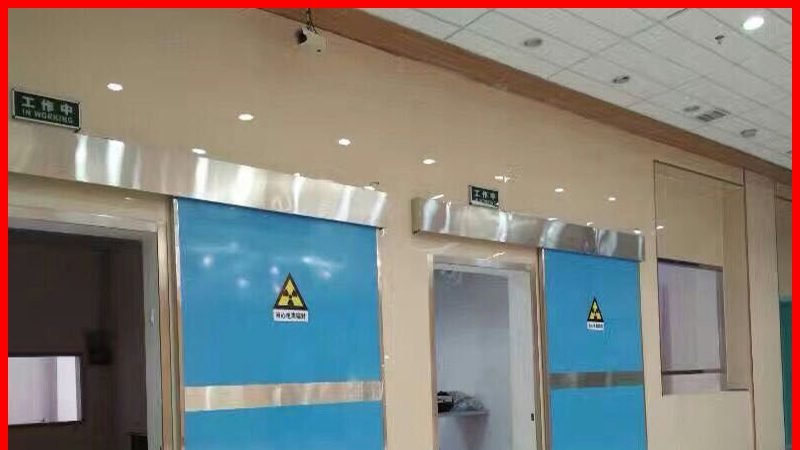
- Sliding doors, manual or automatic — used where the door is large, where trolleys pass constantly, or where a bunker door would be too heavy to swing. Automatic sliding doors normally carry an interlock with the generator.
- Hermetically sealed doors — used in hot rooms and clean suites, where the leaf also has to seal against contamination.
- Lead-shielded window and door sets — a combined package where the vision panel lead equivalent, frame, and door are supplied and tested together.
Lead Grades and Composition
Shielding lead is specified by purity, because impurities — especially bismuth, antimony and tin — reduce density and create inhomogeneity that shows up as a variation in attenuation. Chinese lead sheet for shielding is normally ordered to GB/T 1470, in grades Pb1 to Pb3, with Pb1 the purest.
| Gred | Pb min, % | Cu max | Bi max | Sb max | As max | Sn max | Zn max | Fe max |
|---|---|---|---|---|---|---|---|---|
| Pb1 | 99.994 | 0.0005 | 0.003 | 0.001 | 0.0005 | 0.0005 | 0.0005 | 0.0005 |
| Pb2 | 99.95 | 0.003 | 0.02 | 0.005 | 0.002 | 0.002 | 0.002 | 0.002 |
| Pb3 | 99.90 | 0.005 | 0.05 | 0.01 | 0.005 | 0.005 | 0.005 | 0.005 |
Typical limits to GB/T 1470 lead sheet. Medical shielding is normally Pb1; Pb2 is acceptable for secondary barriers where the calculation allows.
Purity is not the only variable. Lead sheet is produced by rolling, and the thickness tolerance of a rolled sheet is looser than most buyers expect: ±5% is common for thin sheet, which on a 2 mm specification is ±0.1 mm. Attenuation is proportional to mass thickness, so a 5% thin spot is a 5% loss of shielding at that spot. For medical work, ask for the measured thickness on the mill certificate rather than the nominal figure, and verify a sample with a calibrated micrometer before lamination.
Lead is also soft. A 2 mm sheet weighs 22.7 kg/m², sags under its own weight if unsupported, and work-hardens if it is bent repeatedly. In a door it is always laminated to a carrier — plywood, MDF, steel sheet or aluminium honeycomb — and never left as a free-standing leaf.
Shielding Performance and Mechanical Data
The relevant performance number for a door is lead equivalent, expressed in millimetres of lead (mm Pb). It is measured with a radiation survey at the energy the room actually uses, not calculated from the sheet thickness alone, because seams, frame joints and vision panels all reduce the figure.
| Harta benda | Typical value | Nota |
|---|---|---|
| Ketumpatan | 11.34 g/cm³ | Basis of the mass-thickness calculation |
| Mass per mm per m² | 11.34 kg | 2 mm sheet = 22.68 kg/m²; a 1.5×2.1 m leaf with 2 mm Pb weighs about 71 kg of lead alone |
| Kekuatan tegangan | 12–20 MPa | Very low; the carrier provides structural strength |
| Pemanjangan | 40–50% | Allows the sheet to conform to a curved frame |
| Kekerasan | 4–6 HB | Soft enough to be marked by handling |
| Takat lebur | 327 °C | Not a fire barrier on its own; the door core must be rated separately |
| Attenuation, 1 mm Pb at 80 kV | roughly 90–95% | Falls with rising kV; di 120 kV the same 1 mm passes more |
| Attenuation, 2 mm Pb at 120 kV | roughly 97–99% | Depends on spectrum; always confirm by survey |
Attenuation figures are indicative for a broad spectrum; the shielding calculation for the room is done by a medical physicist to the applicable code, for example GBZ 130 or NCRP 147.
| Room / barrier | Typical lead equivalent | Door note |
|---|---|---|
| Dental intraoral X-ray | 0.5–1.0 mm Pb | Light leaf, swing door, small vision panel |
| General X-ray and fluoroscopy | 1.5–2.0 mm Pb | Most common medical door specification |
| CT suite | 2.0 mm Pb | Higher kV; often sliding door for trolley access |
| Cardiac catheterisation lab | 2.0–3.0 mm Pb | Long procedures, higher workload |
| Radiotherapy bunker | 3.0–6.0 mm Pb or more | Heavy sliding door, engineered structure |
| Nuclear medicine hot room | 1.0–2.0 mm Pb plus sealing | Hermetic leaf, contamination sealing |
Indicative ranges only. The actual requirement comes from the room shielding calculation, which accounts for workload, kV, distance and occupancy.
Construction and Tolerances
A shielding door is assembled like a sandwich. The typical build-up is: 1.0 mm stainless or painted steel skin, 18 mm plywood or MDF carrier, lead sheet of the specified thickness, another carrier, and the inner skin. The lead is continuous across the leaf, turned into the edges, and overlapped at every seam by at least 20 mm so that no straight-line gap exists.
| item | Typical specification | Why it matters |
|---|---|---|
| Leaf size | 900×2100 mm single; 1500×2100 mm double | Larger leaves need a heavier closer and a stronger frame |
| Leaf thickness | 45–55 mm | Carrier plus lead plus skins; keeps the leaf stiff |
| Lead thickness | 1.0–3.0 mm, ±5% measured | Attenuation follows mass thickness |
| Lead seam overlap | ≥20 mm at all joints | A butt seam is a direct leak path |
| Frame lining | Same lead equivalent, continuous with the wall lining | The frame is the most common leak |
| Frame section | 1.5–2.0 mm galvanised or stainless | Supports the lead and takes the door load |
| Vision panel | Lead glass matching the door lead equivalent | A thinner window is a hole in the shield |
| Leaf-to-frame gap | 3–5 mm, with a lead-lined rebate | The rebate closes the line of sight through the gap |
| Door closer | Sized to the leaf mass, 2–4 setting | An undersized closer lets the leaf slam and distort |
| Selesai | Powder-coated steel or stainless, 1.0–1.2 mm skin | Protects the lead and provides cleanable surface |
The leaf-to-frame gap is the detail that decides whether the door passes a survey. A 5 mm gap with a plain jamb is a straight line through the barrier; a 5 mm gap with a lead-lined rebate is shielded because the radiation would have to travel around a corner. Every door drawing should show the rebate and its lead thickness, not just the leaf.
Fabrication and Assembly
Laminating the lead
Lead sheet is cut oversize, then bonded to the carrier with a contact adhesive or fixed with countersunk screws around the perimeter and at 300 mm centres across the face. Adhesive alone is not enough for a 2 mm sheet on a 2.1 m leaf; the weight will eventually peel it. Seams are overlapped, never butt-jointed, and the overlap is documented on the shop drawing because it is invisible after assembly.
Frame and rebate
The frame is fabricated first, lined with lead on the inner face and into the rebate, and then fixed to the wall lining so that the lead in the frame overlaps the lead in the wall by at least 50 mm. That overlap is what makes the door and wall one continuous barrier instead of two separate ones.
Hinges, locks and penetrations
Every penetration through the lead is a potential leak: hinge bolts, lock cases, card-reader cables, door closer fixings. The usual practice is to keep the hinge and lock as close to the leaf edge as the hardware allows, line the immediate area with additional lead, and avoid cutting a hole through the lead for anything that can be routed outside the shielded envelope.
Interlock and warning
Automatic sliding doors in X-ray rooms normally carry a door interlock: the generator cannot expose until the door is closed and the lock signal is made, and a warning light confirms the room is in use. The interlock is a safety function, so it is wired and tested by the medical equipment contractor, not by the door fabricator alone.
Selection and Installation Rules
- Start from the shielding calculation. The room physicist gives the lead equivalent for each barrier; the door specification follows from that, not from a catalogue.
- Match the vision panel. A 2 mm Pb door with a 1.5 mm Pb window is a 1.5 mm barrier wherever the window is.
- Line the frame and overlap the wall. The frame lining must be continuous with the wall lining and overlapped, or the joint leaks.
- Check the substrate before fixing. Frames are set plumb and level; a door that racks because the wall is out of plumb will not close against its rebate.
- Size the closer and hinges to the mass. A 2 mm Pb double leaf can weigh 150 kg or more; standard closers and hinges are not adequate.
- Keep the finish cleanable. Hospital doors are washed daily; powder coating or stainless is preferred, and edges should not trap water.
- Commission with a survey. The door is only accepted after the radiation survey confirms the design lead equivalent across the leaf, the frame and the vision panel.
Handling, Storage and Maintenance
Lead is soft and heavy, and a shielding door is easily damaged between the factory and the room. Panels are shipped upright in a crate, never stacked flat, with the leaf restrained so it cannot swing against the crate sides. On site the door is stored under cover, dari lantai, with the protective film left on until the wall finishes are complete.
Maintenance is deliberately minimal: wipe the finish with a neutral detergent, check the closer and the hinges annually, and check the interlock and warning light at the same service interval as the X-ray equipment. Any physical damage that exposes the lead — a scrape through the skin at a trolley height — should be reported, because the shielding at that point is no longer what the survey approved.
Where a door is moved or the room is reconfigured, the shielding survey is repeated. A door that was acceptable at the original workload may not be acceptable after a tube change or an increase in patient throughput, and the lead thickness is not something that can be adjusted on site.
Common Mistakes
- Quoting a lead equivalent without a build-up. “2 mm Pb door” means nothing if the frame, hinges and window are not included.
- Butt-jointed lead seams. A straight seam is a straight leak; overlaps of at least 20 mm are the rule.
- Frame not lined. The most frequent cause of a failed shielding survey on an otherwise correct door.
- Ignoring the weight. Undersized closers, hinges and frames produce a leaf that sags and will not close into the rebate.
- Cutting the lead for a card reader or cable. Every hole must be planned and compensated, or the barrier is broken.
- Using a standard glazed panel. Ordinary glass provides almost no attenuation; the vision panel must be lead glass of the matching equivalent.
- No interlock on an automatic door. A safety and compliance failure, not a cosmetic one.
Soalan Lazim
How thick should the lead be in an X-ray room door?
Most general X-ray and fluoroscopy rooms use 1.5–2.0 mm Pb; CT suites typically 2.0 mm Pb; radiotherapy bunkers far more. The number comes from the room shielding calculation, which accounts for workload, kV, distance and occupancy. Do not accept a thickness that is not tied to that calculation.
Can the lead be replaced by a lead-composite board?
ya, in some secondary barriers, where a manufactured board with a stated lead equivalent is accepted by the physicist. The advantage is weight and ease of assembly; the disadvantage is that joints between boards need the same overlap discipline as lead sheet, and the board’s equivalent must be certified, not estimated.
Why does the door have to be so heavy?
Because lead is dense: 11.34 g/cm³. A 1.5× 2.1 m leaf with 2 mm lead carries about 71 kg of lead before skins and carrier are added. The mass is the shielding; there is no lighter material that gives the same attenuation in the same thickness.
Does the door need a vision panel?
Not always, but where one is fitted it must be lead glass of the same or greater lead equivalent as the leaf, and the frame around it must be lined. A standard window in a shielding door is a hole in the barrier.
How is the door tested?
With a radiation survey after installation, using the room’s own equipment or a test source, checking the leaf, the frame joint, the vision panel and the corners. The survey report is the acceptance document; a mill certificate for the lead sheet is supporting evidence, not a substitute.
Can a lead-lined door be retrofitted to an existing frame?
Usually not. The existing frame has no lead lining and no rebate, so the shielding would be broken at the jamb. The practical route is to replace the frame and door as a set, with the wall lining opened back far enough to overlap the new frame lining.
Produk Berkaitan
Door leaves are normally finished with a stainless or powder-coated steel skin; thickness and finish options are listed on the 304 kepingan keluli tahan karat kemasan 2B page. Where the door frame is fabricated from plate rather than tube, yang Bar rata keluli karbon Q235B page covers the sections used for jamb and rebate profiles.
Need a lead-lined door quoted against a shielding calculation?
Send the room type, required lead equivalent, leaf size, vision panel requirement and whether the door is swing or sliding. We will return a door-and-frame package with the lead build-up stated per component.