 PROGRESSO
Copper Tube C12200 for Medical Gas: Cleanliness, Capping and Brazing
Copper tube C12200 is the phosphorus deoxidised high residual phosphorus copper tube grade that dominates medical gas, refrigeration and plumbing systems. In the medical gas trade it is known less by its UNS number than by its condition: cleaned and capped, nitrogen purged, and certified to a standard that governs residual contamination rather than mechanical strength. A tube that meets the dimensional specification but was capped with a plastic plug and stored in a humid yard is not a medical gas tube, whatever the stencil on the wall says.
This guide covers C12200 tube as a product and as a specification: what the grade is, which chemistry and mechanical values apply, how wall thickness and temper are defined for medical gas, why cleanliness and capping decide the acceptance of a shipment, and how brazing practice interacts with the delivered condition of the tube.
1. What C12200 Copper Tube Is and Where It Is Used
C12200 is refined copper with a minimum of 99.9 percent copper and a controlled phosphorus addition of 0.015 A 0.040 per cento. The phosphorus serves as a deoxidiser: it removes residual oxygen from the melt so the cast billet does not contain copper oxide inclusions, which would otherwise cause cracking during drawing and, more importantly, would provide sites for corrosion and contamination in service.
Tube is produced by extrusion or by welding strip, then drawn or pilgered to the final size and annealed. The annealed temper, designated O in the American system, is soft enough to bend and to be joined by brazing. Hard drawn temper, H, is stronger and is used for straight lengths where bending is not required.
Typical applications of C12200 tube include:
- Medical gas distribution: oxygen, nitrous oxide, medical air, nitrogen and vacuum lines in hospitals and clinics.
- Refrigeration and air conditioning circuits, including R410A and R32 systems.
- Potable water and heating services in plumbing and HVAC.
- Fuel gas and compressed air lines in industrial installations.
- Solar thermal and heat pump collector loops.
- Marine and offshore utility systems where copper alloys are accepted.
- Laboratory and analytical gas lines requiring clean, non reactive bore surfaces.
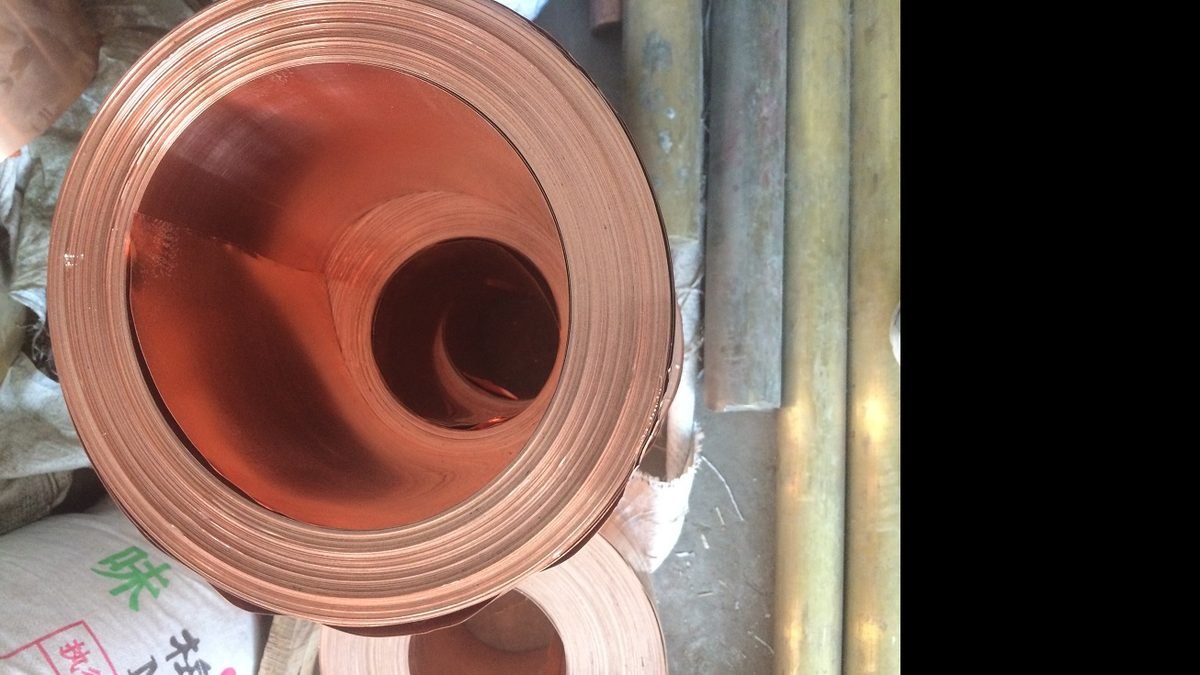
Medical gas tube is a subset of this product, and it is defined by a cleaning and packaging standard rather than by a different alloy. The tube may be the same C12200 chemistry, but it must be cleaned to remove drawing lubricant and oxide, dried, and then capped so that the bore stays clean until the moment of installation.
2. Grade and Chemical Composition
C12200 is specified in ASTM B280 for air conditioning and refrigeration tube, ASTM B819 for medical gas tube, IN 1057 for water and gas in sanitary applications, and GB/T 1527 for drawn copper tube. The chemistry limits are narrow because the phosphorus range controls both deoxidation and conductivity.
| Elemento | C12200 limit (%) | Funzione |
|---|---|---|
| Cu | 99.9 min | Base metal; defines conductivity and corrosion behaviour |
| P | 0.015 A 0.040 | Deoxidation; below 0.015 the melt retains oxygen, above 0.040 brazing flow suffers |
| O | Non specificato, residual only | Phosphorus deoxidation removes it; free oxygen causes hydrogen embrittlement |
| Ag | 0.015 massimo | Residual impurity from scrap |
| Pb | 0.01 massimo | Impurità; also a health limit in potable water service |
| Fe | 0.005 massimo | Impurità; small amounts are tolerated |
| Total others | 0.1 massimo | Sum of residual elements |
The phosphorus range is the value to check on a mill certificate. A tube at 0.040 percent phosphorus is within specification but will braze less freely than a tube at 0.020 per cento, because the phosphorus forms a fluid oxide that can interfere with filler flow. For medical gas work, where joints are often made in awkward positions and must pass a pressure test on the first attempt, a certificate near the middle of the range is worth asking for.
3. Proprietà meccaniche
| Proprietà | Ricotto O | Hard drawn H | Practical meaning |
|---|---|---|---|
| Resistenza alla trazione | 205 A 250 MPa | 290 A 360 MPa | Pressure rating and bendability |
| Forza di rendimento | 60 A 90 MPa | 250 A 300 MPa | Denting resistance of thin wall tube |
| Elongation A50 | 40 A 50 % | 8 A 15 % | Bending without cracking |
| Hardness HV | 40 A 55 | 90 A 110 | Tool wear and cut quality |
| Densità | 8.9 g/cm3 | 8.9 g/cm3 | Weight per metre |
| Conduttività termica | 400 W/mK | 380 W/mK | Heat transfer and brazing heat distribution |
| Melting range | 1065 A 1082 ° C. | 1065 A 1082 ° C. | Brazing temperature margin |
Medical gas tube is normally supplied in the annealed temper, because the installation requires bending and because a hard drawn tube would need annealing at every bend. The low yield strength of the annealed temper is the reason the wall thickness matters: UN 1 mm wall in annealed copper dents easily, and a dented tube reduces flow area and creates a stress concentration at the dent.
4. Dimensioni e tolleranze
| Parametro | Common range | Typical tolerance | Nota |
|---|---|---|---|
| Diametro esterno | 6 A 108 mm | più o meno 0.05 mm below 12 mm, più o meno 0.1 mm above | Fitting compatibility |
| Spessore della parete | 0.6 A 3.0 mm | più o meno 0.05 mm, O 10 percent of nominal | Pressure rating uses minimum wall |
| Coil length | 15 M, 25 M, 50 M | 0 to plus 1 per cento | Pancake coil for site bending |
| Straight length | 3 M, 5.8 M, 6 M | 0 to plus 10 mm | Disegnato duro, capped both ends |
| Ovality | All sizes | 80 percent of diameter tolerance | Oval tube leaks at compression joints |
| Rettilineità | Straight lengths | 1.5 mm al metro | Affects brazing alignment |
| Bore cleanliness | Medical gas | No visible oil, oxide or particulate; residual carbon limit by standard | Checked by white cloth swab and solvent test |
| Capping | Medical gas | Cap on both ends, cap colour coded to gas service | A missing cap fails the delivery inspection |
The cleanliness line in a specification is the one that cannot be verified by a tape measure, and it is the one that decides whether a hospital accepts the delivery. A clean tube has a bright, pinkish bore with no dark oxide and no oil sheen. A tube that was drawn with a lubricant and not properly cleaned shows a dull, brownish bore, and swabbing it with a white cloth leaves a stain.
5. Cleanliness, Capping and Packaging
Medical gas standards, including ASTM B819 and the relevant national pharmacopoeia and hospital engineering codes, require tube to be cleaned, dried and capped before shipment. The purpose is simple: a copper bore that has been exposed to air for a month develops a oxide film and adsorbs moisture, and a bore that has been handled with bare hands carries chlorides and oils that later contaminate the gas stream.
The cleaning sequence normally runs: alkaline or detergent wash to remove drawing lubricant, rinse, acid pickling to remove oxide, rinse, neutralise, dry with oil free air or nitrogen, and finally cap. Some suppliers purge the coil with nitrogen before capping. Nitrogen purging is not a substitute for cleaning; it prevents re oxidation during storage, but it cannot remove a lubricant film that was left behind.
Capping practice varies by market. Plastic caps are common for plumbing tube. Medical gas tube usually carries colour coded caps that identify the gas service, and the caps must remain in place until the tube is cut for installation. A tube delivered with one end open, or with a cap that has fallen off in transit, should be rejected: there is no way to prove the bore stayed clean.
Packaging matters as much as capping. Coils should be wrapped, protected against abrasion, and packed so that the caps cannot be knocked off. Straight lengths are usually bundled with the ends protected. A shipment that arrives with the caps crushed against the tube wall has effectively lost its cleanliness certification.
6. Brazing and Joining Practice
Copper tube for medical gas is joined by brazing, not by soft soldering. The filler is typically a copper phosphorus alloy for copper to copper joints, or a silver bearing filler where the joint involves a fitting of another alloy. Brazing temperature is above 600 ° C., well below the melting point of the tube, but high enough to soften the annealed temper locally.
Four points decide whether a brazed joint passes a pressure test and stays clean:
- The tube and fitting must be cleaned to bright metal immediately before brazing. Oxide inside the joint prevents filler flow and creates a leak path.
- Heat must be applied evenly around the joint, with the tube heated slightly more than the fitting, so the filler is drawn into the clearance by capillary action rather than pooled outside.
- The joint must be purged with nitrogen during brazing. Without purge, the inside of the joint oxidises and forms black scale that later contaminates the gas and can loosen to block a valve.
- The joint must be cooled without water quenching. Quenching a hot brazed joint can crack the filler and leave residual stress.
A common failure in medical gas work is a joint that looks sound from outside but has a black, flaky bore. That is the signature of brazing without purge. The joint will pass a short pressure test and fail a purity test, and the remediation is to cut it out and redo it. The cost of the purge is a fraction of the cost of cutting out a joint inside a finished ceiling void.
7. Selection and Installation Rules
- Specificare la norma, the temper, and the cleanliness and capping requirement in the purchase order, not only the diameter and wall.
- Use annealed temper for any run that will be bent on site, and hard drawn only for straight runs with no field bending.
- Confirm that the caps are colour coded to the gas service and that they are still in place on arrival.
- Keep coils indoors, dal pavimento, and away from solvents, paint and carbon steel grinding dust.
- Cut tube with a rotary cutter or a fine tooth saw, and deburr the bore before brazing. A burr left in the bore becomes a trap for particulate.
- Do not use the same tube for medical gas and for potable water, even if the grade is identical. Once a tube has carried water, it is no longer a clean gas tube.
- Pressure test after brazing and before the system is closed up, and record the test on the installation certificate.
Where a manifold or header is fabricated from copper plate rather than tube, the plate should come from the same deoxidised grade family. IL C11000 ETP copper plate page covers the plate counterpart, and the two products are often specified together on a medical gas manifold package.
8. Common Misconceptions
Misconception one: all C12200 tube is medical gas tube. The alloy is the same, but the cleaning, drying and capping process is not. Plumbing tube from the same mill is not acceptable for medical gas without the certified clean process.
Misconception two: nitrogen purging cleans the tube. Purging prevents oxidation during storage and brazing. It does not remove lubricant or oxide that is already on the bore.
Misconception three: a visual check of the outside is enough. The outside of a coil can be spotless while the bore is stained. Inspection has to include a swab test on a cut sample.
Misconception four: soft solder is acceptable for medical gas. Medical gas joints are brazed. Soft solder melts at too low a temperature, has poor creep strength, and its flux residues contaminate the bore.
Misconception five: a thicker wall is always better. A thicker wall raises pressure capacity but also raises cost, weight and bending force. For a low pressure medical gas line, the standard wall is adequate and a heavier wall simply makes the installation harder.
9. Domande frequenti
What is the difference between C12200 and C11000?
C12200 contains 0.015 A 0.040 percent phosphorus as a deoxidiser, while C11000 is oxygen free electronic copper with no deliberate phosphorus. C12200 is the standard tube grade because the phosphorus prevents embrittlement during drawing and brazing.
Which standard covers medical gas copper tube?
ASTM B819 is the common reference for medical gas tube in the United States, e EN 13348 covers copper tube for medical gas in Europe. Both add cleanliness, capping and marking requirements to the base tube standard.
Can copper tube be used for oxygen service?
SÌ, and it is the usual material for hospital oxygen lines, provided the tube is cleaned to an oxygen compatible level. Oil or hydrocarbon residue in an oxygen line is a fire risk, which is why the cleanliness requirement is strict.
How should a coil be stored before installation?
Indoors, dry, dal pavimento, with caps in place, away from solvents and carbon steel work. A coil stored on a wet concrete floor with the caps off is no longer a certified clean tube.
What filler should be used for copper to copper brazing?
A copper phosphorus brazing alloy is standard for copper to copper joints and does not require flux. For joints to brass or bronze fittings, a silver bearing filler with flux is normally used.
Does C12200 tube work harden?
Copper work hardens far less than stainless steel, but repeated bending in the same place will still stiffen the tube. Annealing with a soft flame restores the temper if a bend has to be reworked.
10. Next Step
If you are buying C12200 tube for medical gas, refrigeration or potable water, put the standard, temperare, spessore della parete, cleanliness level and capping requirement on the enquiry. Those details separate a commodity coil from a tube that will pass a hospital commissioning inspection.
Related product pages: Copper tube C12200, C11000 ETP copper plate.

