 הִתקַדְמוּת
Stainless Steel U-Channel: מידות, Weight and Fabrication
Stainless Steel U-Channel: מידות, מִשׁקָל, Welding and Support Use
A stainless steel U-channel is a hot rolled or cold formed section with two parallel flanges joined by a web, giving a U-shaped cross section. In the trade it is also called a channel bar, a C-channel, or simply channel. It is the section you reach for when you need a linear member that carries a load in one direction, presents a flat face for bolting, and can be welded into a frame without the closed-section cleaning problem that a hollow section creates.
Stainless channel is used for machine frames and guards, conveyor supports, drainage channels and trench covers, food processing tables, truck body ribs, stair stringers, marine brackets, and architectural sub-frames. In each case the material is chosen for the same reason: the part is exposed to water, cleaning chemicals, or coastal air, and a painted carbon channel would need maintenance that the owner does not want to schedule.
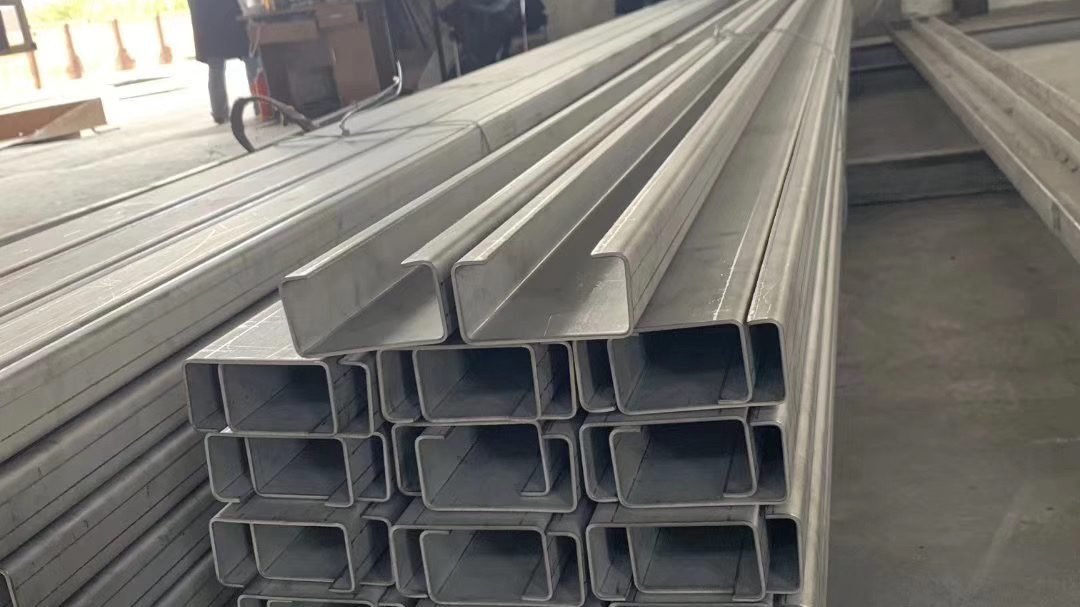
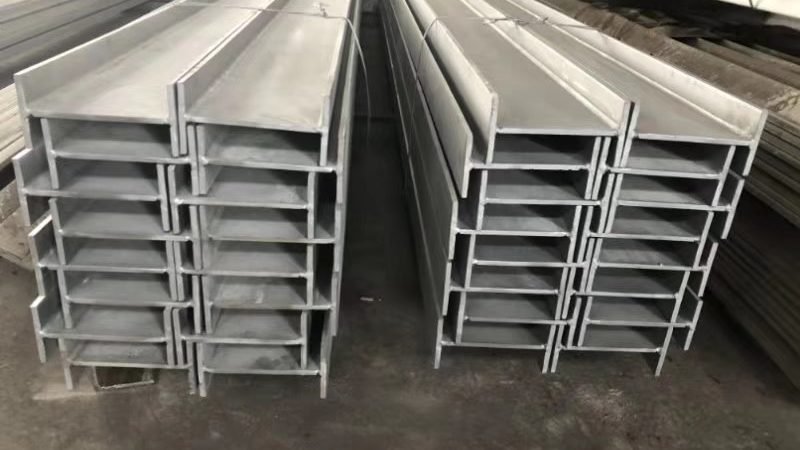
The photographs in this article show stainless channels stacked on the floor of a fabrication shop and the same section stored on racking. The surface is mill finish and the sections are straight, square cut, and free from the twist that a badly cooled hot rolled section can carry.
1. What the Section Is and How It Behaves
The geometry is simple: a web of height h, two flanges of width b, and a wall thickness t that is nominally uniform. The properties that matter follow directly from this shape. The channel is stiff about its strong axis, which is the axis that bends the web, and comparatively weak about its weak axis, which bends the flanges. It is also weak in torsion, because an open section has no closed cell to resist twisting.
This is why channel is usually loaded in one plane and braced in the other. A machine frame built from channel will be stiff against vertical load and flexible against sideways load unless it is cross-braced, sheeted, or combined with a second channel back to back. Two channels welded back to back form a box-like member that resists torsion far better than a single channel, and this is a standard detail for columns and crane rails.
The second consequence of the open shape is that it collects water and debris if it is installed with the flanges up. A channel used as a drainage trough is designed that way on purpose; a channel used as a structural member on a coastal site is usually installed with the flanges down, or with drainage holes drilled at the low points, so that water cannot stand in the web.
2. Grades and Chemical Composition
Four grades cover almost all stainless channel demand. 304 is the general purpose austenitic grade and the default for indoor and fresh water service. 316L adds molybdenum and lowers carbon, which gives it resistance to chlorides and to the intergranular corrosion that welded thick sections can suffer. 430 is a ferritic grade used for dry indoor work where cost is the driver. 201 is a low nickel austenitic grade used for decorative indoor sections, and it should not be specified for wet or coastal service.
| אֵלֵמֶנט | 304 | 316ל | 430 | 201 |
|---|---|---|---|---|
| כְּרוֹם | 18.0 אֶל 20.0 | 16.0 אֶל 18.0 | 16.0 אֶל 18.0 | 16.0 אֶל 18.0 |
| נִיקֵל | 8.0 אֶל 10.5 | 10.0 אֶל 14.0 | 0.5 מקסימום | 3.5 אֶל 5.5 |
| מוליבדן | not specified | 2.0 אֶל 3.0 | not specified | not specified |
| פַּחמָן, מקסימום | 0.08 | 0.030 | 0.12 | 0.15 |
| מַנגָן, מקסימום | 2.0 | 2.0 | 1.0 | 5.5 אֶל 7.5 |
| מִבְנֶה | אוסטינית | אוסטינית | Ferritic | אוסטינית |
| נֶכֶס | 304 | 316ל | 430 | 201 |
|---|---|---|---|---|
| חוזק מתיחה, MPa | אוֹדוֹת 520 | אוֹדוֹת 485 | אוֹדוֹת 450 | אוֹדוֹת 650 |
| חוזק תפוקה, MPa | אוֹדוֹת 205 | אוֹדוֹת 170 | אוֹדוֹת 205 | אוֹדוֹת 310 |
| הַאֲרָכָה, % | אוֹדוֹת 40 | אוֹדוֹת 40 | אוֹדוֹת 22 | אוֹדוֹת 40 |
| צְפִיפוּת, g/cm3 | 7.93 | 7.95 | 7.75 | 7.85 |
| Magnetic after welding | Slightly | Slightly | כֵּן | Slightly |
The density values matter because they decide the weight per metre, and buyers compare quotes on weight. A 316L channel is about 0.3 percent heavier than the same 304 עָרוּץ, which is negligible in cost but visible when a shipping document is checked against a theoretical weight table.
3. מידות, Weight and Load Capacity
The weight per metre is calculated from the nominal cross-sectional area and the alloy density. For a channel of uniform wall thickness t, height h and flange width b, the area is approximately:
Area (mm2) = h × ט + 2 × (b − ט) × ט
מִשׁקָל (ק"ג/מ"ר) = Area × density × 1000 / 1 000 000
With a density of 7.93 g/cm3 for 304, the second expression reduces to Area × 7.93 / 1000. The table below uses nominal dimensions and uniform thickness; hot rolled channel has tapered flanges and a slightly thicker web, so the mill certificate weight can differ by a few percent. That difference is normal and should not be treated as a short delivery.
| Size h × b × ט (מ"מ) | Area (mm2) | מִשׁקָל 304 (ק"ג/מ"ר) | שימוש אופייני |
|---|---|---|---|
| 50 × 25 × 3 | 282 | 2.24 | Light frames, שומרים, cable support |
| 75 × 40 × 4 | 588 | 4.66 | Conveyor supports, table frames |
| 100 × 50 × 5 | 950 | 7.54 | General structural frames, stair stringers |
| 120 × 50 × 5 | 1050 | 8.33 | Longer spans, heavier equipment bases |
| 150 × 75 × 6 | 1728 | 13.70 | Truck bodies, heavy frames |
| 160 × 65 × 6 | 1668 | 13.23 | Drainage channels, trench liners |
| 200 × 75 × 8 | 2672 | 21.19 | Heavy platforms, marine brackets |
Load capacity is not a single number and should not be taken from a table without checking the actual support condition. The governing check for a channel used as a beam is bending about the strong axis, followed by web crippling at the support and by lateral torsional buckling over a long unsupported span. For a 100 × 50 × 5 channel of 304, a span of 1.5 m with a uniformly distributed load and both ends simply supported will carry a few kilonewtons per metre before deflection becomes the practical limit; the exact figure depends on the allowable deflection, which is usually set as span over 250 for machine frames and span over 360 for architectural work.
Deflection, not strength, usually decides the size. A stainless channel is roughly three times as stiff as the same channel in carbon steel is not true; the modulus of stainless is about 200 GPa against 210 GPa for carbon, so the difference is only about five percent. What changes is the allowable stress and the corrosion allowance: stainless does not need a thickness allowance for rust, so a lighter stainless channel can sometimes replace a heavier painted carbon one.
4. Dimensions and Tolerances
| פָּרָמֶטֶר | Typical tolerance | Notes |
|---|---|---|
| Height h | plus or minus 1.0 אֶל 2.0 מ"מ | Measured at mid-length, not at the cut end |
| Flange width b | plus or minus 1.0 אֶל 2.0 מ"מ | Flange taper on hot rolled section is normal |
| Wall thickness t | plus or minus 10 percent nominal | Check at three points; thin web is the usual complaint |
| מֶשֶׁך | 6 m or 12 מ, plus 0 / minus 0 אֶל 10 מ"מ | Confirm whether the mill charge is by piece or by weight |
| יוֹשֶׁר | 4 mm per metre, 0.4 percent of length | Camber in the web plane is the usual deviation |
| Twist | 1 mm per metre, measured over the length | Twist is serious for welding; reject rather than straighten |
| Square cut | 2 mm out of square on 100 מ"מ | Saw cut, not shear cut, for welded frames |
| מִשׁטָח | גימור טחנה, כָּבוּשׁ, or polished | State the finish; pickled channel is standard for welding |
5. Fabrication and Welding
Cutting is straightforward but the method matters. A bandsaw or a cold saw gives a square, cool cut that is ready for welding. Plasma cutting is fast but leaves a heat-affected edge that must be ground back before welding or passivating. Abrasive cutting leaves embedded iron that will rust unless it is removed; if an abrasive wheel has been used on carbon steel, it must not be used on stainless at all.
הַלחָמָה 304 channel is usually done with 308L filler, and 316L channel with 316L filler. Matching the filler to the base metal is not optional: a 316L section welded with 308L filler has a weld deposit that is lower in molybdenum than the parent and becomes the first place to pit in a chloride environment. עֲבוּר 430, a 430 or 309L filler is used, and the ferritic grade needs lower heat input because it is less forgiving of grain growth.
Heat input should be kept low and interpass temperature controlled. Stainless has a lower thermal conductivity than carbon steel, so heat stays near the weld and distortion is concentrated. A common shop practice is to alternate welds on both sides of the web, back-step the run, and clamp the section to a rigid fixture until it cools. A channel welded on one side only will bow toward the weld, and no amount of straightening will restore a good fit-up.
Tack welds deserve attention. A tack on stainless that is not cleaned before the final pass can leave a carbon-rich deposit and a crevice, and crevices are where chloride pitting starts. Tacks should be small, on the joint line, and either consumed by the final pass or ground out.
After welding, the joint must be cleaned. Brushing with a stainless-only wire brush removes the heat tint, and pickling paste or a pickling bath restores the passive film. A welded channel that is left with a blue-black heat tint in a wet environment will show rust in the tinted zone within months, and the rust will be read as a material failure when it is a finishing failure.
6. Selection Rules
Grade first, size second. Decide whether the service is dry indoor, fresh water, חוֹפִי, or chemical. א 201 channel in a coastal wash-down area is a false economy; a 316L channel in a dry warehouse is an unnecessary cost. If the answer is unclear, לְפַרֵט 304 as the baseline and 316L where chlorides are present.
Check the weak axis. A single channel is flexible about its weak axis. If the member will see sideways load, either select a larger channel, add a brace, or use two channels back to back. The cost of a brace is far below the cost of a failed frame.
Watch the web for bolted connections. A bolt through the web needs enough clear metal around the hole. As a rule, the bolt diameter should not exceed about half the web height, and the edge distance from the hole centre to the flange should be at least 1.5 bolt diameters. א 100 mm channel with M16 bolts through the web is comfortable; a 50 mm channel with M12 bolts is not.
Drainage and cleaning. In food or pharmaceutical service, the channel should be installed with the flanges down or with a positive slope and drain holes, so that cleaning liquid cannot stand in the web. A channel with flanges up and no drain is a trap, and a trap is a hygiene problem.
Expansion. Stainless expands about 0.03 mm per metre per 10 degrees Celsius, which is similar to carbon steel but not identical. On long runs, particularly outdoors, provide a slip joint or a flexible fixing at one end rather than bolting both ends hard.
7. Installation Practice
Frames built from channel are usually welded, and the sequence decides the final squareness. Weld the frame in a jig, weld the short sides first, then the long sides, and check diagonals before the frame cools. A frame that is square when hot will usually stay square; a frame that is out of square when hot will get worse.
Where the channel is bolted rather than welded, use flat washers under the bolt head and nut. A bolt tightened directly onto the thin flange of a channel deforms the flange and loses preload. For a flange of 5 mm or less, a washer is not a detail, it is a requirement.
Where the channel is embedded or in contact with carbon steel, isolate the joint. Stainless in contact with carbon steel in a wet environment forms a galvanic couple, and the carbon steel will corrode preferentially. A isolating tape, a plastic shim, or a painted barrier at the interface is enough for most architectural and industrial details.
Do not weld a stainless channel to a galvanized member without removing the coating locally and repairing it afterwards. Welding over zinc produces porosity, fumes, and a joint that will fail inspection.
8. Common Mistakes
Using a carbon steel weight table. Stainless density is lower than carbon steel, and the section shape differs from the carbon standard, so a theoretical weight taken from a carbon table can be wrong by several percent. Use the mill certificate or the stainless table.
Welding with the wrong filler. 316L base metal with 308L filler loses molybdenum in the weld and pits first. Match the filler, and keep a separate spool for 316L work.
Welding one side and expecting it to stay straight. Channel distorts toward the weld. Balance the sequence, use a jig, and accept that straightening stainless is difficult and often damaging.
Leaving heat tint. The tinted zone is the least corrosion resistant part of the finished assembly. Pickle it, or accept early rust stains.
Installing flanges up outdoors. Water stands in the web, debris collects, and the section corrodes from the inside where it cannot be inspected.
Bolting through a thin web with no washer. The flange or web deforms, preload is lost, and the connection loosens under vibration.
Specifying 201 for wet service. The lower nickel content gives a much lower pitting resistance, and a coastal installation will show staining within a year.
9. שאלות נפוצות
Is stainless channel the same shape as carbon channel? Not exactly. Stainless channel is often rolled to a similar nominal height and flange width, but the wall thickness and the flange taper differ from the carbon standard. Check the actual section properties before substituting.
Can I weld 304 channel to 316L channel? כֵּן, using 316L filler, which is over-alloyed relative to the 304 and gives a weld at least as resistant as the 304 side. Using 308L would leave the 316L side under-alloyed.
What is the standard length? Six metres is the common mill length, with twelve metres available. Longer lengths are usually fabricated by welding, and the weld should be away from the point of maximum bending moment.
Should the channel be pickled? For welded assemblies in wet or coastal service, כֵּן. For dry indoor frames with a clean weld, brushing may be enough, but pickling is the safer specification.
How much does a stainless channel weigh compared with carbon? About one percent less for the same nominal dimensions, because the density is lower. The bigger difference in a real installation is that stainless needs no corrosion allowance.
Can channel be used as a drainage trough? כֵּן, and it is common in food plants. Specify flanges up, a slope of at least 1 ב 100, drain outlets at the low points, and a polished or pickled internal surface.
Why does my channel twist after welding? Heat was applied on one side, or the section was not restrained. Channel is an open section, so it twists easily. Weld in a jig, balance the sequence, and do not try to straighten a twisted stainless section with heat.
Is 430 channel suitable outdoors? לֹא. 430 is a ferritic grade with limited corrosion resistance and poor weld toughness. It is a dry indoor material.
What edge distance do I need for bolts? At least 1.5 bolt diameters from the hole centre to the nearest free edge, and preferably 2 diameters for connections that will be loaded in tension.
Can the channel be supplied cut to length? כֵּן, and saw cutting with a square tolerance of 1 mm is the usual specification for frames. State the length, the cut method, and whether the ends need deburring.
Need stainless U-channel in a specific size and grade?
Send the section size, צִיוּן, מֶשֶׁך, surface finish and quantity. We will confirm the mill rolling programme, weight per metre and delivery, and quote against the actual section properties rather than a converted carbon table.
Related reading: 304 2B stainless sheet · 316L stainless plate · 304 2B stainless coil

