 הִתקַדְמוּת
צלחת משובצת מפלדת פחמן: תַבְנִית, Thickness and Floor Use
צלחת משובצת מפלדת פחמן: תַבְנִית, Thickness and Floor Use
Checkered plate is a hot-rolled carbon steel plate with a raised pattern rolled into one face. It is bought for three reasons: it grips underfoot, it hides wear, and it adds stiffness without adding much weight. It is also bought badly, because the pattern is the only feature most buyers look at, and the things that actually decide whether a floor survives — base thickness, pattern type, support spacing and edge treatment — are left off the order.
This guide covers the pattern types, the base grades and their chemistry, the mechanical properties, the dimensional and mass calculation, the fabrication rules for cutting and welding, and the thickness-to-span relationship that determines whether a platform feels solid or springy. It deals with hot-rolled checkered plate in Q235B and Q345B, thickness 2.0–8.0 מ"מ, the material used for workshop floors, mezzanine decks, vehicle running boards, trench covers and stair treads.
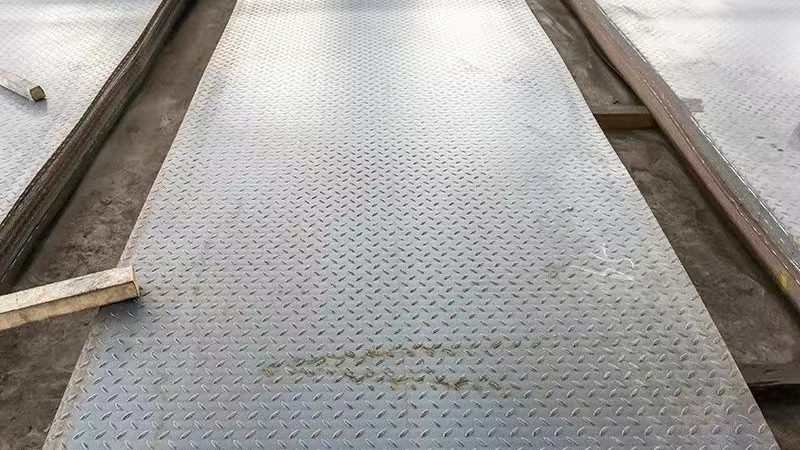
1. What Checkered Plate Is
Checkered plate starts as a plain hot-rolled coil or plate. The pattern is rolled in on the finishing stand by a patterned roll, at a temperature high enough for the steel to flow into the roll cavities. The result is a single piece of steel with a raised pattern on one side and a flat or slightly indented surface on the other. The pattern height is typically 0.6–1.5 mm above the base surface, and the base thickness is the number that matters for strength.
Because the pattern is rolled rather than welded or embossed after the fact, it does not delaminate and it does not create a crevice for water to sit in. It also cannot be repaired: once the pattern is worn flat, the plate is a plain plate with a floor’s worth of traffic history.
The coil is normally supplied in the hot-rolled, pickled or unpickled condition, with mill edge or trimmed edge. Unpickled plate carries mill scale, which is acceptable under a paint system that is designed for it and unacceptable where the plate is to be welded without preparation.
2. Pattern Types
| תַבְנִית | Geometry | Grip | Cleaning | שימוש אופייני |
|---|---|---|---|---|
| יַהֲלוֹם (tear-drop) | Raised bars at 45° in two crossing directions | High in all directions | לְמַתֵן; debris sits against the bars | Workshop floors, פלטפורמות, מדרגות מדרגות |
| Lentil (bean) | Raised lens shapes in a staggered grid | טוֹב, slightly softer underfoot | Better; open channels between lenses | Vehicle decks, שבילים, רמפות |
| Bar-and-check | One-directional raised bars with cross checks | Directional; strong along the bar | Easy to sweep along the bar | Ramps, trench covers, לוחות ריצה |
| שָׁטוּחַ (no pattern) | Plain surface, pattern omitted | אַף לֹא אֶחָד | Easy | Under coatings, non-walking structures |
The diamond pattern is the default in most markets, and it is the pattern that most buyers picture when they say “checkered plate”. The lentil pattern is common on vehicle floors and on plates that will be walked on in wet conditions, because the gaps between the raised shapes drain better. The choice is not purely aesthetic: a diamond pattern with bars at 45° grips in every direction, while a bar-and-check pattern grips strongly in one direction and weakly across it, which matters on a ramp.
Pattern pitch also varies. A coarse pattern with a 30–50 mm pitch is easier to clean and less aggressive underfoot; a fine pattern with a 10–20 mm pitch grips harder but traps more dirt and is harder on tyres. For a workshop floor, the coarse pattern is usually the better compromise.
3. Base Grades and Chemistry
| אֵלֵמֶנט, % | Q235B | Q345B | SS400 |
|---|---|---|---|
| ג, מקסימום | 0.20 | 0.20 | 0.21 |
| ו, מקסימום | 0.35 | 0.55 | 0.35 |
| Mn, מקסימום | 1.40 | 1.70 | 1.40 |
| פ, מקסימום | 0.045 | 0.045 | 0.035 |
| ס, מקסימום | 0.045 | 0.045 | 0.035 |
| נ.ב / V / שֶׁל | — | 0.02–0.15 (one or more) | — |
Q235B is the standard Chinese structural grade and the material most checkered plate is made from. It is weldable, cheap and available in the full thickness range. Q345B is the higher-strength option used when the plate must span further or carry more load at the same thickness, and it costs 8–15 % more. SS400 is the Japanese equivalent of Q235 and is common in export orders where the buyer specifies a JIS grade.
For plate that will be galvanized after fabrication, the silicon content matters: a silicon level above about 0.25 % makes the zinc–iron reaction uneven and produces a thick, grey, brittle coating. Standard Q235B is usually below that, but the mill certificate should be checked when hot-dip galvanizing is specified.
4. מאפיינים מכניים
| צִיוּן | עוֹבִי, מ"מ | Yield Re, min MPa | Tensile Rm, MPa | הַאֲרָכָה, דקה % |
|---|---|---|---|---|
| Q235B | ≤ 16 | 235 | 370–500 | 26 |
| Q235B | 16–40 | 225 | 370–500 | 25 |
| Q345B | ≤ 16 | 345 | 470–630 | 21 |
| Q345B | 16–40 | 325 | 470–630 | 20 |
| SS400 | ≤ 16 | 245 | 400–510 | 21 |
These are minimum values from the plate standard. The measured yield is usually 20–60 MPa above the minimum, which is why a floor designed at the minimum figure sometimes feels stiffer than the calculation predicts. Do not rely on that surplus: it varies by heat and by mill.
The pattern reduces the effective cross-section slightly, but not enough to change the design. What does change is the local behaviour: under a concentrated load, the raised bars act as small stiffeners and spread the load over a slightly wider area, which helps against surface indentation but does nothing for overall bending.
5. מידות, Mass and Tolerances
Checkered plate is specified by base thickness, רוחב ואורך. The pattern adds mass, and the convention is to calculate the nominal mass from the base thickness and then add 2.5–3 % for the pattern. The formula is:
Mass per square metre (ק"ג/מ"ר²) = 7.85 × base thickness (מ"מ) × 1.025
So a 3.0 mm plate weighs about 24.1 kg/m², and a 5.0 mm plate about 40.2 kg/m². The figure matters twice: once when the plate is priced per kilogram, and again when the structure is designed for dead load. A deck that is 5 % heavier than the estimate is not a problem; a deck that is 15 % heavier because the supplier rolled a thicker base is.
| Base thickness, מ"מ | סוֹבלָנוּת, מ"מ | Mass, ק"ג/מ"ר² | שימוש אופייני |
|---|---|---|---|
| 2.0 | ±0.18 | 16.1 | Light trench covers, מגני מכונות |
| 2.5 | ±0.20 | 20.1 | שבילים, light platforms |
| 3.0 | ±0.22 | 24.1 | Workshop floors, מדרגות מדרגות |
| 4.0 | ±0.25 | 32.2 | Mezzanine decks, סיפונים לרכב |
| 5.0 | ±0.30 | 40.2 | Heavy plant floors, רמפות |
| 6.0–8.0 | ±0.35–0.45 | 48.3–64.4 | Heavy vehicle floors, dump truck beds |
Width tolerance is usually 0/+15 mm for hot-rolled plate, length 0/+25 mm, and flatness is the parameter that causes the most complaints. A hot-rolled plate that has been cooled unevenly arrives with a longitudinal bow; when it is laid on a frame, the bow becomes a visible gap at one end. Specify flatness to 8 mm per 2 m for walking surfaces and check it on a surface table before cutting.
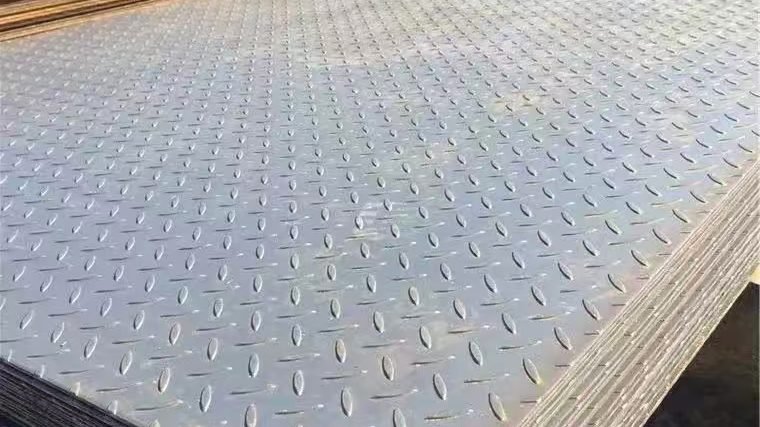
6. Load Capacity and Floor Use
A checkered plate floor is a plate on a frame. The design question is not the plate’s strength but its stiffness under foot: a floor that deflects visibly feels unsafe even if it is structurally adequate. The usual criterion is a deflection limit of L/200 for walking surfaces, with the load taken as a distributed load plus a concentrated load of 1–2 kN at mid-span.
| Base thickness | Maximum span, walking load | Maximum span, light vehicle | Support spacing note |
|---|---|---|---|
| 2.0 מ"מ | 500–600 מ"מ | not recommended | Full perimeter support |
| 3.0 מ"מ | 700–900 מ"מ | — | Bearers at 400 mm centres |
| 4.0 מ"מ | 1,000–1,200 מ"מ | 600–800 מ"מ | Edge support mandatory |
| 5.0 מ"מ | 1,300–1,500 מ"מ | 800–1,000 מ"מ | Weld or bolt to frame |
| 6.0–8.0 מ"מ | 1,600–2,000 מ"מ | 1,000–1,300 מ"מ | Heavy vehicle decks |
The spans are indicative for Q235B with a distributed load of 2 kN/m² plus a 1 kN point load, and they assume the plate is fixed or simply supported on continuous bearers. On a ramp, the same plate must also resist the traction load, and the trailing edge of each plate becomes a step that catches wheels and trolleys. Ramp plates should be at least 4.0 mm and should overlap in the direction of travel, not against it.
Slip resistance is usually quoted as a pendulum test value or as an R-rating. A new diamond pattern in dry conditions is comfortably in the R11–R12 range. Once the pattern is worn, the same plate drops to R9–R10, which is the point where a floor that was specified for grip becomes a floor that meets the minimum and nothing more. For a wet process area or a food plant, the floor should be specified with a minimum R11 and inspected again after a year of traffic.
7. Fabrication Rules
גְזִירָה. Plasma or laser cutting leaves a clean edge with a small heat-affected zone. Shearing is faster and cheaper but distorts the pattern near the cut and can leave a burr that catches hands. For a floor that will be walked on, the cut edge should be ground or dressed.
הַלחָמָה. The pattern makes a full-penetration weld difficult to inspect, and the raised bars can hold moisture against the weld toe. Weld from the flat side where possible, use a low-hydrogen process, and run a continuous fillet rather than a series of tacks. On galvanized plate, remove the coating 25 mm either side of the weld and repair with a zinc-rich compound afterwards.
הִתעַקְמוּת. Checkered plate bends readily across the pattern and less readily along it. A tight bend across the pattern can open the bars on the outside of the bend into small cracks. For a folded edge, a bend radius of at least two thicknesses is recommended.
Drilling and bolting. A hole drilled through the pattern leaves a raised collar that prevents the washer from seating. Countersink or spot-face the hole, or drill from the flat side and deburr.
Galvanizing. Hot-dip galvanizing adds 40–80 µm of zinc and closes the pattern slightly, but it fills the valleys between the bars and can make the surface less grippy in the first weeks. A sweep blast or a light acid wash after galvanizing restores the texture.
8. Selecting Thickness and Pattern
The rule of thumb is that the plate thickness is set by the span and the load, and the pattern is set by the traffic. A workshop floor with forklifts needs 5–6 mm regardless of span, because the wheel loads are concentrated and the plate must resist indentation as well as bending. A pedestrian mezzanine can use 3–4 מ"מ. A trench cover in a yard can use 3 mm if it is fully supported on a frame, and needs 5 mm if it is not.
For a ramp, the plate should be one step thicker than the adjacent floor, and the pattern should be the bar-and-check type laid across the direction of travel. For a vehicle deck, the lentil pattern drains better and the plate should be 5 mm or more with a welded frame beneath.
9. Common Mistakes
Specifying pattern and ignoring thickness. “3 mm checkered plate” is a complete description of the material and an incomplete description of the floor. The span and load have to be stated.
Using 2 mm plate as a walking surface. It looks adequate on a pallet and deflects visibly under a person’s weight once it is laid on a frame at 600 mm centres. The plate is not defective; the application is wrong.
Stacking plates pattern-to-pattern. The bars interlock, the stack becomes unstable, and the top plate slides. Mills normally alternate with bearers; if the plates are re-stacked on site, keep the bearers.
Welding without dressing the pattern. A weld bead that sits proud of the surface becomes a trip hazard, and a weld that sits in a valley traps water. Both are avoidable with a little grinding.
Assuming galvanized checkered plate is automatically anti-slip. A thick zinc coating can smooth the profile. If slip resistance is a requirement, specify a post-galvanizing sweep blast and test the finished floor.
Cutting plates with a guillotine and leaving a burr. The burr on a walking surface is a cut waiting to happen. Deburr every edge that a person can step on.
10. שאלות נפוצות
Is checkered plate the same as diamond plate? In common usage, כֵּן. Diamond plate is the American term for the diamond-pattern product; checkered plate is the broader term that also covers lentil and bar-and-check patterns.
Can checkered plate be used outdoors? כֵּן, but it must be protected. Uncoated carbon steel checkered plate rusts quickly on a walking surface because water sits in the valleys. Galvanizing or a heavy-duty coating is standard for outdoor use.
Does the pattern increase load capacity? Negligibly for overall bending. The pattern helps against local indentation and improves grip, but the bending capacity comes from the base thickness.
What is the standard size? Common widths are 1,000 mm, 1,250 mm and 1,500 mm; lengths are usually 2,000–6,000 mm or cut to order. Coil form is available for continuous forming lines.
Can the pattern be rolled on both faces? Not normally. Double-sided plate exists but is rare, and the second pattern weakens the plate because both faces are indented.
How do I check the pattern height? With a depth gauge or a straight edge and feeler gauge across the bars. A pattern below 0.5 mm is nearly flat and provides little grip.
11. Sourcing Checkered Plate
QIDAMT supplies hot-rolled checkered plate in Q235B, Q345B and SS400, thickness 2.0–8.0 מ"מ, widths up to 1,500 mm, יַהֲלוֹם, lentil and bar-and-check patterns, pickled or unpickled, in plate or coil form. גובה תבנית, base thickness and flatness are confirmed on the mill certificate, and plates can be cut to size and galvanized on request.
For carbon steel flat bar used as the frame beneath such a floor, לִרְאוֹת בר שטוח מפלדת פחמן Q235B. For tubular structures, לִרְאוֹת Q345D Seamless Steel Pipe.
Need a specific pattern, thickness or cut size?
Send the pattern type, base thickness, רוֹחַב, length and surface treatment, and we will confirm availability.
Related reading: בר שטוח מפלדת פחמן Q235B · Q345D Seamless Pipe