 TOSO
Q235B Carbon Steel Rectangular Tube
Cold-formed welded rectangular hollow section from 20×10 mm to 400×200 mm, 6 m kei na 12 m balavu.
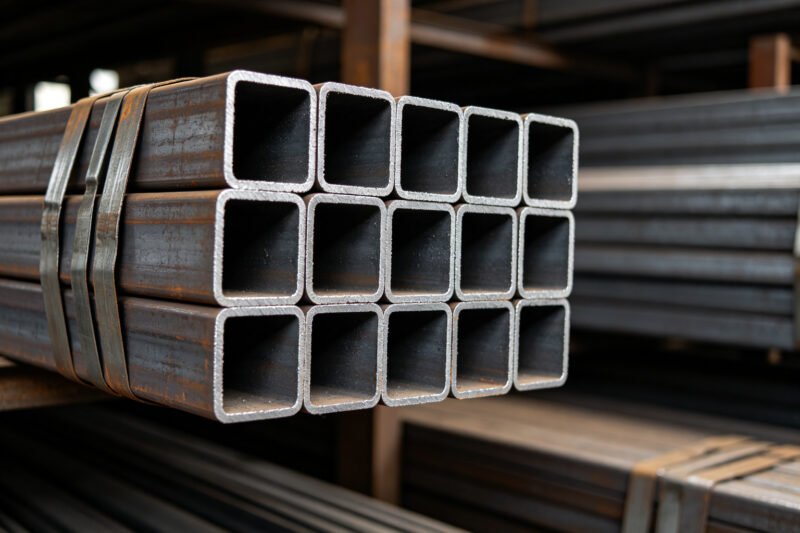
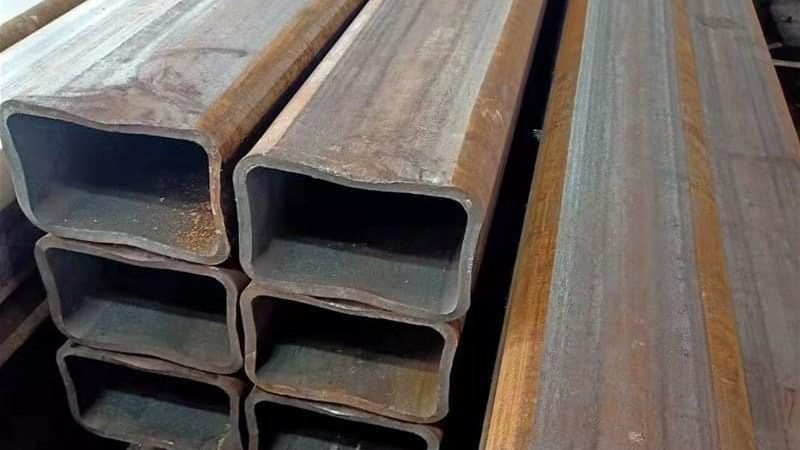
A Q235B rectangular tube is a cold-formed, electric-resistance-welded hollow section with a rectangular outside profile. It carries bending load in two directions more efficiently than a round pipe of the same weight, which is why it dominates frames, racking, yadra, matamata, greenhouse structures and light vehicle bodies. QIDAMT supplies RHS in Q235B to GB/T 6728, with square, rectangular and custom lengths, and can galvanize or prime on request.
The section looks simple, but most quality problems start before the tube reaches the welder: wall thickness below the tolerance, corner radius out of spec, twist in a long length, or a weld seam that opens when the tube is bent. This page sets out the grade, the size range, the tolerances that matter and the rules for selecting and installing RHS.
What a Q235B Rectangular Tube Is and Where It Is Used
Rectangular hollow section (RHS) is produced from steel strip that is slit to width, roll-formed into a rectangular profile, welded along the seam by high-frequency resistance welding, then sized and straightened. Q235B is the Chinese carbon structural steel grade most commonly used for this product; it is readily welded, formed and cut, and it accepts paint, powder coating and hot-dip galvanizing.
- Veimama ni misini, yadra, enclosures and conveyor supports
- Warehouse racking, mezzanine floors and shelving uprights
- Gate frames, fence panels, carport and greenhouse structures
- Trailer bodies, agricultural implements and light vehicle chassis
- Sign supports, iqaqalo ni liga, balustrades and architectural frames
- Temporary structures, staging and exhibition build systems
The rectangular shape is chosen when a flat face is useful for mounting, when the section must fit a shallow depth, or when the designer wants different stiffness about the two axes. A square section is better when the load direction is unknown; a round tube is better for fluid service and for uniform wind loading.
Steel Grade and Chemical Composition
Q235B is defined by GB/T 700. The table gives the heat-analysis limits; product analysis tolerances apply.
| Ivakatakilakila | Limit (%) | Effect on the tube |
|---|---|---|
| Kaboni (C) | 0.20 max | Weldability and strength |
| Silikoni (Kei) | 0.35 max | Deoxidation; affects galvanizing |
| Makanisi (Mn) | 1.40 max | Strength and hardenability |
| Fosiforo (P) | 0.045 max | Too high reduces ductility |
| Sulifa (S) | 0.045 max | Too high promotes weld cracking |
Because the tube is made from strip, the strip grade and the tube standard both matter. A tube marked Q235B should be made from Q235B strip; re-rolled or unknown strip with a similar analysis is not the same product and will not carry the same certificate. Ask for the strip heat number and the tube mill certificate, not just a grade stamp on the bundle.
Na iyau vakamisini
| Iyau | Requirement | Thickness note |
|---|---|---|
| Na kaukauwa ni solibula | ≥235 MPa | For thickness ≤16 mm |
| Na kaukauwa ni solibula | ≥225 MPa | For thickness 16 – 40 mm |
| Fuerza de tensión | 370 – 500 MPa | All common wall thicknesses |
| Vakabalavutaki | ≥26% | For thickness ≤16 mm, gauge 50 mm |
| Vakabalavutaki | ≥25% | For thickness 16 – 40 mm |
| Kena rawa ni vude | 7.85 g/sm3 | Used for weight per metre |
Na mavoa ni bai, not the grade, usually decides whether a tube survives. KEI 2.0 mm nominal wall rolled at the lower tolerance limit can be 1.8 mm, which cuts the section modulus by roughly 10%. On a long span that is the difference between a stiff frame and a sagging one.
Size Range and Weight per Metre
The sizes below are representative of what is produced to GB/T 6728. Weight is calculated for nominal dimensions at 7.85 g/sm3; actual weight follows the actual wall thickness.
| Kena ivakatautavata (mm) | Lalaga (mm) | Bibi (kg/m) | Vakayagataki vakawasoma |
|---|---|---|---|
| 40 × 20 | 2.0 | 1.76 | Guards, fremu, light shelving |
| 50 × 25 | 2.0 | 2.23 | Gate frames, veitokoni ni saini |
| 60 × 40 | 2.5 | 3.73 | Raking, isema ni misini |
| 80 × 40 | 3.0 | 5.37 | Conveyor supports, mezzanine |
| 100 × 50 | 3.0 | 6.78 | Na isema ni ituvatuva, trailer bodies |
| 120 × 60 | 4.0 | 10.80 | Heavy frames, crane rails |
| 150 × 75 | 4.5 | 15.26 | Kolomu, long-span beams |
| 200 × 100 | 5.0 | 22.77 | Portal frames, heavy structures |
| 250 × 150 | 6.0 | 36.55 | Industrial structures |
| 300 × 200 | 8.0 | 60.79 | Heavy fabrication, temporary works |
Standard delivery length is 6 m se 12 m, with cut-to-length supplied against a cutting list. For long spans, remember that transport length, not mill capability, is usually the limit: kei 12 m bundle needs a suitable trailer and unloading space.
Tolerances That Matter
GB/T 6728 sets the dimensional tolerances for cold-formed hollow sections. The values below are typical and should be confirmed against the edition cited on your purchase order.
| itovo | Typical tolerance | Why it matters |
|---|---|---|
| Outside dimension (H, B) | ±1% | Affects fit into frames and brackets |
| Na mavoa ni bai | ±10% | Directly changes strength and weight |
| Balavu | 0 / +30 mm | Cutting list allowance |
| Dodonu | ≤1.5 mm/m | Visible bow on long rails |
| Vuki | ≤1.5 mm/m | Prevents flat mounting of frames |
| Squareness of corners | 90° ±1° | Welded joints gap or close |
| Radius ni tutu | Rauta ni 2 – 3 times wall | Affects bending and fit |
Twist is the least visible and most expensive tolerance failure. A bundle can look straight on the truck and still show a propeller twist when the tubes are laid on a flat floor. Check by sighting along the tube from one end and by measuring the height of both corners at the far end.
How the Tube Is Made
The process runs from coil to finished bundle in one line: strip uncoiling, slitting to the developed width, edge preparation, roll forming through a series of stands, high-frequency welding of the seam, removal of the external weld flash, sizing, vakadodonutaki, cutting to length and bundling.
Three process details control quality. Taumada, the strip width determines the finished dimensions and wall; a narrow strip gives an undersize tube. Ikarua, the welding power and speed determine whether the seam is fully fused; a cold weld can pass a visual check and fail under bending. Ikatolu, the sizing and straightening rolls determine straightness and twist. A tube that is dimensionally correct but poorly straightened will not fabricate well.
Optional processes include hot-dip galvanizing, pre-galvanizing from zinc-coated strip, primer coating, and hydrostatic testing for pressure applications. If the tube will be galvanized after fabrication, specify vent and drain holes in the design; sealed sections can burst or distort in the zinc bath.
Lawa ni Digidigi
RHS, SHS or round pipe
Use RHS when one face must be flat for mounting or when depth is restricted. Use square hollow section when the load direction is uncertain or when the section must look symmetrical. Use round pipe for fluid service, for uniform wind or impact loading, and where the connection is by saddle or sleeve.
Wall thickness and span
For a first pass, size the tube by deflection rather than by stress. A common limit is L/250 for general frames and L/360 for structures that carry equipment or glazing. Then check bending stress, shear at supports and local crushing at bolted connections. If the tube is drilled or slotted, subtract the lost section at that point.
Corner radius and connections
RHS has a defined outside corner radius, typically two to three times the wall thickness. Bolted connections through the flat face need washers large enough to span the corner; welded connections need the joint detailed so the weld does not sit in the radius. If the tube is to be bent, specify a bend radius large enough to avoid seam opening and wall thinning.
Fabrication and Installation Notes
- Cut with a cold saw or abrasive saw for clean square ends; a band saw is slower but gives a better weld fit-up.
- Remove the internal weld flash if a sleeve or insert must slide inside the tube.
- For Q235B, E43 series electrodes (J422/E6013 type) suit general work; use E50 series for higher-strength joints or heavier sections.
- No preheat is normally needed below 20 mm bai, but dry the surface and avoid welding at temperatures below 0 °C without protection.
- Drill with sharp HSS bits at moderate speed; the weld seam is harder than the parent strip and will deflect a dull bit.
- When hot-dip galvanizing after fabrication, drill vent holes at both ends of each sealed compartment and drain holes at low points.
- Do not lift bundles by the tube faces with fork tines; use slings and timber spreaders to avoid denting and permanent set.
- Store bundles on timber bearers, clear of standing water, and remove strapping only when the tubes are on a flat surface.
Cala Dau Caka
- Specifying nominal wall thickness without stating the acceptance limit, then receiving tube at the lower tolerance.
- Using RHS as a column without checking local buckling and the effective length.
- Welding a sealed section and then galvanizing it without vent holes.
- Assuming a rectangular tube and a round pipe of the same weight have the same stiffness. They do not.
- Buying by outside dimension only and forgetting that corner radius reduces the clear internal space.
- Mixing Q235B tube with Q345B fittings and expecting the joint to develop the higher grade.
- Accepting a bundle with visible twist because the tubes are going to be cut short anyway — the twist remains in every piece.
Packing and Delivery
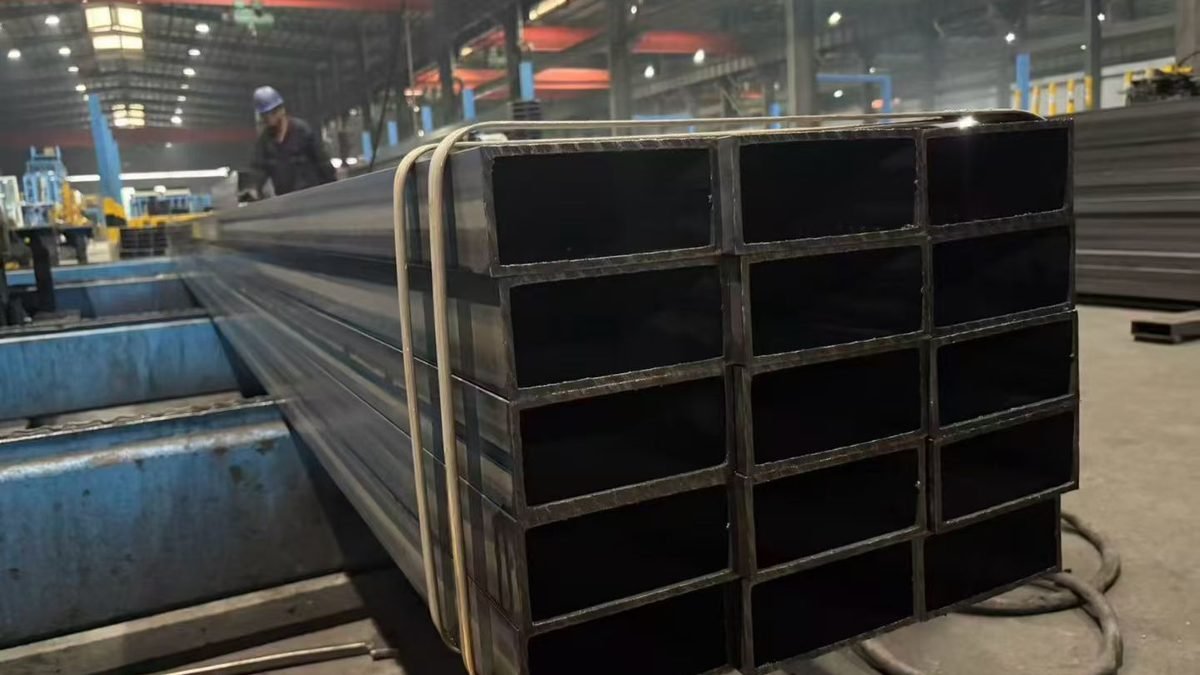
Tubes are bundled in hexagonal or square stacks, vesuki ena iqaqalo kaukamea, with timber or plastic edge protection under the straps. Bundles are marked with size, lalaga, ivakatagedegede, balavu, heat number and quantity. KEI 20 ft container typically takes 20 – 25 tonnes of 6 m tube; 12 m tube needs a 40 ft container or a flat rack.
For export, we can supply mill test certificates, packing lists with bundle weights and pre-shipment photos. If the tubes will be galvanized after arrival, tell us so the bundle can be packed to drain and ventilate.
Taro e dau tarogi wasoma
What does Q235B mean on a rectangular tube?
Q235B is the steel grade: a carbon structural steel with a minimum yield strength of 235 MPa and controlled carbon, manganisi, phosphorus and sulphur. The B suffix denotes the quality class with a specified impact test at +20 °C.
Can you supply non-standard lengths?
Io. We cut to length against a cutting list, typically with a tolerance of 0 / +30 mm. Very short pieces and mitred ends are available on request.
Is the tube suitable for hot-dip galvanizing?
Io, provided the silicon content is controlled and the fabrication includes vent and drain holes. Very high silicon can produce a thick, iubi malumu; mention galvanizing at the enquiry stage.
What is the difference between RHS and SHS?
RHS has a rectangular outside profile, SHS has a square one. Both are cold-formed welded hollow sections and share the same grade and tolerance framework; the difference is the shape and the stiffness about each axis.
Do you provide test certificates?
Io. Mill test certificates with chemistry, mechanical properties and heat number traceability are standard; ENA 10204 3.1 and third-party inspection are available on request.
Veika e Veisemati
Vakauta mai na kena levu, matolu ni bai, balavu, quantity and finish (loaloa, primed or galvanized). We confirm weight, price and lead time within 24 aua.
KEREA E DUA NA VEIVAKADEITAKI