 پیشرفت
Stainless Steel Wire: درجه, Temper and Surface Selection Guide
Stainless steel wire is drawn from wire rod through a series of dies until the diameter and the mechanical condition meet the application. The diameter is the easy part to specify; the temper is the part that decides whether the wire bends, springs back, holds a load or fails in service. Two coils of 304 wire at the same 1.2 mm diameter can differ by a factor of three in tensile strength depending on how many drawing passes they received and whether they were annealed afterwards. This guide sets out the grades, the drawing and annealing route, the temper designations used in trade, the strength ranges that follow from each temper, and the selection rules for mesh, چشمه ها, اتصال دهنده ها, welding wire and filtration.
سیم, Wire Rod and the Drawing Route
Wire rod is the hot rolled input, supplied in coils typically from 5.5 میلی متر به 16 mm diameter. Wire is the cold drawn output, supplied from about 0.10 mm up to 12 میلی متر. Between them sit pickling, پوشش, drawing and annealing. The rod is first descaled, either by acid pickling or by mechanical shot blasting, because oxide scale destroys dies. A lubricant carrier is then applied: lime, borax or a phosphate/oxalate coating depending on the grade and the reduction schedule. The coated rod is drawn through carbide or diamond dies, each pass reducing the diameter by roughly 10 به 25 percent, with the reduction limited by the wire’s ability to deform without cracking.
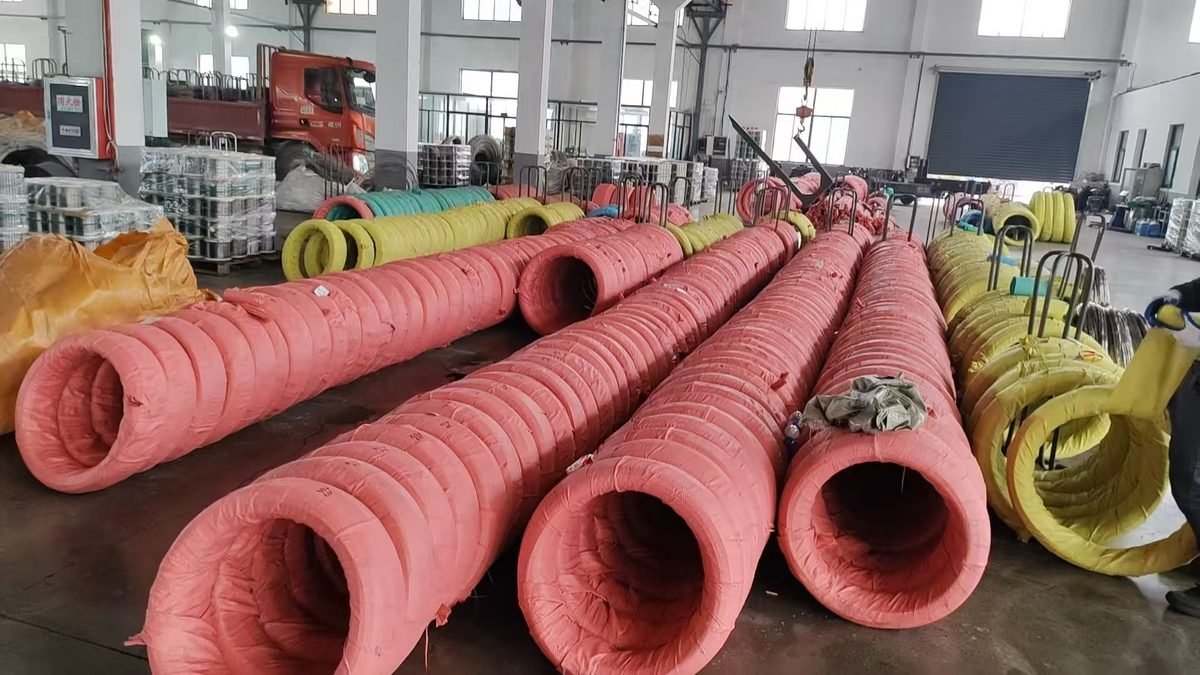
As reduction accumulates, the wire work hardens: tensile strength rises, ductility falls and the material becomes magnetic. To continue drawing, or to deliver a soft product, the wire is annealed. Bright annealing in a hydrogen or cracked ammonia atmosphere is the standard route because it removes the oxide that air annealing would leave and produces the clean silver surface associated with bright wire. After the final pass, the wire is spooled, wrapped and, برای کاربردهای حیاتی, tested for diameter, کششی, torsion, coating mass and surface defects.
The consequence for buyers is simple: diameter alone does not define the product. A purchase order that says “304 wire, 1.0 میلی متر” leaves the temper, the surface, the coil weight, the spool type and the tolerance open, and the supplier will fill those gaps in whatever way suits their standard stock rather than the application.
Grades and Chemistry
The austenitic grades dominate wire production because they draw well and resist corrosion: 304, 304L, 316, 316L, 321 و 201. Ferritic and martensitic grades appear where hardness or cost matters, and duplex grades appear in aggressive service. The chemistry follows the same logic as for bar and sheet, but wire adds two constraints: sulfur and oxygen must stay low so the wire does not break during drawing, and the residual copper and tin must be controlled because they embrittle at drawing temperature.
| درجه | Cr % | در % | مو % | C max % | Notes for wire |
|---|---|---|---|---|---|
| 304 | 18.0–20.0 | 8.0–10.5 | - | 0.08 | هدف کلی, good drawability |
| 304L | 18.0–20.0 | 8.0–12.0 | - | 0.030 | Welded mesh, lower strength |
| 316 | 16.0–18.0 | 10.0–14.0 | 2.0–3.0 | 0.08 | دریایی, شیمیایی, higher spring strength |
| 316L | 16.0–18.0 | 10.0–14.0 | 2.0–3.0 | 0.030 | Welded assemblies in chloride service |
| 321 | 17.0–19.0 | 9.0–12.0 | - | 0.08 | Titanium stabilised, high temperature use |
| 201 | 16.0–18.0 | 3.5–5.5 | - | 0.15 | Low cost, poor chloride resistance |
| 410 | 11.5–13.5 | - | - | 0.15 | Hardfacing, magnetic, limited corrosion |
برای 201, the manganese and nitrogen substitution raises strength and lowers cost, but pitting resistance in humid or chloride-bearing environments falls well below 304. It is used for dry indoor mesh, decorative weaving and short-life applications, not for coastal or wash-down service. 410 is martensitic and magnetic; it can be hardened but resists corrosion poorly and is normally chosen for wear resistance rather than for exposed service.
Temper and Tensile Strength
Temper describes the amount of cold reduction left in the wire. Trade uses several naming systems and they do not map one to one, so the safest specification states the temper and the required tensile range together. The table below gives representative ranges for 304 wire; other grades shift the values but follow the same pattern.
| خلق و خوی | وضعیت | کششی, MPa | Behaviour | استفاده معمولی |
|---|---|---|---|---|
| نرم / روشن آنیل شده | Annealed after final draw | 550–700 | Very ductile, low springback | Weaving, knitting, redrawing, ties |
| Quarter hard | Light reduction | 850–1050 | Formable, قدرت متوسط | Hooks, hangers, light springs |
| Half hard | Medium reduction | 1050–1250 | Balanced | Mesh, fence, اتصال دهنده ها |
| Hard drawn | Heavy reduction | 1250–1550 | High strength, limited bending | Springs, brushes, کابل ها |
| Spring temper | Maximum practical reduction | 1550–1900 | High elastic limit, brittle if over-bent | Compression and torsion springs |
Two rules follow. اول, strength and ductility trade against each other, so a wire strong enough for a spring is not the wire to weave into a filter mesh. Second, the temper is set at the mill and cannot be recovered by the user; if a hard drawn coil needs to be bent tightly, the correct route is to specify soft or half hard from the start, or to anneal locally, which changes the properties in a way that must be re-qualified.
Diameter tolerance matters as much as temper for automated processes. Standard commercial tolerance is often ±0.02 mm for small diameters, tightening to ±0.01 mm for precision grades. Coil-to-coil variation is more dangerous than absolute deviation, because a spring coiler set for one coil will produce different spring rates on the next if the diameter drifts within tolerance. Buyers running automatic equipment should ask for the tolerance and the within-coil consistency separately.
Surface Condition and Coatings
Bright annealed wire has the cleanest surface and is the default for food, medical and decorative work. Electrolytically polished wire goes further, removing the residual drawing marks and raising the corrosion resistance of the surface; it is used for surgical instruments, implants and high-end architectural mesh. Matte or scratch-brushed finishes hide handling marks and suit brushes and scouring products.
Drawing leaves a lubricant residue that is invisible until it interferes with welding, plating or food contact. Wire for welding must be clean and dry, with no residual soap or carrier. Wire for food equipment should be degreased and, where required, منفعل شده. Coatings such as copper flash or zinc are used to aid subsequent drawing, not to provide corrosion protection in service; a copper-flashed wire exposed outdoors will show rust at the coating breaks.
Hydrogen embrittlement is a real risk for high-strength wire that is pickled, plated or cathodically cleaned. Spring temper wire is the most sensitive. If such wire must be plated, the process should be followed by a baking step within the specified window, and the design should avoid sustained tensile stress in a corrosive environment.
Applications and Selection Rules
Woven mesh and screen: soft or half hard 304 is standard; 316L for coastal, marine and chemical screening. Wire diameter 0.5 به 3.0 mm covers most woven and welded mesh. For welded mesh, 304L or 316L avoids sensitisation at the weld nuggets.
Springs: 302 و 304 hard drawn or spring temper are the workhorses; 316 gives better corrosion resistance at slightly lower strength; 631 (17-7 PH) is used where high strength and corrosion resistance must coexist and cost allows. Spring design should stay below roughly 40 به 45 percent of tensile strength in service to avoid relaxation, and the wire should not be bent to a radius smaller than about three times the diameter in spring temper.
اتصال دهنده ها, ties and lock wire: half hard 304 یا 316, with diameter chosen so the wire fills the hole without forcing. Safety wire for aviation follows specific alloy and diameter rules, and substitution is not permitted.
Welding wire: ER308L, ER316L and ER347 are the common stainless fillers; the wire must be clean, of consistent diameter and free from lubricant residue. For submerged arc and MIG, the spool and the wire feeding system matter as much as the analysis, because kinking and cast cause arc instability.
Filtration and brushes: 304 یا 316 لیتر, often in crimped or woven form. Brush wire benefits from a matte surface and a temper hard enough to resist bending but not so hard that it snaps at the brush cup.
Redrawing: soft annealed wire supplied in heavy coils, with controlled surface quality and low residual lubricant, so the customer’s drawing dies are not damaged by inclusions or scale.
ذخیره سازی, Handling and Safety
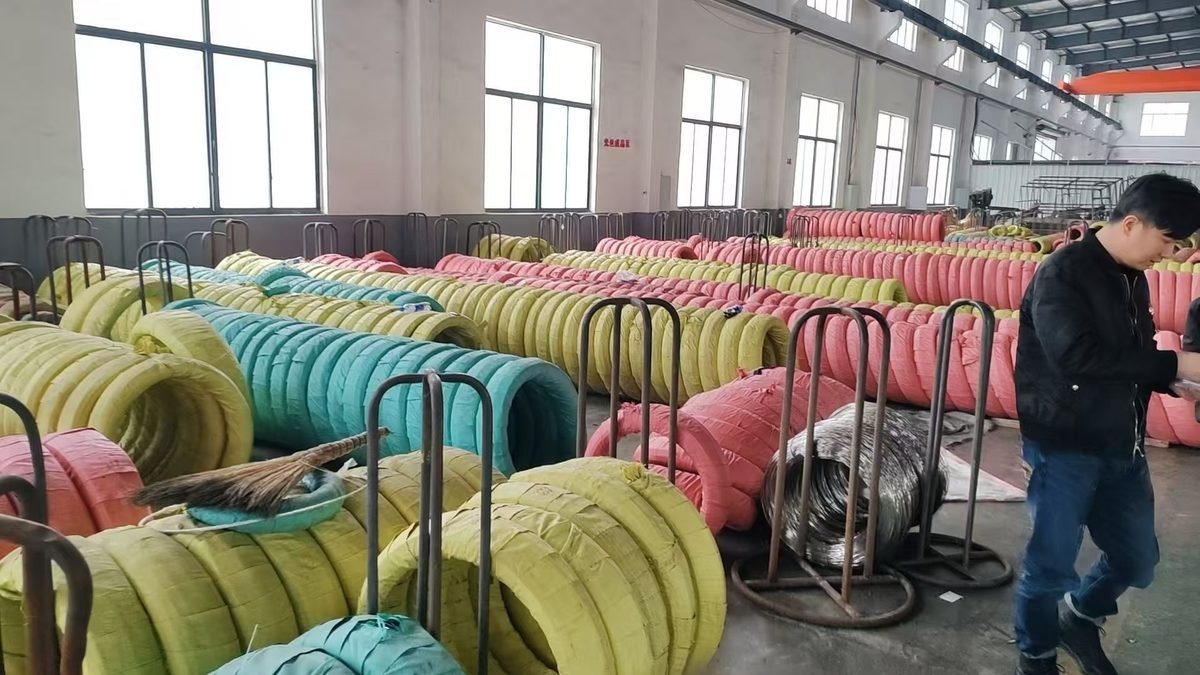
Wire coils are stored indoors, off the floor, with the wrap intact. Moisture under a coil produces crevice corrosion at the contact points; condensate from a cold store entering a warm room is a common cause. Coils should not be stacked so that the weight rests on the wrap of the coil below, because the wrap deforms and the coil loses its shape.
A coil of hard drawn wire contains stored elastic energy. When the tie is cut, the coil can spring outward with enough force to injure hands and eyes. Keep the wrap on until the coil is on the pay-off stand, cut the tie while standing outside the coil plane, and wear gloves and eye protection. Do not lift a coil by the wire itself; use a coil hook or a cradle.
Testing and Incoming Inspection
Wire is difficult to inspect after it has been wound into a coil, so the tests are defined before dispatch and repeated on a sample at goods-in. The standard set is tensile, torsion, diameter, surface and, where specified, coating mass and resistivity.
The tensile test gives the actual strength rather than the nominal temper, and it is the only way to prove that the temper matches the purchase order. Torsion testing twists a length until it fractures; the number of turns and the fracture appearance reveal drawing defects, surface cracks and internal inclusions that a tensile test can miss. A wire that passes tensile but fails torsion will break on a spring coiler or a mesh loom.
Diameter is checked with a micrometer at several points along the coil, not only at the end, because the diameter can drift through a long coil if the drawing line was unstable. Surface inspection looks for scratches, die marks, laps and lubricant residue; a longitudinal scratch becomes a stress raiser and a crack initiation point in a spring.
For mesh and weaving wire, check the cast and the helix: a wire with excessive cast will not lie flat in the loom and will produce a wavy mesh. For welding wire, check the surface for residue and the spool for layer winding, because a crossed layer causes feeding hesitation and arc instability.
Record the results against the heat number. If a problem appears months later, the traceability is the only way to identify whether one coil or a whole heat was affected, and that decides whether the response is a replacement or a process change.
Common Mistakes
Ordering by diameter only, then discovering the wire is spring temper when the process needs soft. Assuming 201 is interchangeable with 304 because both are “ضد زنگ”. Using copper-flashed wire outdoors and blaming the base metal for rust. Welding wire that was stored in a humid workshop and now feeds porosity. Bending spring temper wire to a radius below three diameters. Cutting a coil without restraining the wrap. Mixing wire from two suppliers in one automatic machine without checking diameter and tensile consistency. Using 316L wire where 304 was specified, which is safe but pays for molybdenum nobody needed, and the reverse, which is not safe at all.
سوالات متداول
What is the difference between bright annealed and soft wire? Bright annealed wire is annealed in a protective atmosphere after the final draw, giving low strength and a clean surface. “نرم” describes the mechanical condition; a soft wire can have a dull surface if it was annealed in air and pickled.
Can hard drawn wire be bent? It can be bent to a limited radius. Below roughly three times the diameter, the surface strain exceeds what the temper allows and the wire cracks or snaps. Use soft or half hard if tight bends are needed.
Is 316 wire suitable for coastal mesh? بله, 316 or 316L is the normal choice within about one kilometre of the coast, and it still needs periodic washing to remove salt deposits. In splashing zones, 2205 duplex wire is sometimes used instead.
Why does my 304 wire rust after welding? The weld nugget and the heat tinted zone are chromium depleted. Pickling and passivation restore the film. If the assembly is also exposed to chlorides, the grade may be underspecified.
What coil weight should I order? Match the coil to the pay-off equipment. A coil that is too heavy for the stand causes tension variation; a coil that is too light causes frequent stoppages. Standard HVAC and mesh coils run from 10 به 50 کیلوگرم, with larger coils available on request.
Specification checklist: grade with chemistry, temper with tensile range, diameter with tolerance, surface condition, وزن سیم پیچ, spool type, lubricant residue limit, and the test reports required. Without the temper and the tolerance, two quotations are not comparable.
Wire is a small-ticket item that decides the behaviour of a much larger assembly. The cost difference between soft and spring temper is negligible; the cost of discovering the wrong temper after a production run is not. Specify temper, tolerance and surface at the enquiry stage and the rest of the process becomes predictable.
Related material: 304 کویل فولاد ضد زنگ for downstream slitting, 316ورق استیل ضد زنگ L for marine assemblies, و Q345D seamless steel pipe where corrosion resistance is not the governing requirement.

