 پیشرفت
Hot Rolled H-Beam Q235B: بخش, Length and Fabrication Guide
Hot Rolled H-Beam Q235B: بخش, Length and Fabrication Guide
An H-beam is a hot rolled structural section with two parallel flanges and a vertical web, shaped so that the outer profile resembles the letter H. The flanges are of equal width and are parallel to each other, which distinguishes the product from the older I-beam with tapered flanges. The geometry puts more material at the extremities of the section, where it contributes most to bending resistance.
Q235B is the Chinese structural carbon steel grade most often paired with this section. It is a general purpose mild steel with a minimum yield strength of 235 MPa, good weldability and wide availability. The combination is the default choice for industrial building frames, طبقات نیم طبقه, pipe racks, crane support beams and temporary structures across a large part of the world.
This guide covers the section geometry, the Q235B chemistry and mechanical values, the dimensional and length tolerances, the fabrication rules for cutting, حفاری, welding and galvanising, the selection logic between H-beam and I-beam, and the mistakes that turn a sound section into a poor connection.
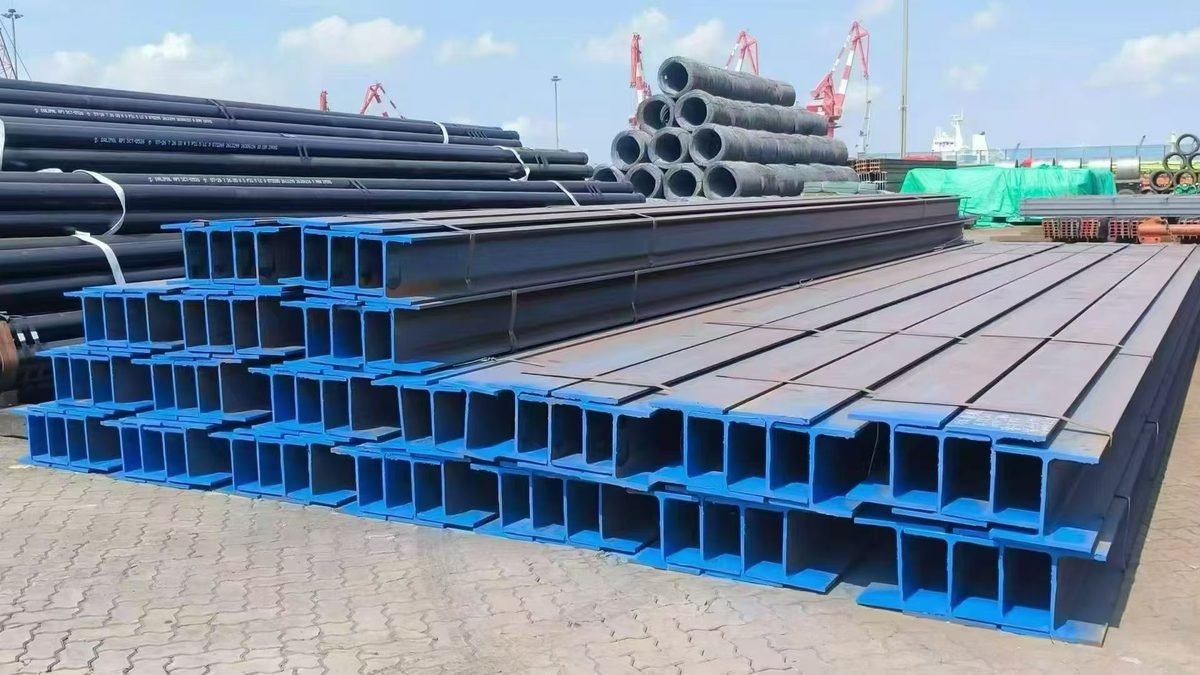
What an H-Beam Is and Where It Is Used
The H-beam is produced by hot rolling a bloom through a series of universal and edger stands, or by a welding process for very large built-up sections. The hot rolled product has a uniform metallurgical structure and a surface finish that carries mill scale unless it is pickled or shot blasted.
The key geometric feature is the parallel flange. Because the flange faces are parallel, a plate can bear uniformly on the flange, a bolted connection can be detailed without tapered washers, and a column can be erected with simple base plates. The I-beam, by contrast, has tapered flanges that require tapered details and are less efficient for bearing loads.
Typical applications include the main frames of industrial sheds, mezzanine floor beams, roof purlin supports, pipe racks in process plants, crane runway beams, conveyor gantries, bridge girders in short span bridges, and temporary works such as excavation shoring. The section is also used as a lifting beam and as a machine base frame.
The product is normally supplied in lengths from 6 به 12 metres, with the section designation written as height times flange width times web thickness times flange thickness. A designation such as HW200x200x8x12 means a wide flange section 200 mm high, 200 mm wide, with an 8 mm web and a 12 mm flange.
Q235B Chemistry and Mechanical Properties
Q235B is defined in GB/T 700. The B suffix indicates a controlled phosphorus and sulphur level, which is what makes the grade suitable for welding and for dynamic loading. The table below gives the limits that appear on mill certificates.
| عنصر | Range or maximum | اثر |
|---|---|---|
| کربن | 0.12 به 0.20 | قدرت, سختی, weldability balance |
| سیلیکون | 0.30 حداکثر | Deoxidation |
| منگنز | 0.30 به 0.70 | Strength and toughness |
| فسفر | 0.045 حداکثر | Embrittlement risk, kept low in grade B |
| Sulphur | 0.045 حداکثر | Hot shortness and weld cracking risk |
The mechanical values depend on the thickness of the product, because thicker sections cool more slowly and develop a coarser grain structure. The table below gives the GB/T 700 values for the relevant thickness bands.
| ضخامت | قدرت تسلیم, دقیقه | استحکام کششی | ازدیاد طول, دقیقه |
|---|---|---|---|
| تا 16 میلی متر | 235 MPa | 370 به 500 MPa | 26 percent |
| 16 به 40 میلی متر | 225 MPa | 370 به 500 MPa | 26 percent |
| 40 به 60 میلی متر | 215 MPa | 370 به 500 MPa | 25 percent |
| 60 به 100 میلی متر | 205 MPa | 370 به 500 MPa | 24 percent |
Q235B is not a low temperature steel. It has no guaranteed impact toughness at sub-zero service temperatures, and it should not be used for structures that must operate below about minus 20 degrees Celsius without a specific toughness specification. Grade Q235C or Q355 with Charpy guarantees is the correct choice for cold climates and for dynamically loaded crane beams.
The grade is readily weldable with conventional processes. The carbon equivalent is low enough that preheat is not normally required for thicknesses below 25 mm in mild conditions, but thick sections and low ambient temperatures call for preheat to avoid hydrogen cracking in the heat affected zone.
Section Series and Dimensional Range
Chinese standard H-beams are grouped into three series. The HW series has a flange width approximately equal to the section height and is used for columns and for heavily loaded beams. The HM series has a medium flange width and sits between the wide and narrow ranges. The HN series has a narrow flange and is used where the section must fit into a restricted width, such as a wall opening or a closely spaced frame.
| سری | Height range | Flange width | استفاده معمولی |
|---|---|---|---|
| HW | 100 به 400 میلی متر | 100 به 400 میلی متر | ستون ها, heavy beams, crane girders |
| HM | 150 به 600 میلی متر | 100 به 300 میلی متر | General beams, طبقات نیم طبقه |
| HN | 200 به 1000 میلی متر | 100 به 300 میلی متر | Narrow bays, long spans, bridge girders |
Larger sections than the standard rolled range are usually built up by welding plates into an H shape. A built-up beam can be designed to any size, but it carries residual welding stress and requires a qualified welding procedure. The rolled section is preferable whenever a standard size fits the design.
The section properties that matter for design are the second moment of area about the strong axis, the section modulus, the radius of gyration about the weak axis, and the plastic section modulus. These values are published in the standard tables and should be taken from the standard rather than calculated from nominal dimensions, because the rolling tolerances change the actual values slightly.
Tolerances on Dimensions and Length
The tolerances below are typical of GB/T 11263 and comparable to EN 10034. They are the values that should be checked at goods-in inspection.
| بعد | Typical tolerance | How to check |
|---|---|---|
| Section height | plus or minus 2.0 mm up to 400 میلی متر, plus or minus 3.0 mm above | Steel tape or caliper at mid length |
| Flange width | plus or minus 3.0 میلی متر | Caliper at both ends |
| Web thickness | plus or minus 1.0 میلی متر | Micrometer at three points |
| Flange thickness | plus or minus 1.5 میلی متر | Micrometer at four flange points |
| طول | 0 to plus 50 میلی متر | Tape measure, end to end |
| کمبر | 0.15 percent of length maximum | String line and rule |
| پیچ و تاب | 1 mm per metre maximum | Level and dial gauge on the flange |
| End squareness | 2 mm maximum out of square | Square against the web |
Camber and twist are the two tolerances that cause the most trouble on site. A beam with camber beyond the limit cannot be erected straight without forcing, and forcing introduces locked-in stress that reduces the load capacity. A twisted beam produces a floor or roof that is visibly out of level and a connection that must be shimmed.
Length is normally supplied with a plus tolerance only, so that the beam can be cut to the exact length on site. Ordering to a fixed length with both plus and minus tolerance creates the risk of a beam that is short and cannot be recovered. For projects with a detailed cutting list, order the mill length and cut on site, or order a precision cut length and accept the price premium.
How the Section Is Rolled
The rolling train for H-beams uses a universal mill with vertical and horizontal rolls, or a tandem mill with a specific pass design. The bloom is reheated, descaled by high pressure water, and then shaped in a series of passes. The flange and the web are formed simultaneously, which is why the web thickness and the flange thickness can differ in the same section.
After rolling, the beam is cooled on a cooling bed, straightened by a roller straightener, and cut to length by a cold saw or a shear. Straightening is critical because the rolling process leaves residual curvature, and a beam that is not straightened will not assemble into a straight frame.
The surface condition depends on the cooling and the descaling. A uniform blue-grey mill scale is normal and acceptable for painted work. A heavy, flaky scale indicates inadequate descaling and will disbond under a paint system. Shot blasting to Sa 2.5 is the usual preparation before a high performance coating.
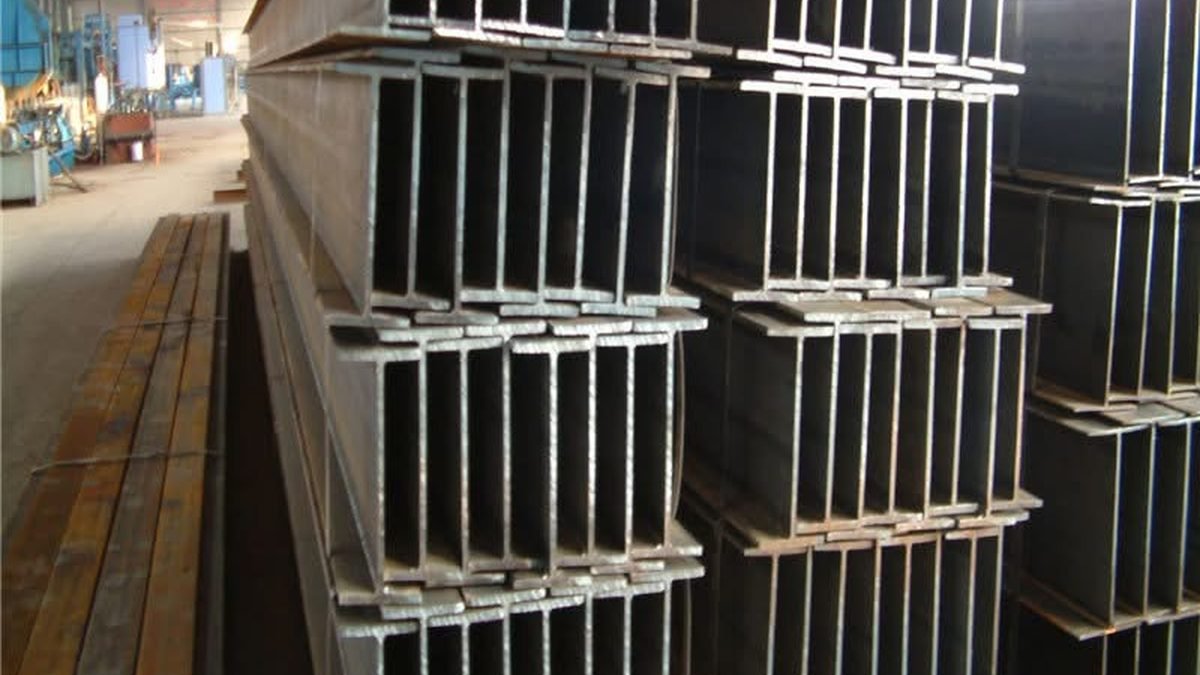
برش, Drilling and Welding
Cutting is done by band saw, cold saw, plasma or oxy-fuel. A band saw gives a square, burr-free end that is ready for a bearing plate or a welded connection. Plasma gives a faster cut with a small heat affected zone and a slightly rougher edge. Oxy-fuel cutting is economical for thick sections but leaves a heat affected zone that must be removed before welding on dynamically loaded connections.
Drilling should be done with a carbide or cobalt drill at a speed suited to mild steel, with coolant. The hole should be drilled from both sides when the web is deep, to avoid breakthrough burrs. Hole spacing and edge distance should follow the connection design, not the drill operator’s convenience.
Welding Q235B is routine with E43 series electrodes or ER50-6 filler wire. The joint preparation should be clean and dry, with mill scale removed from the weld zone. A root gap and a bevel that match the procedure are essential for full penetration. For fillet welds, the leg length should be specified, because an undersized fillet is the most common cause of a connection that fails below its calculated capacity.
Distortion control is a fabrication planning issue. Welding one side of a beam first pulls the section toward that side. Balanced welding sequences, back-step technique, and restraint before welding all reduce the distortion. A beam that is distorted after welding cannot be straightened without heat, and heat straightening is a specialized operation that should be done by a qualified contractor.
Bolted connections are common in demountable structures. The bolt grade, the plate thickness and the hole type should be designed together. A bearing connection with a slotted hole needs a hardened plate or a stiffener to prevent the bolt from slipping under load.
Corrosion Protection and Fire Performance
Hot dip galvanising to ISO 1461 is the standard protection for exposed H-beams. The coating thickness depends on the steel thickness: for material 6 میلی متر و بالاتر, a minimum average of 85 micrometres is typical, and thicker coatings are specified for aggressive environments. The galvanising process requires vent and drain holes so that the molten zinc can reach every surface and the air can escape. A closed box section without vents will not galvanise properly and may explode during dipping.
Paint systems are used where the appearance matters or where galvanising is impractical. A zinc-rich primer followed by an intermediate coat and a polyurethane top coat is a common three coat system for industrial atmospheres. Surface preparation to Sa 2.5 is the minimum for a coating that is expected to last more than ten years.
Fire protection is a separate design issue. An unprotected steel beam loses strength quickly above 500 degrees Celsius. Intumescent paint, board protection or a sprinkler system can be used, and the required fire resistance period determines the protection thickness. The structural engineer should specify the fire protection, not the fabricator.
Site storage should keep the beams off the ground on timber bearers, with drainage away from the stack. Water trapped between the flanges of two stacked beams creates a corrosion cell that is difficult to inspect and expensive to repair.
Choosing Between H-Beam and I-Beam
The H-beam is more efficient for a given depth because the parallel flanges place more material at the extremities and provide a wider bearing surface. The I-beam has a tapered flange that is cheaper to roll in some mills and is traditional in older designs, but the taper complicates connections and reduces the bearing width.
For a column, the H-beam is the obvious choice because the equal flange width gives a stable base and a symmetrical section for buckling in both directions. For a beam where the load is applied to the top flange, the wider flange of the H-beam distributes the load over a larger area and reduces local buckling.
For a span where the section depth is restricted, the HN series provides a deeper, narrower beam that fits into the available space. For a heavily loaded short span, the HW series provides a compact, stocky section. The choice should follow the design table, not the availability in the yard.
The cost comparison should include the connection cost. An H-beam that requires simple bearing plates and standard bolts may be cheaper overall than an I-beam that requires tapered details and custom fabrication, even if the I-beam price per tonne is lower.
Common Mistakes in Specification and Use
Specifying Q235B for a cold climate structure is the first mistake. The grade has no guaranteed low temperature toughness, and a brittle fracture in a cold snap is a catastrophic failure mode that no amount of inspection can catch after the fact.
The second mistake is ignoring the weak axis. An H-beam is strong about the major axis and much weaker about the minor axis, and a beam that is braced only in the strong direction can buckle laterally under load. Lateral torsional buckling should be checked for every unbraced beam.
The third mistake is treating the mill scale as a paint primer. Mill scale is not a protective coating, and painting over it produces a coating that disbonds in a few years. Blast the surface before painting.
The fourth mistake is welding without a procedure. A welder who is skilled in one position may produce a defective weld in another, and the connection capacity assumed in the design may not be achieved. A qualified procedure and a qualified welder are the only reliable controls.
The fifth mistake is mixing grades in one frame without recording which is which. Q235B and Q355B look identical, and a frame that mixes them has a load path that does not match the design. Mark every member with its grade and heat number.
The sixth mistake is ordering lengths that are too short to allow for site adjustment. A beam cut exactly to the theoretical length leaves no room for erection tolerances, and the frame must be forced into position. A small plus allowance, cut on site, is the practical approach.
سوالات متداول
What does Q235B mean? Q stands for the yield strength in Chinese standards, 235 is the minimum yield strength in megapascals for thickness up to 16 میلی متر, and B is the phosphorus and sulphur control grade.
What is the difference between HW, HM and HN? The flange width relative to the height. HW is wide, HM is medium, HN is narrow. The series determines the section properties and the applications.
Can H-beams be welded on site? بله, with a qualified procedure and a qualified welder. Site welding should be minimized where possible, and bolted connections are often preferred for speed and inspection.
How long can an H-beam span? The span depends on the section, the load and the bracing. A designer should calculate it rather than use a rule of thumb, because lateral torsional buckling often governs before bending strength.
Is Q235B the same as S235JR? They are similar in strength but not identical in chemistry and tolerance. Substitution requires an engineering check and a certificate comparison.
Why does the beam have mill scale? Hot rolling at high temperature produces an oxide layer. It is normal and can be removed by shot blasting or pickling before painting.
Can H-beams be hot dip galvanised? بله, with proper vent and drain holes. The coating thickness depends on the steel thickness and the environment.
How should H-beams be stored? Off the ground on timber bearers, with drainage, and with the flanges not bearing directly on each other.
What is camber and why does it matter? Camber is the initial curvature along the length. Excessive camber prevents straight erection and introduces locked-in stress.
Can the section be cut with a torch? Oxy-fuel cutting is possible, but the heat affected zone must be removed before welding on fatigue sensitive connections. A saw cut is preferable for end bearing.
Need H-beams in a specific section, length or grade for a frame or mezzanine project? Send the sizes and quantities for a quotation.
محصولات مرتبط
Related pages on this site: میله تخت فولاد کربن Q235B, Q345D seamless steel pipe, و hot dip galvanized round steel tube Q235B.

