 PROGRESO
Prepainted Steel Coil PPGI: Coating Thickness, Gloss and Coil Handling Guide
Prepainted Steel Coil PPGI: Coating Thickness, Gloss and Handling Rules
A prepainted steel coil is a cold rolled or galvanised steel strip that has been coated with an organic paint system on a continuous line. The product is usually called PPGI when the substrate is hot dip galvanised, and the abbreviation stands for prepainted galvanised iron. The coil leaves the line already finished, so the user does not need a paint shop, a spray booth or a curing oven.
Most quality problems with this product are not steel problems at all. They are coating problems: a film that is too thin, a gloss that does not match the sample, a back coat that was never specified, or a coil that was stored in a way that let condensation sit between the wraps. This guide deals with the coating system and the handling rules. Profile design, roofing sheet shapes and installation details are a separate subject.
The article covers the substrate, the paint layers, the thickness and gloss values that should appear on a certificate, the coil dimensions and tolerances, the tests that predict forming behaviour, and the storage and handling practice that keeps a coil usable until the last metre.
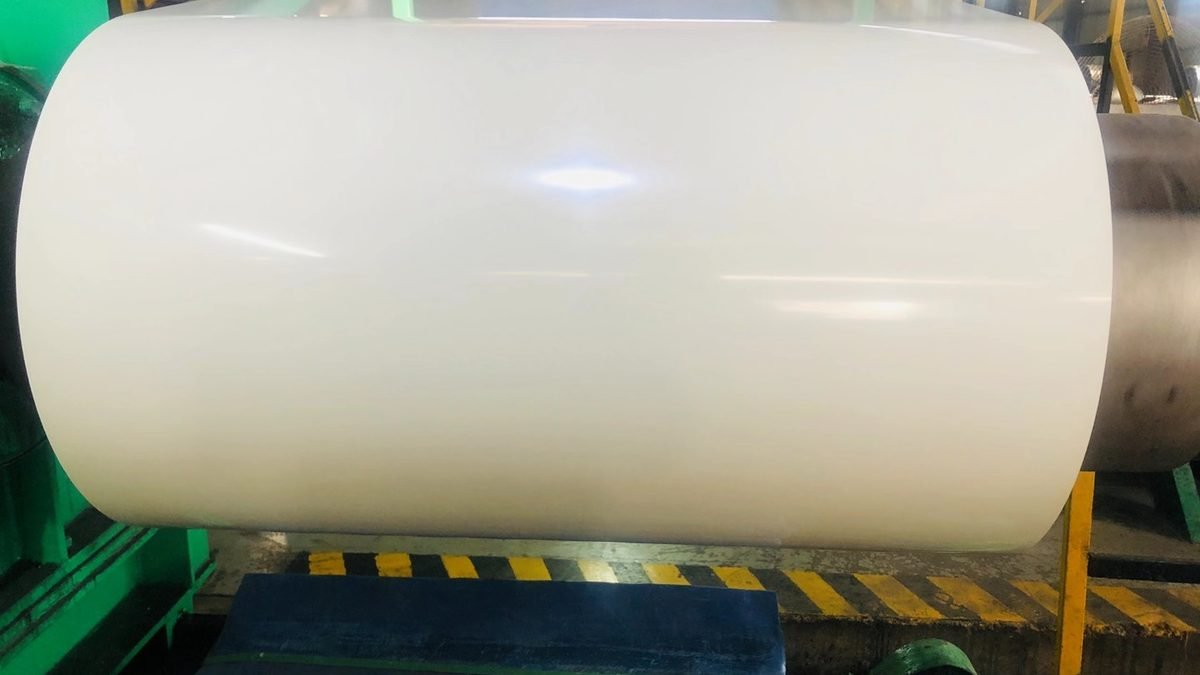
What Prepainted Steel Coil Is and Where It Is Used
The product is a coil of flat steel with a factory applied paint system. The substrate is either cold rolled steel, designated by a grade such as DC01, or hot dip galvanised steel, designated by a grade such as DX51D+Z. The zinc coating under the paint provides sacrificial protection at cut edges and at scratches, which is why galvanised substrate dominates outdoor applications.
The paint system normally consists of a pretreatment layer, a primer, a top coat and, on many products, a back coat. Each layer has a job. The pretreatment converts the steel surface into a thin conversion coating that anchors the primer. The primer provides adhesion and corrosion inhibition. The top coat provides colour, gloss and weather resistance. The back coat protects the reverse face and provides a defined appearance when the sheet is visible from both sides.
Applications divide into two broad groups. Exterior building products include roofing sheets, revestimiento de la pared, sandwich panel faces, canalones, flashings and garage doors. Interior and appliance products include refrigerator panels, washing machine housings, air conditioner cases, muebles de acero, lockers, ceiling panels and lighting reflectors. Each group has a different balance of gloss, hardness and flexibility.
Substrate Grades and Chemical Composition
The substrate grade determines the mechanical behaviour of the finished coil, because the paint adds almost no stiffness. The table below lists the grades that appear most often on purchase orders, with typical chemistry limits. Values vary slightly between EN 10346, ASTM A653 and JIS G3302, so the governing standard on the order should be checked.
| Elemento | DX51D+Z | DX52D+Z | S250GD+Z |
|---|---|---|---|
| Carbón, máximo | 0.12 | 0.12 | 0.20 |
| Manganeso, máximo | 0.60 | 0.60 | 1.60 |
| Silicio, máximo | 0.50 | 0.50 | 0.60 |
| Fósforo, máximo | 0.100 | 0.100 | 0.100 |
| Azufre, máximo | 0.045 | 0.045 | 0.045 |
| Recubrimiento de zinc | Z100 to Z275 | Z100 to Z275 | Z100 to Z275 |
The zinc coating designation is expressed as grams per square metre over both faces. Z100 means 100 g per square metre total, apenas 50 g per face, which corresponds to about 7 micrometres of zinc on each side. Z275 corresponds to about 19 micrometres per side and is the usual choice for external roofing in a coastal or industrial atmosphere. Doubling the zinc weight roughly doubles the time to red rust at a cut edge, which is why the coating designation belongs in the specification alongside the paint thickness.
Mechanical Properties of the Coated Coil
The paint system is cured at a peak metal temperature that is high enough to crosslink the resin but low enough to avoid over-ageing the steel. For a DX51D substrate the mechanical values are typical of a drawing quality galvanised sheet, while the higher strength grades trade ductility for load capacity.
| Propiedad | DX51D+Z | DX52D+Z | S250GD+Z |
|---|---|---|---|
| Fuerza de producción, típico | 140 a 210 MPa | 140 a 240 MPa | 250 a 320 MPa |
| Resistencia a la tracción, típico | 270 a 390 MPa | 270 a 420 MPa | 330 a 430 MPa |
| Alargamiento, mín. | 22 por ciento | 24 por ciento | 19 por ciento |
| Coating adhesion, T-bend | 3T or better | 2T or better | 3T or better |
| Pencil hardness, mín. | media pensión | media pensión | media pensión |
Yield strength matters for roll forming. A coil with a yield strength at the top of the range will spring back more after forming, and the profile rolls may need adjustment. A coil at the bottom of the range can buckle in the roll former if the strip is thin. Suppliers who run the same profile every day know the working range of their line, and they should buy coils that sit in the middle of it rather than at either extreme.
Elongation matters for bending and for locking seams. A roof panel that is folded at a hip or a valley sees severe local strain, and a coating with poor flexibility will crack at the fold even if the steel underneath survives. The T-bend test is the practical measure of that behaviour, and the result should be stated on the inspection record, not assumed from the grade name.
Coating Build, Thickness and Gloss
The coating system is specified as a dry film thickness for each layer and as a total. A typical polyester system on a galvanised substrate is a primer of 5 a 8 micrometres, a top coat of 15 a 25 micrometres, and a back coat of 5 a 10 micrometres. The total therefore sits between 25 y 40 micrometres. Thin systems of 15 a 20 micrometres exist for interior applications where weather resistance is not required.
| Layer or property | Valor típico | Test method |
|---|---|---|
| Primer thickness | 5 a 8 micrometres | Magnetic induction gauge |
| Top coat thickness | 15 a 25 micrometres | Magnetic induction gauge |
| Back coat thickness | 5 a 10 micrometres | Magnetic induction gauge |
| Total dry film | 25 a 40 micrometres | Sum of layers, or direct gauge reading |
| Gloss at 60 degrees | 30 a 80 gloss units | Gloss meter, three readings per sample |
| Colour difference | Delta E 1.5 or less against the approved sample | Spectrophotometer under D65 light |
| Solvent resistance | 100 double rubs without breakthrough | MEK rub test |
Gloss is a specification item that buyers often leave to the supplier. A 30 unit matt finish hides surface waviness and is common on wall cladding, mientras un 70 unit gloss gives a sharper architectural appearance and shows every ripple in the substrate. Two coils that are the same colour but different gloss will not look the same on one facade, and the difference is obvious in raking sunlight. Specify the gloss range, not just the colour code.
Colour control is a separate discipline. The approved sample should be kept under controlled conditions and replaced when it ages. Buyers should ask for the colour difference value on the inspection report and should compare panels under the same light source that will illuminate the finished building. Metallic and pearlescent colours vary with viewing angle by design, and a simple Delta E number does not fully describe them.
Coil Dimensions and Tolerances
Prepainted coil is supplied in a narrower range than bare steel coil because the coating line and the downstream roll former both impose limits. The table below shows the common commercial range and the tolerances that should be written into the order.
| Parámetro | rango típico | Common tolerance |
|---|---|---|
| Espesor | 0.20 a 1.20 milímetros | más o menos 0.03 mm hasta 0.40 milímetros, más o menos 0.05 mm above |
| Ancho | 600 a 1250 milímetros | 0 to plus 3 milímetros |
| Inner diameter | 508 o 610 milímetros | 0 to plus 5 milímetros |
| Diámetro exterior | arriba a 1900 milímetros | By coil weight |
| Peso de la bobina | 3 a 8 montones | más o menos 10 por ciento |
| Coil length | By weight and thickness | Continuous, with welds declared |
Thickness tolerance is more important than it looks. A coil at the low end of the tolerance forms a profile with a slightly different section modulus, and a roof sheet designed at 0.50 mm may behave differently at 0.47 milímetros. The difference is small for one sheet and significant across a large roof under wind uplift. Buyers who design to a minimum thickness should state it, and the mill will then guarantee the minimum rather than the nominal.
Coil weight drives crane capacity and the number of setups on the roll former. A 3 tonne coil is convenient for small jobbing shops, mientras un 7 o 8 tonne coil reduces changeover frequency on a long production run. The inner diameter must match the uncoiler mandrel, and the outer diameter must fit the coil car and the line clearance.
How the Coating Line Works
The line runs the strip from an uncoiler through an accumulator, a cleaning section, a pretreatment section, a primer coater, a curing oven, a top coat coater, a second curing oven, a back coater, a laminator for protective film if required, and finally a recoiler. The strip tension and the line speed are controlled together because the film thickness depends on the applicator roll speed relative to the strip speed.
The peak metal temperature in each oven is the variable that determines the final coating properties. Too low and the resin does not fully crosslink, which shows up as poor solvent resistance and weak adhesion. Too high and the coating embrittles, which shows up as cracking at a bend. A mill that records the peak metal temperature for each coil is a mill that can explain a coating failure later.
The pretreatment is the least visible and most important step. A poorly rinsed conversion coating leaves salts under the paint, and the coating then blisters in humid service even though every thickness measurement passed. Buyers who audit a supplier should look at the rinse water conductivity and the coating weight of the conversion layer, not only at the colour of the finished coil.
Tests That Predict Forming Behaviour
The T-bend test is the simplest and most useful. A coated sample is bent around itself and the number of thicknesses at which the coating still shows no cracking is recorded. A 1T result means the coating survives a bend equal to one sheet thickness, which is severe. A 3T result is typical for a standard exterior polyester on a galvanised substrate. Roofing profiles with sharp ribs need better adhesion than a flat wall panel.
The reverse impact test drops a weight on the back of a coated panel and checks whether the coating delaminates at the impact point. The cupping test does something similar with a slow deformation. Both tests are specified in EN 13523 and both should be reported for exterior products.
Salt spray testing runs a coated panel in a neutral salt fog for a defined number of hours and records creep from a scribed line. A 500 hour result with less than 2 mm creep from the scribe is a reasonable target for a standard exterior system; a 1000 hour requirement usually points to a higher performance resin or a thicker system. The test is slow, so it validates a system rather than a single coil.
Accelerated weathering, usually by QUV or xenon arc, predicts colour change and gloss loss. A polyester top coat typically retains gloss for several years in a temperate climate and loses it faster in strong ultraviolet and high humidity. Buyers in tropical or high altitude markets should ask for a resin that has been tested for that climate rather than assume that any exterior polyester will do.
Almacenamiento, Handling and Slitting
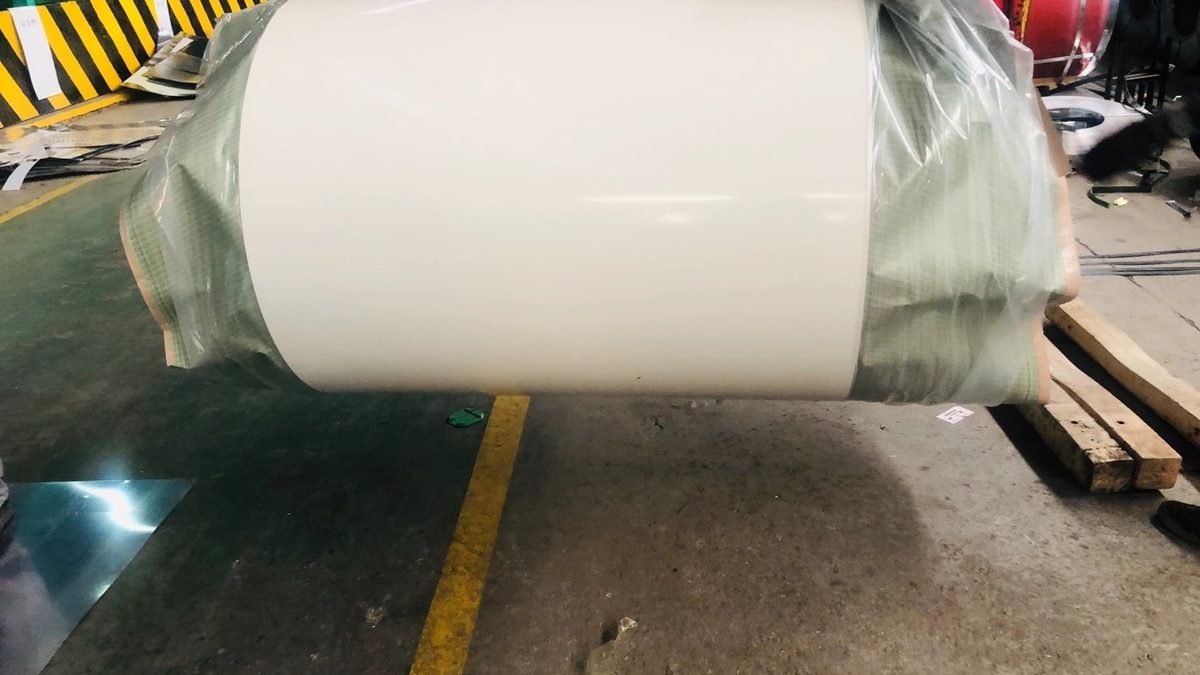
A coated coil is fragile in ways that a bare coil is not. The coating can be scratched by a fork tine, marked by a strap, or damaged by relative movement between wraps during transport. The coil should be lifted with a properly sized C-hook or a coil clamp, never with a chain sling that bears on the coated face.
Storage should be indoors, on a dry floor, with the coil axis horizontal and the eye protected. Moisture between wraps is the classic cause of white rust on the galvanised substrate and of blistering under the paint. A coil that arrives cold from a winter transport should be allowed to reach room temperature before it is unwrapped, because condensation forms on a cold surface in a warm room.
Stack height should be limited to two or three coils, and the stack should be arranged so that the upper coil does not sit directly on the coated face of the lower one. Timber or rubber separators help. Coils should not be stored where forklift traffic can strike them, and they should not be left in direct sun because the surface temperature cycling adds stress to the film.
Slitting introduces a cut edge with exposed steel and, on a galvanised substrate, exposed zinc. The edge is the first place to corrode. Slit coils should be used promptly, and the slit edge should be protected during storage. When the material is roll formed into a profile, the cut edge travels along the length of every sheet, so edge protection is a design decision as much as a storage one.
Selecting the Right System for a Project
The first question is the exposure. An interior ceiling panel sees no rain and little ultraviolet light, so a thin polyester system on a cold rolled substrate is adequate and economical. An exterior roof in a coastal industrial area sees salt, moisture and sun, and needs a galvanised substrate of at least Z200, a primer, and a top coat with proven weather resistance.
The second question is the forming severity. A profiled roof sheet with deep ribs and sharp bends needs a coating with good T-bend performance. A flat wall panel or a sandwich panel face needs less flexibility and can use a harder, more scratch resistant film.
The third question is the appearance requirement. A visible facade needs colour consistency across coils, a defined gloss, and a film that does not chalk. A hidden component such as a purlin or a duct liner can use a standard system with a wider colour tolerance.
The fourth question is the back side. A panel that is visible from below, such as a canopy soffit, needs a finished back coat in a specified colour. A panel that is always concealed can use a thin protective back coat. Specifying the back coat late is one of the most common causes of a colour mismatch on site.
Common Mistakes and Misunderstandings
Specifying a colour without a gloss and a film thickness is the first mistake. A colour code alone does not define a product, and two suppliers can both match the colour while delivering surfaces that look different and last differently.
The second mistake is assuming that a thicker coating is always better. Beyond the optimum, a thick film becomes brittle, cracks at bends and wastes money. The correct thickness is the one that passes the forming and weathering tests for the application.
The third mistake is ignoring the substrate. A premium paint on a Z100 substrate in a coastal environment will still fail at cut edges, because the paint cannot protect an edge that is constantly wet. The zinc weight and the edge treatment matter as much as the top coat.
The fourth mistake is storing coils outdoors under a tarpaulin. A tarpaulin traps moisture and creates a greenhouse, which is worse than a ventilated shed. Coated coil belongs indoors.
The fifth mistake is mixing coils from different production runs on one elevation without checking colour. Even within a specification, colour varies slightly between runs, and a facade assembled from two runs can show a visible band. Large projects should reserve a single production campaign or accept a controlled shade range.
Preguntas frecuentes
What does PPGI stand for? Prepainted galvanised iron. The substrate is hot dip galvanised steel and the surface carries a factory applied organic coating system.
What is the difference between PPGI and PPGL? The substrate differs. PPGI uses zinc coated steel, PPGL uses zinc-aluminium coated steel, generalmente 55 percent aluminium and 43 percent zinc. PPGL generally performs better in high temperature and some atmospheric conditions.
How thick is the paint on a standard coil? A typical exterior polyester system has a total dry film of 25 a 40 micrometres, made up of primer, top coat and back coat. Interior systems can be thinner.
Can prepainted coil be welded? Resistance welding through the coating is unreliable because the coating insulates the surfaces. The coating must be stripped at the weld zone, and the joint must be refinished afterwards.
Why does the coil have a back coat? The back coat protects the reverse face during transport and service and provides a defined appearance where the panel is visible from both sides. It also balances the stress in the film system.
How should cut edges be protected? Use a repair paint or a touch up stick matched to the top coat, and inspect edges after slitting and after site cutting. On coastal projects, consider a profile with an overlap that hides the edge.
How long can a coil be stored? Indoors and dry, six months is a reasonable planning figure for a standard system. Longer storage is possible but should be confirmed with the supplier, and the coil should be inspected before use.
Does gloss affect durability? Gloss itself does not determine durability, but the resin that produces a high gloss may chalk faster. The resin chemistry and the weathering test results matter more than the gloss number.
Can the same coil be used for roofing and wall cladding? Often yes, if the thickness and the coating system suit both profiles. The forming severity and the required wind uplift resistance should be checked separately for each application.
What documentation should come with a coil? A mill certificate for the substrate, a coating inspection report with film thickness and gloss, the colour reference, and the coil weight and dimensions. Batch traceability should link the coil to those documents.
Planning a roofing or cladding project? Send the colour, brillo, film thickness and coil size you need for a quotation.
Productos relacionados
Related pages on this site: galvanized steel strip DX51D, hot dip galvanized round steel tube Q235B, y Barra plana de acero al carbono Q235B.

