 FORTSCHRITT
Schneiden von Edelstahlspulen: Breitentoleranz, Kantenzustand und Coil-Handhabung
Schneiden von Edelstahlspulen: Breitentoleranz, Kantenzustand und Coil-Handhabung
Slitting is the process that converts a wide master coil into narrower coils of a specified width. For buyers of stainless steel strip, slitting is where most quality problems are either created or avoided: width tolerance, camber, edge burr, edge damage, coil concentricity and interleaving all depend on how the slitting line was set up and how the finished coil was handled afterwards.
This guide explains how a stainless slitting line actually works, what tolerances are realistic for 304 and 316L strip, how edge condition affects downstream stamping and tube welding, and what to specify in a purchase order so that the coil you receive can run on your machine without adjustment.
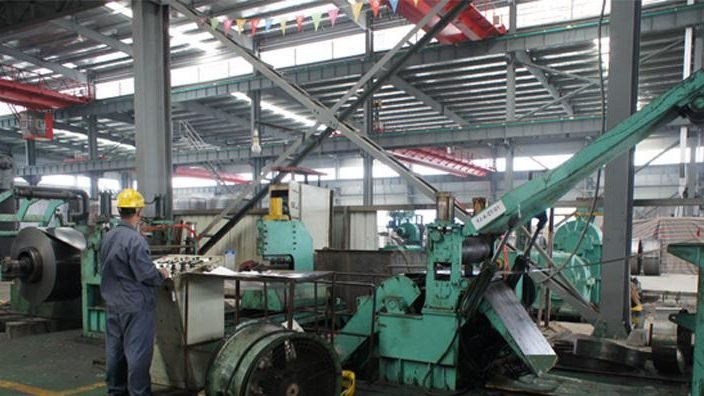
What a Slitting Line Actually Does
A slitting line has four functional zones. The uncoiler holds the master coil and pays it off under back tension. The slitter head carries a pair of rotary knives per cut line, arranged on arbors, and shears the strip as it passes. The recoiler rewinds the slit strands onto separate mandrels, and a tensioning system keeps every strand at the same elongation so the finished coils do not differ in length. Between these zones sit the guide, the stripper, and often an edge trimmer and a paper or film applicator.
The critical detail is knife clearance. Für 304 stainless at 0.5 mm, the horizontal clearance between the upper and lower knife is typically 3 Zu 6 percent of thickness, and the vertical overlap is small. Set clearance too wide, and the strip is torn rather than sheared, producing a heavy burr and a work-hardened edge. Set it too tight, and the knives wear quickly and the edge is over-compressed, which shows up later as edge cracking during bending. A competent slitter adjusts clearance per thickness and per grade, not once per shift.
Tension control is the second critical detail. If one strand runs at higher tension than its neighbour, it will be longer than the others at the end of the coil. When the customer feeds several strands into a roll-forming or tube-welding line, uneven strand length causes strip wander, uneven weld bead and scrap. Good slitters measure strand length and report the length difference, not just the nominal coil weight.
Breitentoleranz: What Is Realistic
Width tolerance on slit stainless strip is normally quoted to a standard such as EN 10140 or ASTM A480, but the practical number depends on width and thickness. The table below reflects what a well-set slitting line can hold for 304 and 316L in coil form.
| Streifenbreite | Normal tolerance | Tight tolerance | Practical note |
|---|---|---|---|
| Unter 50 mm | ±0.20 mm | ±0.10 mm | Burr control dominates |
| 50 – 150 mm | ±0.25 mm | ±0.15 mm | Most common range |
| 150 – 400 mm | ±0.30 mm | ±0.20 mm | Camber matters more than width |
| 400 – 650 mm | ±0.50 mm | ±0.30 mm | Check with your roll former |
Two warnings on tolerance. Erste, a tolerance below ±0.10 mm on narrow strip usually requires a second operation such as edge shaving, which adds cost and lead time. Zweite, width measured at the coil head is not the same as width at the coil tail. Ask for width at both ends and at mid-coil. A slitter with poor tension control can drift 0.3 mm across a 5-tonne coil and still claim the coil is in tolerance.
Edge Condition: The Hidden Cost Driver
Slit edges fall into three categories. A rolled edge is produced by the master coil itself and is smooth and work-hardened. A sheared edge from slitting is clean but carries a slight burr. A trimmed or shaved edge removes the burr and the work-hardened zone entirely, at extra cost.
Edge condition drives three downstream problems. In stamping, a burr on the strip edge acts as a stress raiser and initiates cracking when the blank is drawn. In tube welding, a burred edge does not close cleanly, so the weld seam is wider and the weld penetration is uneven; high-frequency tube mills also suffer from edge arcing when the burr contacts the welding shoe. In roll forming, edge cracking appears as a series of fine splits along the outside of a bend, especially on 316L and on heavily cold-worked tempers.
The practical specification for tube welding is a burr height under 0.05 mm and no edge cracking visible at 10× magnification. For deep drawing, specify shaved edge and a work-hardened zone under 0.3 mm. For simple blanking and bending, a standard sheared edge is enough, and asking for shaved edge only raises cost without benefit.
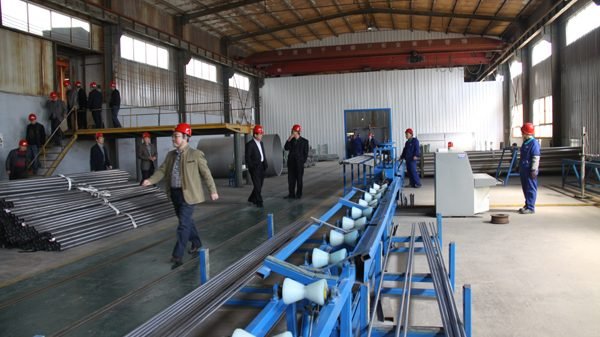
Sturz, Telescoping and Coil Geometry
Camber is the sideways curvature of the strip when it is laid out flat. It comes from uneven tension across the width, from a slitter that is not square to the line, or from residual stress in the master coil. Camber is normally expressed as millimetres of deviation over a one-metre length. For a 300 mm breiter Streifen, 1 mm per metre is a reasonable normal value; 0.5 mm per metre is tight. Camber matters most in long feed lines, because a 20-metre run of strip with 1 mm/m camber will wander 20 mm sideways.
Telescoping is the axial offset of the wound layers, where one layer protrudes beyond the next and forms a stepped face. It is caused by insufficient tension at the start of winding, by a crooked mandrel, or by strip with camber. A telescoped coil cannot be uncoiled at speed without snagging, and the protruding edges are easily damaged in handling. Specification language should include a maximum telescoping allowance, typischerweise 5 mm for a 500 mm wide coil.
Coil inner diameter and outer diameter also matter. Standard stainless coils come with 508 mm ID, mit 610 mm available on some lines. Outer diameter is limited by coil weight and by the capacity of your uncoiler. State the required ID and the maximum OD in the purchase order; a coil that is 100 mm too large in OD simply will not fit the mandrel.
Spulengewicht, Length and Interleaving
Coil weight is a commercial and logistical parameter, not a technical one, but it affects handling. Typical slit coils from Chinese mills run 3 Zu 8 tonnes for wide strip and 1 Zu 3 tonnes for narrow strip. Smaller coils are easier to handle but increase the number of setup changes at the customer’s line and increase packing cost per tonne.
Interleaving is the practice of inserting paper or film between wound layers. For 2B finish stainless, paper interleaving protects the surface from fretting and from scratches during transport. For BA or 8K mirror finish, interleaving is effectively mandatory: two mirror surfaces in direct contact under coil tension will cold-weld and leave permanent marks. Specify paper type and thickness, and specify whether the paper is applied on one side or both.
| Parameter | Typical value | What to specify |
|---|---|---|
| Spulen-ID | 508 mm | 508 oder 610 mm, match your mandrel |
| Spulengewicht | 1 – 8 T | Min and max per coil |
| Telescoping | ≤ 5 mm | Max axial offset |
| Sturz | 1 mm/m | 0.5 mm/m for long feed lines |
| Burr height | ≤ 0.05 mm | State the downstream process |
| Interleaving | Paper 40 – 80 g | Mandatory for BA and mirror |
Grade and Temper Effects on Slitting
304 slits cleanly at most thicknesses. 316L behaves similarly but is slightly gummier and generates a marginally higher burr for the same knife clearance. 430 ferritic stainless is more prone to edge cracking because of its lower ductility, Und 301 in a hard temper will crack along the slit edge if the clearance is wrong. Duplex grades such as 2205 are the most demanding: their high strength means the slitter must be set with tighter clearance and higher knife force, and the slit edge often needs trimming before welding.
Temper also changes the picture. Soft annealed (O Temperament) strip deforms plastically at the edge and produces a rounded, low-burr edge. Half-hard (1/2H) and full-hard (FH) tempers shear more cleanly but leave a work-hardened zone that resists later bending. If your process includes a tight bend after slitting, specify an annealed or quarter-hard temper rather than full hard, or specify edge shaving.
Verpackung, Storage and Transport Damage
Stainless coil damage in transit is almost always caused by three things: inadequate edge protection, Feuchtigkeit, and handling with the wrong equipment. A proper export pack has a wooden or plywood pallet, a V-board or saddle to stop the coil rolling, circumferential strapping at three points minimum, edge protectors on both faces, and VCI film or desiccant inside a sealed wrap for sea freight.
Never lift a coil with a hook through the bore without a spreader beam; the bore will ovalise and the coil will not fit the uncoiler. Never allow a coil to stand on its edge unprotected; the bottom edge takes the entire weight and dents. For long sea voyages, specify desiccant bags sized to the internal volume of the wrap, and specify that the wrap is sealed, not merely draped.
A Purchase Order Checklist
A slitting purchase order that avoids disputes contains the following: grade and standard, Temperament, thickness with tolerance, width with tolerance and where it is measured, burr limit, camber limit, coil ID, coil weight range, telescoping limit, interleaving requirement, surface protection, packing method, and the acceptance test method. Add the downstream process in one line — for example “for HF tube welding” oder “for deep drawing” — because that single line lets the supplier choose the right edge condition instead of guessing.
Inspection on arrival should cover width at three points along the coil, burr height, camber over one metre, coil ID, Gewicht, and a visual check of the outer two wraps for edge damage. If the material is destined for a certified pressure application, add PMI to confirm the grade and a hardness check to confirm the temper.
How Slitting Fits the Wider Supply Chain
Slitting sits between the mill and the fabricator, and that position determines what it can and cannot fix. It can fix width, coil weight and edge condition. It cannot fix a thickness crown in the master coil, a surface defect inherited from rolling, or a grade that was mis-declared at the mill. When a fabricator receives strip that behaves badly, the first question should be whether the defect originated in rolling or in slitting; the answer decides who pays.
Thickness variation across the width, known as crown, is a rolling issue. A master coil with 0.03 mm crown will produce slit strands of different thickness, and no amount of careful slitting will equalise them. Similarly, a master coil with an off-centre weld will produce a point where the strip thickness jumps; that point survives slitting and will break a stamping die. Buyers who need consistent thickness should ask for a thickness profile across the width, not only a nominal thickness and a tolerance.
Surface defects also pass straight through slitting. Roll marks, Kratzer, pits and scale residue from the mill remain on the strip after slitting, and in some cases slitting makes them worse because the recoiler presses the layers together. For 2B and BA finishes, specify that the master coil is paper-interleaved before slitting as well as after, otherwise the slit strands inherit fretting marks that appeared during master coil winding.
On the commercial side, slitting changes the economics in a way buyers should understand. The kerf loss from each cut is small — typically 0.1 Zu 0.3 mm per cut — but on narrow strip with many cuts the cumulative loss becomes significant, and the slitter charges by the cut line as well as by the tonne. A buyer who needs twenty 25 mm strands from a 600 mm master coil pays for twenty cuts and loses more material than a buyer who needs ten 55 mm strands. Where the design allows, wider strands are cheaper per kilogram.
Endlich, slitting capacity constrains lead time. A line that can run 600 metres per minute still needs time to thread, to change knife sets, and to pack. Narrow multi-strand orders with tight burr limits take disproportionately longer because each strand must be checked. Build that into the schedule rather than treating slitting as an instantaneous step.
Häufig gestellte Fragen
Can I get slit coils narrower than 10 mm? Ja, down to roughly 5 mm on a well-equipped line, but burr control and camber become difficult, and the cost per tonne rises sharply because of the number of cuts and the low coil weight.
Is slitting the same as shearing? The mechanism is similar — both are shear operations — but slitting runs continuously on a coil line, while shearing produces discrete sheets. Slitting therefore needs tension and recoiling control that shearing does not.
Why does my strip crack when I bend it after slitting? Almost always because the slit edge has a work-hardened zone and a burr. Specify shaved edge, or specify a softer temper, or move the bend line away from the strip edge.
Do I need to pay for edge shaving? Only if the downstream process is sensitive. For tube welding and deep drawing, it usually pays for itself in reduced scrap. For simple blanking, it does not.
What is the difference between a slit coil and a cut-to-length sheet? A slit coil remains a continuous strip wound on a mandrel; cut-to-length material is decoiled, levelled and cut into flat sheets. Coil suits continuous processes, sheet suits discrete parts.
View 304 2B stainless coil specifications oder Request a slitting quote

