 FORTSCHRITT
Edelstahlspule 430 vs 304: Cost and Corrosion Trade-off
Edelstahlspule 430 vs 304: Cost and Corrosion Trade-off
Stainless steel coil is bought by the tonne and consumed by the metre, and the two grades that turn up most often in general fabrication are 304 Und 430. The price difference between them is large enough that a purchasing manager will ask the question on every order, and the answer depends on where the finished part will spend its life.
This guide compares the two grades on chemistry, mechanische Eigenschaften, corrosion performance, coil dimensions and tolerances, processing behaviour, and the specific applications where the cheaper grade is a legitimate choice and where it is a false economy. It deals with cold-rolled coil in 2B finish, the default supply condition for both grades.
1. What the Two Grades Are
304 (UNS S30400, IN 1.4301) is the standard austenitic grade: 18 % Chrom, 8 % Nickel, kohlenstoffarm. It is non-magnetic in the annealed condition, formable, schweißbar, and tolerant of a wide range of indoor and outdoor environments. It is the grade most people mean when they say “Edelstahl”.
430 (UNS S43000, IN 1.4016) is a ferritic grade: 16–18 % Chrom, no nickel, kohlenstoffarm. It is magnetic, has lower formability and lower weldability than 304, and costs significantly less because nickel is the single most expensive element in the alloy.
The nickel is not decoration. It stabilizes the austenite phase, which gives 304 its toughness, its weldability and its ability to be deep drawn. Removing it produces a ferritic structure that is stronger in yield but less ductile, and that cannot be welded without a loss of toughness in the heat-affected zone.
2. Chemistry
| Element | 304 (S30400) | 430 (S43000) |
|---|---|---|
| Chrom | 18.0–20.0 % | 16.0–18.0 % |
| Nickel | 8.0–10.5 % | Keiner (0.5 % max) |
| Kohlenstoff | 0.08 % max | 0.12 % max |
| Mangan | 2.0 % max | 1.0 % max |
| Silizium | 0.75 % max | 1.0 % max |
| Phosphor | 0.045 % max | 0.040 % max |
| Sulphur | 0.030 % max | 0.030 % max |
| Struktur | Austenitisch, non-magnetic | Ferritic, magnetic |
Both grades are covered by ASTM A240 for flat products and EN 10088-2 for cold-rolled sheet and strip. 304L (S30403) mit 0.030 % carbon is the low-carbon variant used where welding produces thick sections; 430 has no low-carbon counterpart in general supply, because the ferritic grade does not suffer the same sensitization problem in the same way — its limitation is grain growth and toughness, not chromium carbide precipitation at the grain boundaries.
3. Mechanische Eigenschaften
| Eigentum | 304, geglüht | 430, geglüht |
|---|---|---|
| Zugfestigkeit | 515 MPa min | 450 MPa min |
| 0.2 % yield | 205 MPa min | 205 MPa min |
| Dehnung in 50 mm | 40 % Mindest | 22 % Mindest |
| Härte, HRB | 92 max | 85 max |
| Young’s modulus | 193 GPa | 200 GPa |
| Deep drawability | Gut | Limited |
| Schweißbarkeit | Gut; use 304L for thick sections | Arm; grain growth, cracking risk |
The yield strengths are nominally equal, which misleads a great many drawings. What differs is ductility: 430 has roughly half the elongation of 304, so it fractures earlier in a forming operation and has far less capacity to absorb an impact or a bend. A part designed on yield strength alone will pass the calculation and fail at the press brake.
430 also has a distinct property that matters in forming: it is prone to “orange peel” and to ridging, a surface roughening along the rolling direction that appears after stretching. It is not a defect in the coil; it is a consequence of the ferritic grain structure, and it limits 430 to shallow draws.
4. Corrosion Performance
Both grades rely on the same passive chromium oxide film. The film forms spontaneously in air and repairs itself when scratched, provided there is enough oxygen and enough chromium at the surface.
Atmosphere. 304 performs well in rural, urban and most industrial atmospheres, and resists discolouration better than 430. 430 is adequate indoors and in dry outdoor service, but in polluted or coastal air it stains and, over years, can pit.
Fresh water. 304 is the standard for potable water and for most food contact. 430 is acceptable for low-chloride, low-temperature water, but it is not the grade to specify for a drinking-water tank or a commercial kitchen splash zone.
Chlorides. This is where the grades separate decisively. 430 has lower chromium and no nickel, and its pitting resistance is markedly lower. In a coastal installation, a swimming pool hall, or anywhere chlorides accumulate and concentrate, 430 will show rust spots within months while 304 survives years. Neither grade is suitable for continuous chloride service; 316L is the minimum there.
Intergranular corrosion. 304 with carbon above 0.03 % and welded in sections above about 6 mm can sensitize in the heat-affected zone and corrode along the grain boundaries in an aggressive medium. Specify 304L for welded assemblies. 430 does not sensitize in the same way, but its weld zone is brittle and coarse-grained.
Galvanic behaviour. Both are cathodic to carbon steel and to zinc. A stainless coil bracket bolted to a galvanized frame will corrode the frame, not itself. Insulate the joint.
5. Coil Dimensions and Tolerances
| Artikel | Standardsortiment | Toleranz |
|---|---|---|
| Dicke | 0.3–3.0 mm | ±0.03 mm below 1 mm; ±0.05 mm above |
| Breite | 1000 / 1219 / 1500 mm | 0 / +5 mm |
| Coil inner diameter | 508 / 610 mm | Referenz |
| Spulengewicht | 3–8 t typical | ±10 % |
| Beenden | 2B cold rolled, geglüht und gebeizt | Ra 0.1–0.5 µm typical |
| Ebenheit | Mill standard | 1–3 mm/m depending on thickness |
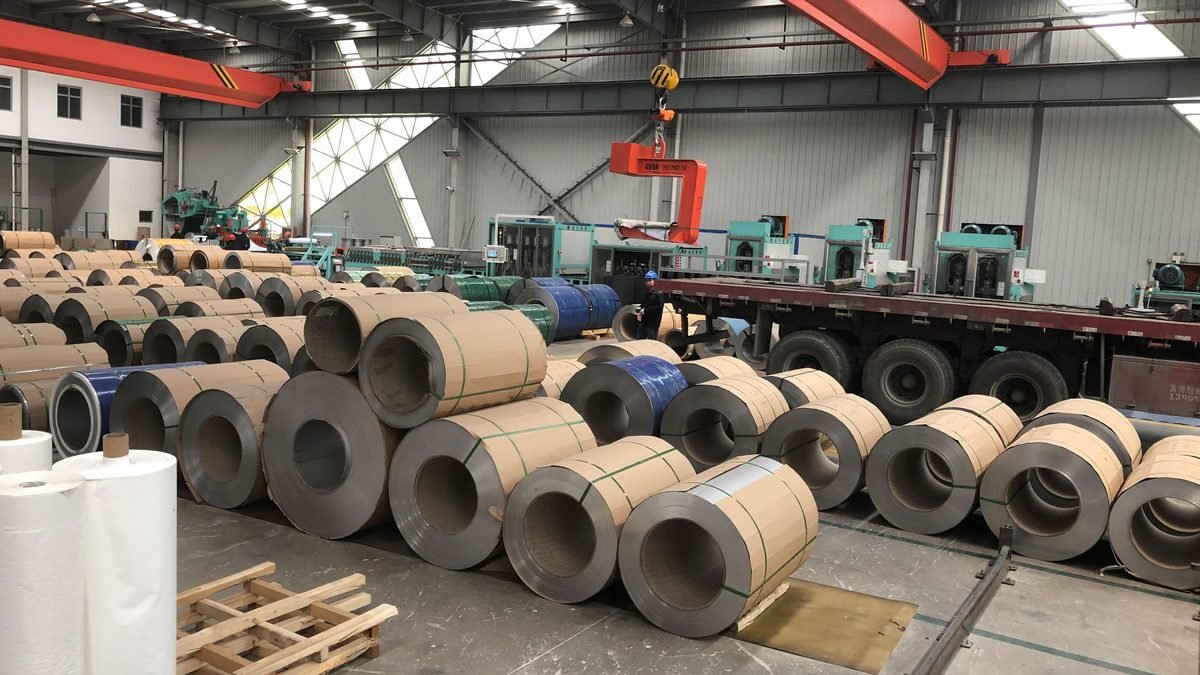
Coil weight matters more than buyers expect. A 3 t coil is convenient for a service centre with a decoiler; A 0.5 t coil suits a small fabricator without lifting equipment. Mills will supply split coils on request, at a small premium. The inner diameter must match the decoiler mandrel, and the coil should arrive with a paper interleave or a felt wrap to prevent the wraps rubbing during transport.
Thickness tolerance is the hidden cost driver. A coil at the minus end of the tolerance range saves the mill metal and costs the fabricator output, because the same part needs a slightly longer strip and the stamping press sees a different tonnage. For critical stamping work, specify a restricted tolerance range, not just a nominal thickness.
6. Processing Behaviour
Schlitzen. Both grades slit well. 430 work-hardens less than 304 and produces a cleaner edge, but it is more prone to burr on the slitter if the clearance is wrong. The burr height limit is usually 10 % of thickness for downstream stamping.
Leveling and cut-to-length. 430 has a higher yield and lower elongation, so it needs more leveling force and is more likely to retain a coil set. A cut-to-length line set up for 304 will produce 430 sheets with more bow.
Stamping and drawing. 304 is the grade for deep drawing: sinkt, Kochgeschirr, holloware, Automobilverkleidung. 430 is suitable for shallow forming, Klammern, panels and trim, but it will crack in a deep draw and show ridging on the visible surface.
Schweißen. 304 welds with TIG, MIG or resistance methods using 308L filler; the weld is ductile and can be annealed or pickled. 430 is difficult: the weld zone coarsens, toughness falls, and cracking is common in restrained joints. Wo 430 must be welded, use a low heat input, a matching ferritic filler, and do not expect the joint to be as formable as the base metal.
Polishing and finishing. 430 polishes to a brighter, harder surface than 304 and holds a mirror finish well, which is why it is used in decorative trim and appliance fronts. 304 is softer and more prone to scratching in service, but it does not rust in the same conditions.
7. Cost Structure
The price gap between 430 Und 304 is driven almost entirely by nickel. At the time of writing, nickel trades at several times the price of chromium per tonne, Und 304 contains 8 % of it. The result is that 304 typically costs 25–40 % more than 430 for the same thickness and finish, and the ratio moves with the nickel market rather than with the mill’s costs.
The saving from 430 is real and should be taken where the application allows. Where it is not real is when the part has to be replaced early: a rusted 430 façade panel, A 430 sink that pits in a commercial kitchen, or a 430 bracket that cracks in a welded assembly all cost more than the material saving. The decision needs the service environment, not just the bill of materials.
There is also a processing cost difference. 430 is harder and less formable, so tooling wears faster and press tonnage rises. 430’s welding difficulty adds labour. On a formed part with several welds, the cheaper coil can end up the more expensive component.
8. Selection Rules
- Indoor appliance fronts, Zierbesatz, elevator panels, kitchen cabinet doors: 430. Dry, low-chloride, appearance-driven, and the magnetic property is irrelevant.
- Commercial kitchen surfaces, sinkt, worktops, Lebensmittelausrüstung: 304. Wet, cleaned with chloride-bearing sanitisers, and often welded.
- Drinking water tanks, dairy and brewing equipment: 304 oder 316L. Never 430.
- Coastal or industrial atmosphere, swimming pool halls, Marine: 316L. Neither 430 nor 304 is adequate.
- Deep drawn parts: 304. 430 will crack or ridge.
- Welded assemblies: 304/304L. 430 welding is a specialist operation with limited ductility.
- Roofing and cladding in rural air: 430 is used and performs; in coastal air use 304 or a coated product.
- Parts requiring non-magnetic behaviour: 304 in the annealed condition. 430 is always magnetic, Und 304 becomes slightly magnetic after cold working.
9. Verifying Grade and Quality on Receipt
Because the two grades are visually identical, receipt inspection needs at least one test that is not visual. The practical sequence for a coil arriving at the factory gate is as follows.
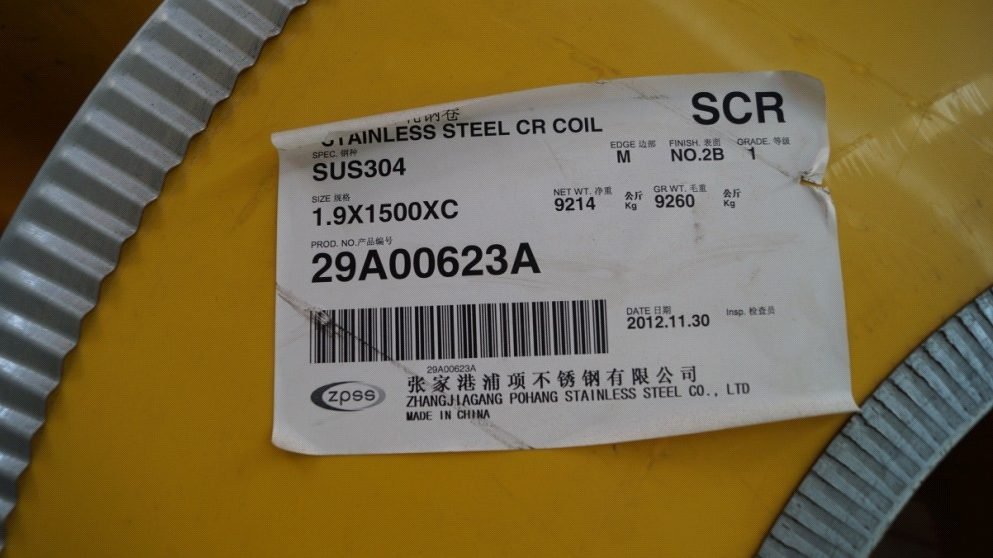
Check the label against the order. Grad, Hitzezahl, Dicke, Breite, Gewicht, finish and standard. Photograph the label before the wrap is cut; after slitting, the label is lost.
Run a positive material identification test. A handheld XRF analyser distinguishes 304 from 430 in seconds by reading nickel and chromium. A chemical spot test (a nickel-detection kit) is slower but reliable and cheap. Neither is a substitute for the mill certificate, but both catch a swapped coil before it reaches the press.
Measure thickness at five points across the width. Coil thickness varies across the width as well as along the length, and a crown or a wedge shows up here. Compare with the certificate and with the tolerance you specified.
Inspect the edge. Slit edges should be straight, with a burr below the agreed limit and no edge cracking. A wavy or torn edge indicates a worn slitter and will jam a stamping die.
Check the surface. 2B finish should be uniform and dull; Kratzer, Rollspuren, stains and “watermark” patterns from poor annealing are rejectable if the part is visible. On a hidden part, a light scratch is not worth rejecting a coil over.
Check the coil set. Lay a metre of strip on a flat table and measure the lift at the ends. Excessive coil set means the leveler will struggle and the parts will bow.
For a first order from a new mill, ask for a sample length before the full coil ships. A 2 m sample costs almost nothing and answers the questions that a certificate cannot.
10. Häufige Fehler
Specifying “stainless coil” without a grade. The supplier ships 430 at the 304 Preis, oder 304 at a premium the buyer did not budget for. Put the UNS or EN number on the purchase order.
Using a magnet to identify the grade. 430 is magnetic and 304 is not in the annealed state — but 304 becomes magnetic after drawing or rolling, and a magnet test on a formed part proves nothing.
Assuming 304 cannot rust. It rusts in chloride service, at weld sensitized zones, and where surface contamination from carbon steel has been embedded by a grinding disc.
Schweißen 430 mit 304 Füllstoff. The dissimilar microstructure cracks at the fusion line. Use a matching ferritic filler and a qualified procedure, or redesign the joint.
Buying the cheapest thickness tolerance. The saving per tonne is small; the scrap and rework in stamping is not.
Storing coils without grade marking. Coil wraps look alike. Mark the grade and heat number on the outside of the wrap and on the coil itself.
11. Häufig gestellte Fragen
Is 430 food safe? For dry contact and short-term handling, Ja. For wet food preparation surfaces, verwenden 304. The limitation is corrosion, not toxicity.
Can 430 be used outdoors? In rural and dry conditions, Ja. In coastal or heavily polluted air, it stains and pits. Consider 304 or a painted system.
Which grade is stronger? They have the same nominal yield. 304 has higher tensile and much higher elongation, so it absorbs energy better; 430 is harder and more wear-resistant.
Does 430 take a magnet? Ja, always. 304 is non-magnetic when annealed and becomes weakly magnetic after cold work.
Can 430 be deep drawn? Only shallow draws. Deep drawing causes cracking and ridging.
Is 304 worth the extra cost? In wet, welded, chloride or food-contact service, Ja. In dry indoor decorative work, 430 is the rational choice.
What finish should I order? 2B is the standard cold-rolled, annealed and pickled finish. For a brushed appearance specify No. 4; for a mirror finish, BA or 8K. Finish is a separate line item from grade.
12. Sourcing Stainless Steel Coil
QIDAMT liefert 304, 304L, 316L and 430 cold-rolled coil in 2B finish, 0.3–3.0 mm, Breiten 1000, 1219 Und 1500 mm, coil weights 3–8 T, with mill certificates stating grade, Hitzezahl, chemistry and mechanical properties. Coils are edge-protected, wrapped and marked, and can be split to the weight your decoiler can handle.
Send the grade, Dicke, Breite, coil weight and finish. We will confirm availability, tolerance range and lead time before booking.
Brauchen 430 oder 304 stainless coil?
Send the grade, Dicke, width and coil weight for a quotation with mill certificate.
Related specifications: 304 2B stainless steel coil, 304 2B cold rolled sheet, Und 316L Edelstahlplatte.

