 FREMSKRIDT
Aluminium Ingot Al99.70: Grad, Ingot Weight and Remelting Practice
Aluminium Ingot Al99.70: Grad, Ingot Weight and Remelting Practice
A remelt aluminium ingot is the first solid, saleable form that aluminium takes after smelting. It is not a finished product and it is not a semi-finished one either. It is a charge material: a shaped, weighed, marked block of metal that a foundry, a rolling mill or a die caster melts again to make something else. Because every downstream property, from the surface of an extruded profile to the elongation of a foil, begins with the chemistry locked into these blocks, the ingot is the point where quality is easiest to secure and hardest to recover later. This guide explains what the Al99.70 designation actually guarantees, how ingot weight and bundle data are set, how the metal is cast and marked, and what a buyer should check before accepting a truckload.
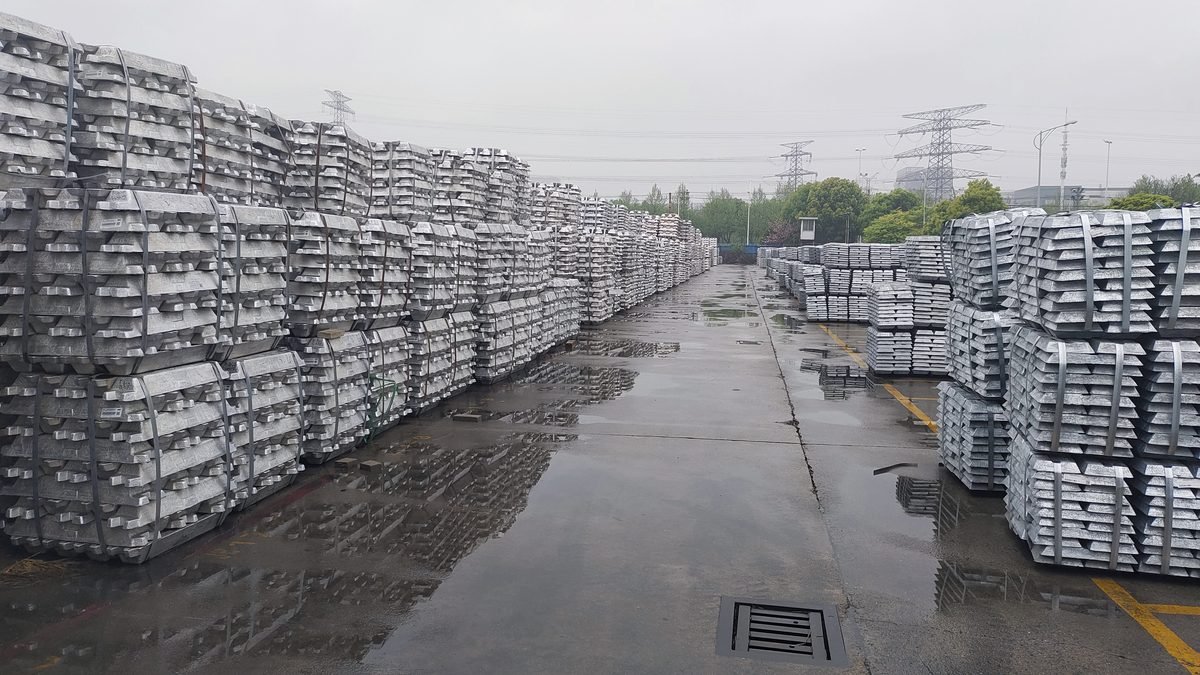
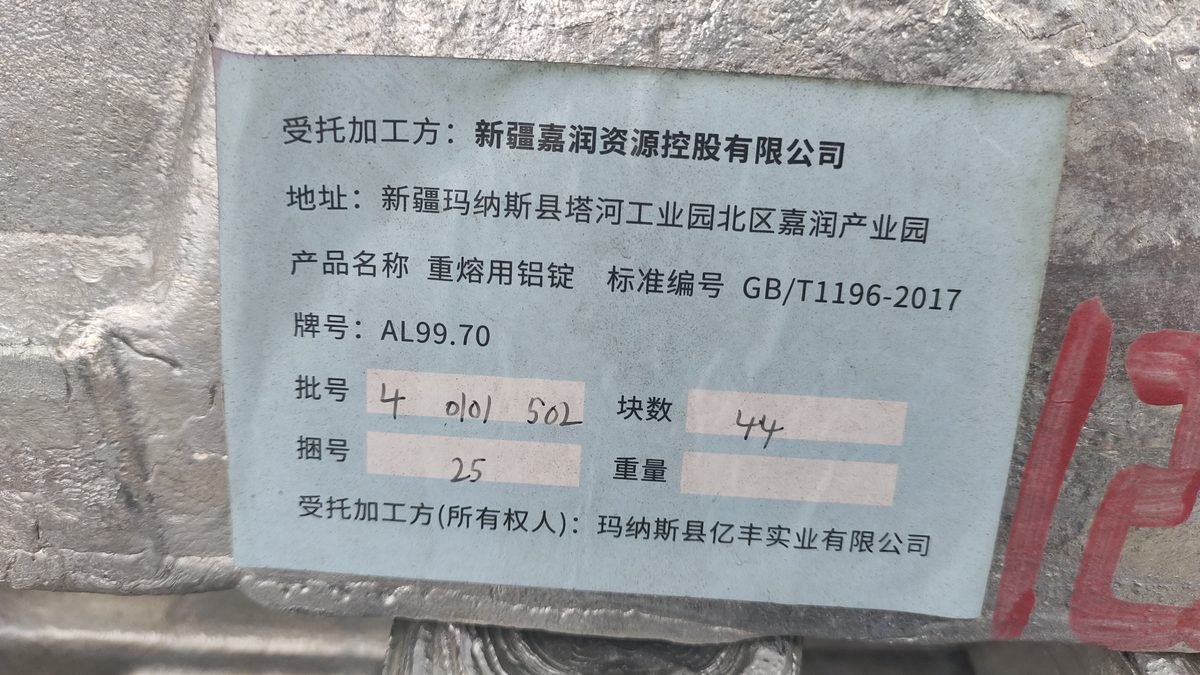
The photographs used in this article were taken in a Chinese aluminium warehouse and show unalloyed remelt ingots stacked in the open yard, together with the mill label of a single bundle. The label carries the grade, the standard, the batch number, the piece count and the unit weight, and it is the document that ties a physical bundle to a certificate of analysis. Reading that label correctly is the difference between buying metal and buying scrap with a story attached.
1. What a Remelt Ingot Is and Where It Goes
A remelt ingot, sometimes called a primary ingot or a smelter ingot, is cast from molten aluminium of controlled purity and sold by weight. Its shape is chosen for handling rather than for engineering: a tapered block with a flat top and a slightly narrower base so that ingots can be stacked, strapped and lifted without slipping. Unlike a billet, which is round and is rolled or extruded directly, or a slab, which is rectangular and is rolled directly into plate, an ingot is intended to be melted. That single purpose explains most of its design rules. Surface smoothness matters only so far as it limits oxide and moisture pickup. Internal soundness matters because trapped gas and shrinkage cavities turn into dross and hydrogen when the block goes into a furnace.
The destinations of Al99.70 are broad and unglamorous, which is exactly why the grade is produced in such volume. Foundries melt it to make gravity castings, sand castings and low-pressure castings for pumps, ventiler, brackets and machine housings. Die casters blend it with silicon and copper to reach the ADC12 and A380 families. Rolling mills charge it into reheat furnaces before hot rolling into sheet, plate and foil stock. Wire rod plants melt it into properzi lines to draw electrical conductor and welding wire. Extruders combine it with magnesium and silicon to reach 6063 og 6061 billets. Secondary smelters use it to dilute scrap so that a recycled heat can still meet a specification. In each case the ingot is an input, and the arithmetic of that input is done in kilograms and in percent.
Because the ingot is a charge material, the commercial unit is the bundle and the technical unit is the heat. A foundry that melts four bundles in one furnace expects the four bundles to behave as one consistent melt. That expectation is the real specification behind every ingot standard, and it is why batch marking, bundle weight control and chemistry control are written into the product standard rather than left to the negotiation table.
2. Grade Designation and Chemical Composition
The Al99.70 designation follows the Chinese national standard for remelt aluminium ingots, GB/T 1196, in its current edition. The number after “Al” is the minimum aluminium content expressed as a percentage, and the remaining allowance is distributed among impurity elements with individual and total limits. A higher number means a cleaner metal and a higher price, and the step from Al99.70 to Al99.85 is far more expensive than the four-digit difference suggests, because removing the last fractions of iron and silicon requires better alumina, cleaner anode operations and tighter casting practice.
Table 1 lists the common unalloyed grades with typical maximum impurity levels. Values are typical of commercial production under GB/T 1196 and should always be confirmed against the certificate of analysis supplied with the specific heat, because individual smelters work to narrower internal limits than the standard requires.
| Grad | Al min (%) | Fe max (%) | Si max (%) | Cu max (%) | Zn max (%) | Typisk brug |
|---|---|---|---|---|---|---|
| Al99.90 | 99.90 | 0.06 | 0.03 | 0.005 | 0.01 | Foil stock, electronic-grade conductor |
| Al99.85 | 99.85 | 0.10 | 0.05 | 0.008 | 0.02 | Fine foil, capacitor stock, anodising base |
| Al99.70 | 99.70 | 0.20 | 0.10 | 0.01 | 0.03 | General castings, sheet and plate stock, conductor rod |
| Al99.60 | 99.60 | 0.25 | 0.16 | 0.01 | 0.03 | Bygningsprofiler, general extrusion billet |
| Al99.50 | 99.50 | 0.30 | 0.22 | 0.02 | 0.03 | Deoxidation, steelmaking, general remelt |
Iron and silicon are not interchangeable impurities. Iron raises strength and lowers ductility, and in sheet it produces the stringy intermetallic phases that show up as dark streaks after anodising. Silicon improves fluidity in casting but coarsens the eutectic and reduces elongation after heat treatment. For a foundry making a ductile pressure casting, an ingot at the top of the iron allowance is a production risk even though it is fully inside the standard. This is the practical reason why experienced buyers ask for the certificate of analysis and not only the grade name.
3. Physical, Thermal and Electrical Properties
The properties below are for unalloyed aluminium at the 99.70 percent level. They are the numbers a foundry uses when it sizes a furnace, a rolling mill uses when it sets a reheat curve, and a conductor plant uses when it calculates current carrying capacity. Alloying changes them, and the change is usually larger than buyers expect: adding two percent copper roughly halves electrical conductivity while nearly doubling tensile strength in the heat-treated condition.
| Ejendom | Værdi (Al99.70) | Practical meaning |
|---|---|---|
| Density at 20 °C | 2.70 til 2.71 g/cm³ | A cubic metre of ingot weighs about 2.7 t; transport and yard loads are calculated from this |
| Smeltepunkt | 660.3 °C | Melt practice sits 40 til 80 °C above this to allow for heat losses |
| Latent heat of fusion | om 397 kJ/kg | Explains why melting consumes far more energy than simply heating the metal |
| Termisk ledningsevne | om 235 W/m·K | Fast heat removal in moulds and dies; also why thin sections cool before thick ones |
| Elektrisk ledningsevne | om 59 til 61 % IACS | Conductor rod made from this grade easily meets the 61 percent IACS wire requirement after proper drawing |
| Coefficient of expansion | om 23.5 × 10⁻⁶ /K | Relevant when ingots are stacked against rigid stops or clamped in fixtures |
| Trækstyrke, cast and annealed | om 70 til 90 MPa | Low by design; this is a charge material, not a structural metal |
| Brinell hardness, udglødet | om 20 til 25 HB | Soft enough to be cut, chipped and bundled without tool damage |
Two of these numbers drive everyday operating decisions. The latent heat explains why a furnace melting scrap and ingot together cannot be modelled as a simple temperature ramp; melting is a plateau, and the plateau is where most of the fuel goes. The conductivity explains why ingot stacks left in the open air reach ambient temperature quickly and why a cold bundle dropped into a molten bath can cause a violent local freeze rather than a gentle sink.
4. Ingot Weight, Bundle Data and Dimensional Tolerances
Weight control is the quiet core of ingot commerce. Every downstream calculation, from furnace charge to freight cost, assumes a known mass per piece and per bundle. The standard commercial ingot weighs 20 kg with a permitted variation, and a bundle is built from a fixed count so that the total can be verified by counting pieces rather than by weighing every load. The label in the photograph below records exactly this structure: grade Al99.70, standard GB/T 1196, bundle number, piece count 44, unit weight 20 kg, and a batch trace.
| Punkt | Typical value | Tolerance or note |
|---|---|---|
| Single ingot weight | 20 kg | Individual pieces commonly held within plus or minus 1 kg, bundle total reconciled by piece count |
| Pieces per bundle | 43 til 45 | Count is marked on the label; a short bundle is a commercial defect even if chemistry is correct |
| Bundle net weight | om 860 til 900 kg | Strapped with steel or PET bands; gross weight includes pallet and straps |
| Ingot length | om 800 til 830 mm | Sized to fit standard furnace charging buckets and forklift forks |
| Ingot width at top | om 180 til 195 mm | Tapered sides so stacked blocks self-align |
| Ingot height | om 90 til 100 mm | Chosen so a bundle stacks four to five high in a container |
| Stack configuration | 3 til 5 layers per stack | Criss-cross stacking keeps bundles stable and lets rain drain |
| Surface condition | Bright to light grey | White oxide film is acceptable; heavy black oxide or corrosion pits indicate long open storage |
| Mærkning | Ink stamp plus bundle label | Grad, standard, batch, bundle number, piece count, unit weight, producer |
Bundle weight is a commercial control point, not only a logistics one. Foundries book metal by the tonne and melt by the bucket. If a supplier ships bundles that are 830 kg instead of 880 kg but invoices by the piece, the price per tonne silently rises by six percent. Weighing one bundle from each lot on a certified scale, and comparing the result with the label, takes two minutes and settles the question for the whole shipment.
5. How the Ingot Is Cast
Most unalloyed remelt ingots in Asia are produced on a continuous chain conveyor casting machine. A row of water-cooled copper or graphite moulds travels on a chain; a launder distributes molten metal into each mould in turn; the filled moulds cool as they move; at the end of the run the solidified ingots are tipped out, quenched, inspected, stamped and stacked. The process is fast, the tooling is cheap, and the geometry is fixed by the mould, which is why ingot dimensions vary so little between producers.
Casting temperature sits typically between 700 og 730 °C. Too cold and the metal freezes in the launder, giving short pours and cold shuts. Too hot and the ingot surface shrinks away from the mould unevenly, leaving a wrinkled skin and a deeper shrinkage cavity at the top. The top face is deliberately the last to freeze, so the shrinkage pipe forms there and can be trimmed or accepted as a known feature of the form.
Degassing is the step that separates a clean ingot from a troublesome one. Hydrogen dissolves readily in liquid aluminium and precipitates as porosity on freezing. Rotary degassing with argon or nitrogen, combined with a covering flux, brings hydrogen down to a level where the cast block is sound. A foundry that remelts a gassy ingot pays for it twice: once in metal lost to dross and once in rejected castings.
Grain refinement and filtration belong to the remelting stage rather than the ingot stage, but the ingot determines how easy they are to apply. A charge with low iron and low oxide loads responds well to a titanium-boron refiner and a ceramic foam filter. A charge with oily scrap, sand and salt flux residues does not, and no amount of downstream treatment will fully repair it. This is why the ingot surface condition clause in the standard is worth enforcing in practice and not only in the purchase order.
6. Remelting Practice: From Bundle to Sound Melt
A remelt shop that runs well treats the ingot as an engineered charge and not as a pile of metal. The sequence below is the standard practice in foundries and rolling mills that melt unalloyed ingot as their base charge.
Charge calculation. Start from the target composition and work backwards. If the final alloy needs 0.45 percent magnesium and the returns already carry 0.40 percent, the fresh ingot and the alloy additions must be balanced so the result lands inside the analysis window on the first try. Melting is not a correction process; every correction costs energy, metal and time.
Charging order. Put heavy ingot at the bottom of the furnace where the burners act, then returns and thin scrap on top where they will be shielded from direct flame. Charging thin material first exposes it to the oxidising flame and converts it into dross before the ingot has even started to melt.
Melt-down control. Hold the bath below 750 °C unless a specific alloy requires more. Every 10 °C above that adds measurably to oxidation loss and to hydrogen pickup from furnace atmosphere and from any moisture on the charge.
Fluxing and degassing. A covering flux protects the surface; a degassing flux or a rotary gas treatment removes hydrogen. Skim dross promptly. Dross left on the bath reabsorbs aluminium and turns a recoverable by-product into a loss.
Grain refinement and modification. For most wrought alloys, add a titanium-boron refiner rod at the launder. For hypoeutectic casting alloys, add a sodium or strontium modifier to refine the silicon eutectic.
Filtration and casting. EN 30 til 50 ppi ceramic foam filter removes oxide films and inclusions that would otherwise become streaks in rolled sheet or machining defects in castings.
Each of these steps is ordinary, and each of them is routinely skipped when production pressure rises. The result is not a dramatic failure but a slow drift: more porosity, more edge cracking, more surface defects, more rejections at the end of the line. Traceability back to the ingot batch is what makes the drift visible in time to correct it.
7. Buying and Inspecting: What to Check Before Acceptance
Inspection of an ingot delivery is short, physical and largely visual. The chemistry claim on the certificate cannot be verified without a spectrometer, but almost everything else can be checked on the truck in fifteen minutes. The list below is the practical acceptance routine used by buyers who have been burned before.
| Check | Method | Reject if |
|---|---|---|
| Label completeness | Read every bundle label | Grad, standard, batch or piece count missing, or label does not match the certificate |
| Piece count | Count one bundle | Count is short against the label by more than one piece |
| Bundle weight | Weigh two bundles on a certified scale | Net weight deviates by more than one percent from the label |
| Surface oxidation | Visual, both faces and sides | Heavy black oxide, white corrosion pits, or visible moisture in the bundle |
| Contamination | Visual plus a magnet sweep | Steel turnings, sand, salt flux crust, plastics or paint residues |
| Soundness | Tap the top face; break one ingot if in doubt | Hollow ring, large exposed shrinkage cavity, or visible gas holes on a fracture |
| Humidity protection | Check whether bundles were stored under cover | Water standing inside the bundle wrapping; wet metal charges dangerously |
One further check is worth the effort on a first order: request a small sample cast. A foundry can remelt 20 kg, cast a test bar, and report porosity and fluidity. The cost is trivial compared with a rejected production heat, and it converts a paper specification into a demonstrated one.
8. Common Mistakes Buyers and Foundries Make
Buying by grade name only. Two suppliers can both deliver Al99.70 with iron at 0.08 og 0.19 percent. Only one of them will make a ductile casting. The grade is a ceiling, not a target.
Charging wet metal. Water under molten aluminium explodes. Ingots stored in the open in a rainy season must be inspected and, if wet, dried and warmed before charging. The yard photograph in this article shows bundles stored on wet concrete, which is normal in logistics and unacceptable at the furnace mouth without drying.
Ignoring bundle arithmetic. Invoicing by bundle count while the supplier reduces unit weight is a slow price increase that no chemistry check will reveal.
Melting with an oxidising flame. A long, lyse, oxidising flame at high excess air converts metal to dross at the surface faster than the bath can absorb heat. Adjust the burner to a slightly reducing or neutral condition and accept the small loss in thermal efficiency.
Over-treating with flux. Salt flux residues trapped in dross and in the melt corrode the crucible and contaminate the metal. The right amount of flux is the smallest amount that produces a clean, dry dross.
Assuming ingot cleanliness increases with price. Price tracks grade and market, not surface condition. An expensive Al99.70 stored badly is worse than a cheaper one stored properly.
Mixing batches without recording. When a defect appears three weeks later, the only route back to a cause is the batch number on the bundle label. Mixing bundles destroys that route.
Treating the certificate as a formality. A certificate without a batch number that matches the label is not traceability; it is paper.
9. Ofte stillede spørgsmål
Is Al99.70 pure aluminium? Commercially, ja. It is at least 99.70 percent aluminium by mass, with the balance being iron, silicon and trace elements. It is not a laboratory-grade metal and should not be treated as one.
Can I use this ingot to make 6061 eller 6063? Ja, as the base charge. You will need to add magnesium, silicon and often copper and chromium to reach the alloy window, and you must account for the iron and silicon already present in the ingot.
Why is iron the first element buyers ask about? Because iron is the hardest impurity to remove once it is in the melt, and it degrades ductility, corrosion resistance and anodised appearance. Prevention at the ingot stage is cheaper than dilution later.
What does the bundle number tell me? It links a physical bundle to a production batch and a certificate. If a customer complaint is traceable to a batch, the bundle number is what lets you quarantine the rest of that heat.
How should ingots be stored? Under cover, on dry ground, clear of the floor by timber or plastic bearers, with drainage away from the stack. Open storage is acceptable for short periods in dry weather, but the bundle must be dried before charging.
How long can ingots stay in the yard? Indefinitely, from a metallurgical point of view. Surface oxide grows slowly and is removed in the melt. The real constraints are working capital, space and the risk of contamination from the yard itself.
Is there a difference between a 20 kg and a 25 kg ingot? Only handling and melting logistics. Larger pieces charge faster but are harder to weigh and cut; smaller pieces charge more evenly but take more labour. Standardising on one size keeps the arithmetic simple.
Why does my casting show porosity after remelting clean ingot? The ingot is rarely the cause. Look at furnace atmosphere, charge moisture, degassing practice, mould temperature and the gating system. The ingot only supplies hydrogen if it was cast wet or stored wet.
Can ingot surface oxide be removed before charging? Mechanical brushing or a brief caustic rinse removes loose oxide and organic contamination. It is not necessary for normal foundry practice and is not a substitute for proper degassing.
What documentation should accompany a shipment? A certificate of analysis per batch, bundle labels on every bundle, a packing list with bundle numbers and net weights, and a weighbridge ticket for the truck.
Need a firm quotation for aluminium ingot or plate?
We supply unalloyed remelt ingots and rolled aluminium products with batch-level documentation. Send us the grade, the tonnage per shipment and the destination port, and we will confirm availability, packing and delivery.
Related reading: 1060 pure aluminium plate · 6061-T6 aluminium plate · 5052-H32 aluminium sheet

