 ПРАГРЭС
Stainless Steel Welded Pipe: Annealing and Pickling Requirements
Stainless Steel Welded Pipe: Annealing and Pickling Requirements
A welded stainless steel pipe is judged by its weld. The strip is formed, the seam is welded, and the pipe that leaves the mill either has a weld that behaves like the parent metal or one that is visibly different in colour, hardness and corrosion resistance. The processes that make the difference are annealing and pickling — and they are the two lines that buyers most often leave out of the purchase order.
This guide explains what happens to the weld during welding, what annealing and pickling actually do, how the processes are specified and verified, and what goes wrong when one of them is skipped or done badly. It applies to longitudinally welded austenitic pipe in 304, 304Л, 316L and 321, the grades used for process lines, sanitary tubing and structural tube.
1. How Welded Pipe Is Made
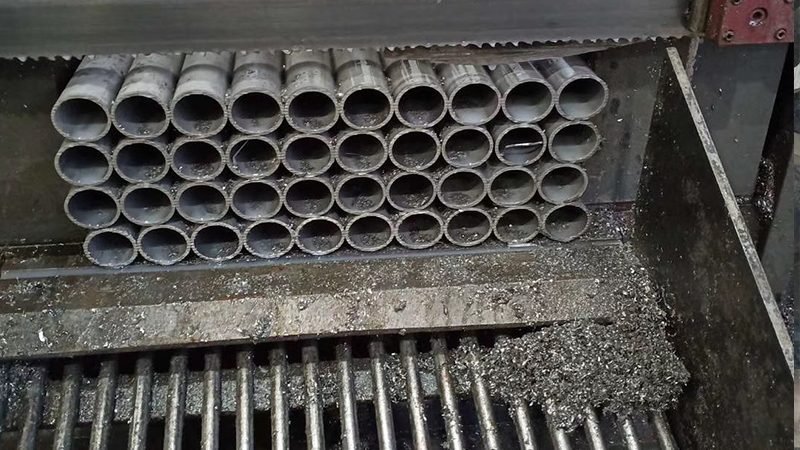
Welded pipe starts as cold-rolled strip, slit to the developed width, uncoiled, formed through a series of rolls into a cylinder, and welded along the seam. Two processes dominate: high-frequency ERW (electric resistance welding), where the strip edges are brought together and welded by resistance heating without filler, and TIG/GTAW welding, where a filler wire may or may not be added depending on the wall thickness.
ERW is fast and produces a narrow weld and a small heat-affected zone. TIG is slower but gives better control on thin wall and on grades that are sensitive to welding. Both leave a seam that has been heated above the melting point and, more importantly, a surrounding zone that has been heated into the range where chromium carbides precipitate.
After welding, the pipe is sized and straightened, затым разрэзаць па даўжыні. At this point the weld is mechanically sound but metallurgically compromised: the heat-affected zone has a different microstructure from the parent strip, the surface has a welding oxide, and under that oxide there is a layer that is depleted in chromium.
2. What Welding Does to the Metal
Austenitic stainless steel at 450–850 °C precipitates chromium carbides at the grain boundaries. The carbon is low but not zero, and the chromium that forms the carbide is taken from the adjacent matrix, leaving a narrow band along each grain boundary that is depleted in chromium. That band is no longer stainless: it cannot form a protective passive film, and in an aggressive medium it corrodes preferentially. The phenomenon is called sensitization, and the heat-affected zone of a weld is exactly where it occurs.
Above roughly 900 °C the carbides dissolve again, and rapid cooling through the sensitization range prevents them from re-forming. That is the basis of solution annealing: heat the pipe to 1050–1100 °С, hold long enough to dissolve the carbides and to homogenize the structure, then cool fast enough — usually by water or forced gas — to keep the carbon in solution.
Welding also leaves residual stress and, in the ferritic grades, grain growth. Annealing relieves the stress and refines the structure in the austenitic grades. У 430 and other ferritics, annealing does not restore toughness in the same way, which is one reason ferritic welded pipe is rare.
Нарэшце, welding produces a surface oxide: a heat tint that ranges from pale straw to blue-black depending on the atmosphere and the heat input. The tint is not just cosmetic. Beneath it, the chromium-depleted layer can be several micrometres deep, and that layer is the starting point for pitting and for crevice corrosion under a gasket.
3. Адпал: Methods and Control
| Method | Atmosphere | Result | Звычайнае выкарыстанне |
|---|---|---|---|
| Bright annealing | Hydrogen or H₂/Н₂ mixture, dew point −40 °C or lower | No oxide; bright surface inside and out | Sanitary, instrumentation, high-purity lines |
| Continuous annealing + марынаванне | Air or combustion atmosphere, then acid | Clean grey surface; oxide removed after | General process pipe, structural tube |
| Batch annealing | Vacuum or inert gas furnace | Softer, slower cooling; more distortion | Heavy wall, small quantities |
| No annealing | As welded | Sensitized HAZ, high residual stress | Only for non-corrosive, non-critical service |
The annealing temperature for 304 and 316L is 1050–1100 °С. Below that range, carbides do not fully dissolve; above it, grain growth becomes excessive and the pipe loses toughness. The hold time depends on wall thickness, but is usually a matter of minutes in a continuous furnace. The cooling rate is the part that is most often short-changed: a slow cool through 850–450 °C re-precipitates the carbides and undoes the anneal.
In a continuous line, the pipe passes through a furnace and then a water quench or a forced-gas cooling section. The quench must be uniform around the circumference; a pipe that is quenched on one side only will distort, and the distorted section will not size properly.
Bright annealing in hydrogen is the premium route. It produces a surface that needs no pickling, which is decisive for sanitary tube where the internal surface must be clean and smooth. The penalty is cost: hydrogen furnaces, tight dew-point control and the safety systems that go with them. For a general process line, anneal-and-pickle is perfectly adequate and much cheaper.
4. Pickling and Passivation
Pickling removes the oxide and the chromium-depleted layer under it. The standard bath for austenitic stainless is a mixture of nitric acid and hydrofluoric acid, typically 10–20 % HNO₃ with 1–3 % HF, at 20–50 °С. The nitric acid oxidizes the surface and passivates it; the hydrofluoric acid dissolves the oxide and the metal beneath it.
Pickling is a metal-removal process. It takes off a few micrometres of surface, which is what makes it effective against the depleted layer, and also what makes it dangerous: over-pickling removes too much wall, dulls the surface and, on thin-wall tube, can take the wall below tolerance. The bath temperature, acid concentration and immersion time must be controlled together, and the pipe must be rinsed thoroughly in water — usually two stages, with a final demineralized rinse.
Passivation is different. It does not remove metal; it chemically cleans the surface and promotes the formation of the chromium oxide film. A nitric acid passivation (typically 20–25 % HNO₃ at 20–50 °С) or a citric acid passivation is used after machining, after welding that has been ground clean, or as a final step after pickling. Passivation will not fix a heat tint or a depleted layer; if the oxide is there, it has to be pickled off first.
For pipe with an internal surface that matters — sanitary, фармацэўтычны, high-purity water — the pickle and the passivation must reach the bore. A pipe that is pickled on the outside only will have a clean exterior and a sensitized, oxide-covered interior, and the first fluid to pass through it will carry the corrosion products.
On site, weld joints are usually cleaned with a pickling paste or a pickling gel, applied to the weld and the heat tint, left for the specified time, then removed and rinsed. The paste is aggressive and the residue must be neutralized and washed away; a paste left on the pipe attacks it in service.
5. Process Sequence and Verification
| Stage | Purpose | Verification |
|---|---|---|
| Forming and welding | Make the pipe; fuse the seam | Weld bead inspection, penetration |
| Адпал | Dissolve carbides, relieve stress | Temperature record, цвёрдасць, microstructure |
| Pickling | Remove oxide and depleted layer | Visual, surface roughness, таўшчыня сценак |
| Пасівацыя | Restore the passive film | Ferroxyl test, ASTM A380/A967 |
| Sizing and straightening | Restore diameter and straightness | Diameter gauge, laser straightness |
| Тэставанне | Confirm integrity | Hydro, eddy current, уплощение, расцяжэнне |
The test package for a welded pipe order normally includes a hydrostatic test at the specified pressure, an eddy-current or ultrasonic test of the weld, a flattening test on a sample, tensile and flattening specimens, and a corrosion test where the service requires it. ASTM A262 Practice E (copper sulphate–sulphuric acid) detects sensitization; ASTM G48 ferric chloride testing detects pitting resistance. For 316L in a chloride service, the G48 test with a specified temperature is the one that matters.
Ask for the test records with the pipe, not just a certificate of conformity. A certificate that says “абпаленых і марынаваных” without a temperature record and a test result is a statement of intent, not evidence.
6. Dimensions and Tolerances
| Вонкавы дыяметр | Таўшчыня сценак | OD tolerance | Wall tolerance |
|---|---|---|---|
| 6–20 мм | 0.8–2.0 мм | ±0.10 мм | ±10 % |
| 20–60 мм | 1.0–3.0 мм | ±0.15 мм | ±10 % |
| 60–114 мм | 1.5–4.0 мм | ±0.20 мм | ±10 % |
| 114–219 мм | 2.0–6.0 мм | ±0.25 мм | ±12.5 % |
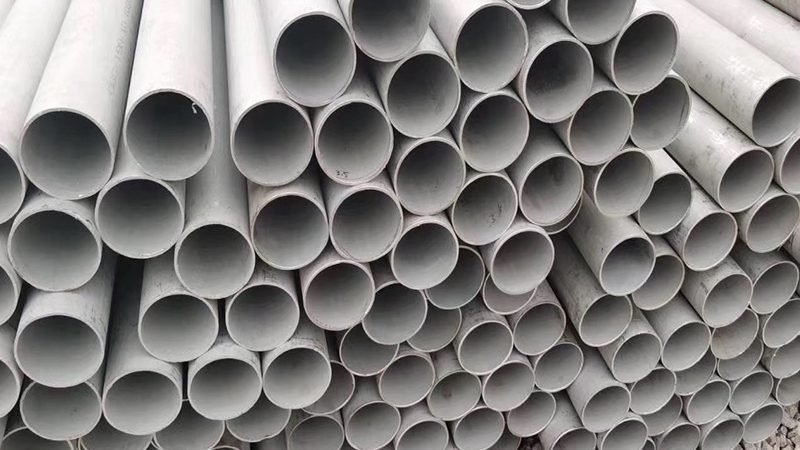
Length is normally 6 м, with a tolerance of 0–10 мм, or cut to a specified length for a fabrication order. The pipe is supplied plain end, скошаны, or with a weld-ready end preparation. Sanitary tube is supplied with a specified internal surface finish, Ra ≤ 0.8 µm for standard hygienic and Ra ≤ 0.4 µm for aseptic work, and that finish is produced by the combination of bright annealing and, where needed, mechanical polishing.
Straightness matters for automated welding. A pipe with a bow of more than 1 mm per metre will not align in an orbital welding head, and the weld will be rejected. Specify the straightness tolerance and check it on receipt with a laser or a string line.
7. Specifying the Requirement
A purchase order that says “welded stainless pipe, 304, 6 м” will be filled with the cheapest interpretation: as-welded, no anneal, no pickle, аздабленне млына. If the pipe is for a decorative handrail in a dry interior, that may be adequate. If it is for a process line carrying chlorinated water, it is a premature failure.
Write the requirement in three lines: the grade and standard, the thermal treatment, and the surface treatment. Напрыклад: “ASTM A312 TP316L, solution annealed at 1050–1100 °C and water quenched, pickled and passivated inside and outside to ASTM A380, hydro tested at 1.5 times design pressure, eddy-current tested on the weld, mill test certificate with heat number.”
For sanitary service, add the internal surface finish and the requirement for bright annealing. For chloride service, add the G48 test at a specified temperature. For high-temperature service above 550 °С, the grade changes to 321 або 347, and the anneal is still required but the stabilization matters more than the pickling.
8. Common Mistakes
Specifying pickling instead of annealing. Pickling removes the oxide and the depleted layer, but it does not dissolve the carbides in the heat-affected zone. A pipe that is pickled and not annealed still has a sensitized weld, and it will corrode along the grain boundaries in service.
Specifying annealing without a cooling rate. Slow cooling through the sensitization range re-precipitates the carbides. The temperature is not the whole requirement.
Assuming bright anneal means sanitary. Bright anneal gives a clean surface, but the internal roughness and the weld bead still have to meet the specification. Sanitary tube also needs the weld bead controlled and often mechanically polished.
Using hydrochloric acid to clean a weld. HCl attacks stainless steel and leaves chloride behind, which is the worst possible residue for a passive surface. Use a proper pickling acid or paste.
Rinsing with tap water high in chloride. The final rinse should be low-chloride or demineralized water, or the pipe will show rust spots within days of shipment.
Leaving pickling paste residue in a crevice. The paste continues to attack the metal, and the crevice is exactly where pitting starts.
Welding after pickling. Any weld made after the final pickle and passivation needs its own local treatment. Sequence the work so that all welding is done before the final surface treatment.
9. Часта задаюць пытанні
Is annealing always necessary for welded 304 труба? For corrosive service, так. For dry, non-critical service, as-welded pipe is used, but the weld will be susceptible to rust and the buyer should accept that.
What is the difference between pickling and passivation? Pickling removes metal and oxide; passivation cleans and promotes the passive film without removing metal. Passivation cannot replace pickling after welding.
Can I pickle on site? так, with paste or gel on the weld and the heat tint, followed by thorough rinsing. It is practical for joints, not for a whole pipe run.
How do I know the pipe was annealed? Ask for the furnace temperature record and the hardness or microstructure result. A hardness reading well above the annealed range suggests the pipe was not annealed.
Does 316L need annealing after welding? так, for the same reasons as 304, and 316L is more sensitive to the consequences because it is usually chosen for a corrosive environment.
What is heat tint and why does it matter? It is the oxide colour left by welding. Under it, chromium is depleted, and that layer pits. It must be removed, not painted over.
What surface finish should sanitary tube have? Ra ≤ 0.8 µm for standard hygienic, Ra ≤ 0.4 µm for aseptic. Specify the measurement method and the inspection frequency.
10. Sourcing Welded Stainless Pipe
QIDAMT supplies longitudinally welded stainless steel pipe in 304, 304Л, 316L and 321, 6–219 mm outside diameter, wall 0.8–6.0 мм, solution annealed and water quenched, pickled and passivated inside and outside, hydro and eddy-current tested, with mill certificates and test records. Bright-annealed and mechanically polished sanitary tube is available to order.
Send the grade, памер, сцяна, даўжыня, surface requirement and the service medium. We will confirm the treatment route and the test package before quotation.
Need annealed and pickled stainless pipe?
Send the grade, памер, wall and service medium for a quotation with the test package.
Related specifications: Q345D seamless steel pipe, 316L пласціна з нержавеючай сталі, і 304 2B cold rolled sheet.

