 ПРАГРЭС
Stainless Steel Handrail: Tube Diameter, Grade and Balustrade Fixing
A stainless steel handrail is a guard or support rail made from stainless tube, звычайна 42.4 мм, 48.3 мм або 50.8 mm outside diameter, fixed to a structure with brackets, posts or a glass clamp system. It looks like a simple product, and that is precisely why it is so often specified badly: a 1.5 mm wall tube of the wrong grade, fixed at 2 m intervals with the wrong anchors, will pass a visual inspection on the day it is installed and fail a load test the same week. This guide covers the grade choice, the tube dimensions that matter, the fixing rules that keep a balustrade within the load requirements of a typical building code, and the mistakes that produce rust stains on a new building facade.
1. What a Stainless Steel Handrail Is and Where It Is Used
A handrail is the element a person holds for support; a guardrail or balustrade is the element that prevents a fall. In many designs the same tube run performs both functions, which is why the structural requirements of a guardrail are usually applied to the whole system. Stainless is chosen for three reasons: it does not need painting, it survives washing and weather without losing its surface, and it can be detailed with slim sections that look lighter than steel or timber.
Typical applications include:
- Bridge decks, river walkways and elevated public footpaths.
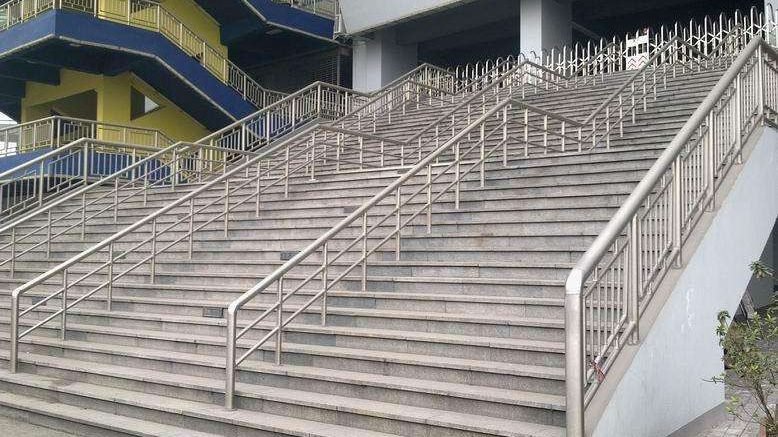
- Staircases in commercial buildings, stations and car parks.
- Hospital, laboratory and food-processing areas where painted steel is not acceptable.
- Coastal promenades, marina walkways and swimming-pool surrounds.
- Balcony and terrace guardrails on residential buildings.
- Temporary or permanent crowd-control rails at events and transport hubs.

2. Гатункі і хімічны склад
Two grades cover almost all handrail work. 304 is the general-purpose austenitic grade; 316L adds molybdenum for chloride resistance and lowers carbon for better weldability. The chemistry below is the standard range under ASTM A269/A312 and EN 10216-5 equivalent specifications.
| элемент | 304 (%) | 316Л (%) |
|---|---|---|
| С | ≤ 0.08 | ≤ 0.03 |
| І | ≤ 0.75 | ≤ 0.75 |
| Мн | ≤ 2.00 | ≤ 2.00 |
| П | ≤ 0.045 | ≤ 0.045 |
| С | ≤ 0.030 | ≤ 0.030 |
| кр | 18.0–20.0 | 16.0–18.0 |
| У | 8.0–10.5 | 10.0–14.0 |
| мо | – | 2.0–3.0 |
The 2 percent molybdenum in 316L is what resists pitting in chloride environments. It is effective up to roughly 500 mg/L chloride at ambient temperature; swimming pools, de-icing salt zones and marine splash zones exceed that, which is why 316L is the minimum for coastal handrail and duplex grades such as 2205 are used for immersed or heavily salted locations.
3. Механічныя ўласцівасці
| Уласнасць | 304 трубка | 316L tube |
|---|---|---|
| Мяжа цякучасці (0.2%) | ≥ 205 МПа | ≥ 170 МПа |
| Трываласць на разрыў | ≥ 515 МПа | ≥ 485 МПа |
| Падаўжэнне | ≥ 35% | ≥ 30% |
| Цвёрдасць | ≤ 90 HRB | ≤ 95 HRB |
| Elastic modulus | 193 ГПа | 193 ГПа |
For a handrail the tensile strength is almost irrelevant; what matters is stiffness, because the serviceability limit is usually a deflection limit rather than a strength limit. A person leaning on a rail applies a few hundred newtons, і а 48 mm tube with a 2 mm wall will deflect visibly long before it yields. That is why fixing spacing, not wall thickness, is the dominant design variable.
4. Tube Dimensions and Tolerances
| Characteristic | Common size | Талерантнасць |
|---|---|---|
| Вонкавы дыяметр | 42.4 / 48.3 / 50.8 мм | ±0.15 mm |
| Таўшчыня сценак | 1.5 / 1.8 / 2.0 мм | ±10% |
| Даўжыня | 6000 стандарт мм | 0 / +10 мм |
| Прамалінейнасць | – | ≤ 1.5 mm/m |
| Ovality | – | ≤ 1% of OD |
| Surface roughness | 400 grit satin or mirror | Ra ≤ 0.8 мкм (satin) |
| Handrail height | 1000–1100 mm above finished floor | ±10 mm |
| Clear gap between rails | ≤ 100 mm for fall protection | Verify with local code |
5. Manufacturing Points
5.1 Welded tube
Handrail tube is normally produced as welded tube from slit stainless strip, then annealed and pickled or bright annealed. The weld seam is the location where corrosion first appears if the anneal is incomplete: unannealed weld metal retains delta ferrite and carbides that are anodic to the parent metal, and the seam rusts in streaks after the first wet season.
5.2 Polishing
Surface finish is usually specified as 320 або 400 grit satin, or a mirror finish for interior work. Polishing removes the oxide skin left by annealing and creates a passive surface. A “No.4” or “600 grit” finish is smoother and easier to clean; a coarse 180 grit finish traps dirt and is more likely to show tea staining.
5.3 Bending and welding
Corners are either bent from the tube or made from fittings. A bend needs a radius of at least 1.5 times the outside diameter for a 90-degree corner; tighter radii wrinkle the inner wall. When fittings are welded, use ER308L filler for 304 and ER316L for 316L, purge the bore with argon, and pickle and passivate the weld afterwards. Skipping the purge leaves a sugared inner surface that will corrode from the inside out, invisible until a pinhole appears.
6. Design and Fixing Rules
- Вышыня. Set the top rail 1000 mm above the finished floor for general access, і 1100 mm where the area is likely to be crowded or where local code requires it.
- Bracket spacing. Keep post or bracket centres at 1200 mm or less for a 48 mm tube, and reduce to 1000 mm where the rail carries a glass infill or where the anchors are into a lightweight substrate.
- Load assumption. Design for a uniformly distributed line load of 0.75 kN/m and a concentrated load of 1.0 kN at any point, applied in the least favourable direction; check deflection as well as stress.
- Anchors. Use M10 or M12 stainless or hot-dip galvanized anchors with a minimum embedment of 60 mm into concrete; avoid chemical anchors into brick or block without a pull-out test.
- Thermal and structural movement. Allow for differential movement between the rail and the structure; a rail rigidly fixed at both ends of a long run will crack its anchors when the slab moves.
- Grade by exposure. 304 for interior and rural exterior; 316L within 1 km of the coast, for pool surrounds and for de-icing-salt zones; 2205 for immersed or highly salted locations.
- Dissimilar metal contact. Isolate stainless from carbon steel and aluminium with a dielectric separator; stainless is noble and will accelerate the corrosion of the other metal.
6.1 Load testing on site
Most building codes accept either calculation or a physical test, and a physical test is often the fastest way to close out a handover. The usual procedure is to apply a 1.0 kN concentrated load horizontally to the top rail at the most unfavourable point, hold it for one minute, and measure both the permanent set and the maximum deflection. Acceptance criteria vary, but a common rule is that the residual deformation after unloading must not exceed 1 mm and the maximum deflection must stay within the project’s serviceability limit, typically height over 100 divided by 50 for a handrail.
Testing should be done on the finished installation, after anchors have cured fully, because a test performed the day after a chemical anchor was installed measures the anchor’s uncured state rather than the finished system. Record the test location, the load applied, the deflection at the top rail and the residual set for each run, and photograph the loading rig. That record is what an inspector will ask for if the balustrade is later challenged.
6.2 Glass infill and rail stiffness
Glass infill changes the structural behaviour of the system more than most designers expect. The glass panel adds wind load, transfers load to the rail through the clamps, and creates a stiff plane that concentrates stress at the posts. Two practical consequences follow: post spacing usually needs to drop to 1000 мм або менш, and the rail must be checked for torsion as well as for horizontal bending, because a wind load on the glass applies a twisting moment to the tube.
Clamp details matter as much as the tube. The clamp must be rated for the glass thickness and type, must not bear directly on the glass edge without a resilient insert, and must be positioned so the glass does not touch the tube. Where the balustrade is exposed to wind and the glass is laminated, check that the interlayer is not exposed at the edges; edge delamination in a coastal environment is the usual first sign of a badly detailed clamp.
6.3 Ўпакоўка, delivery and site handling
Stainless tube is easy to damage in transit and the damage is expensive to repair. Tube should be bundled with timber dunnage rather than strapped metal-to-metal, and each bundle should be wrapped or sleeved so that the polished surface is not abraded by neighbouring tubes. Long bundles need three lifting points; lifting a 6 m bundle from the centre bows the tubes and leaves a permanent set that will be visible when installed.
On site, store the tube horizontally on dunnage clear of the ground, and never drag a bundle across concrete: the grit that embeds in the surface becomes the initiation point for rust staining. Cut lengths should be kept separated by grade and marked, because 304 and 316L look identical and a mixed bundle will produce a rail with a few corroding sections and no obvious explanation.
During installation, protect the finished rail from weld spatter and grinding dust produced by other trades. A single grinding spark that embeds in a polished surface will bleed rust down the rail within a month, and the client will see it as a defect in the handrail rather than in the adjacent work.
7. Common Misconceptions
- “Stainless steel does not rust.” It does, when chlorides, embedded iron or an unpassivated weld are present. The stains on a new facade are usually weld defects, not a material failure.
- “304 is fine everywhere.” 304 pits within a few years in coastal splash zones; the molybdenum in 316L is the difference between a 20-year rail and a 5-year one.
- “Thicker wall is the cheapest way to pass the load test.” Fixing spacing and anchor quality dominate; increasing wall thickness from 1.5 каб 2.0 mm adds cost and weight but does little for deflection at 1.2 m spans.
- “A welded joint is as good as a seamless bend.” A properly purged and pickled weld can be, but a weld made without purge will corrode internally and cannot be inspected from outside.
- “Mirror polish is always better.” Mirror finishes show fingerprints and scratches; satin 400 grit is the practical choice for public areas.
- “Any stainless bolt will do.” Bolts must match the rail grade or be a higher alloy; a 304 bolt in a 316L rail becomes the anode and corrodes at the connection.
- “The rail can be fixed after the concrete has cured for a week.” Anchor design, edge distance and reinforcement position must be decided before the pour; post-installed anchors into the wrong location are a common cause of failure.
8. Часта задаюць пытанні
Which grade should I use for a seaside promenade?
316L as a minimum, with a 400 grit finish and a regular fresh-water rinse schedule. Within the splash zone, удакладніць 2205 or accept a shorter inspection interval.
What diameter tube is normal for a handrail?
48.3 mm is the most common public-building size; 42.4 mm suits interior and residential work, і 50.8 mm is used where a heavier visual profile is wanted or where the rail doubles as a guardrail.
How far apart should the upright posts be?
No more than 1200 mm for a 48 mm tube in normal guardrail service, і 1000 mm where the rail carries glass or where anchors are into lightweight blockwork.
Why does my new handrail show brown stains?
Almost always embedded iron from grinding discs, wire brushes or tooling, or an unpassivated weld. Clean with a pickling gel, rinse thoroughly and passivate; do not use hydrochloric acid on site without neutralising and rinsing.
Can stainless tube be bent on site?
Small diameter tube can be bent with a hydraulic bender if the radius is at least 1.5 times the diameter. Larger sizes are normally bent in the workshop on a mandrel bender to avoid flattening the section.
Is 316L weaker than 304?
Its minimum yield is lower on paper, but both are far above the stress a handrail sees. The choice between them is about corrosion, not strength.
How should the rail be maintained?
Wash with fresh water and a mild detergent every three to six months in coastal or urban locations, and remove salt deposits before they dry. Do not use chlorine-based cleaners, which attack the passive film.
Can I use a glass clamp with a stainless handrail?
так, provided the clamp is rated for the glass thickness and the rail is designed for the additional load. Glass infill increases wind load and requires closer post spacing.
What wall thickness is needed for a 1.2 m span?
1.5 mm is adequate for deflection under a 0.75 kN/m line load in most cases, but confirm with the project’s deflection limit; 2.0 mm gives a useful margin where the rail may be leaned on heavily.
Does the finish affect corrosion resistance?
так. A smoother, properly passivated surface resists pitting better because there are fewer crevices to trap chloride. A rough ground surface from an angle grinder is the usual starting point for tea staining.
Should the handrail be earthed or bonded?
Stainless is a conductor and can carry stray current from nearby equipment. Where the rail is close to electrical installations or lightning protection, follow the project’s earthing design; do not assume that an isolated stainless rail is electrically inert.
9. Next Step
Send the project location, required grade, tube diameter and wall, post spacing and the anchor substrate, and we will confirm the section and the finish that meet the load and corrosion requirements without over-specifying the alloy.
Related product pages: 316L пласціна з нержавеючай сталі, 304 stainless steel sheet 2B finish, 304 stainless steel coil 2B.