 ПРАГРЭС
Lead Sheet Pb1 for Radiation Shielding: Чысціня, Таўшчыня і ўстаноўка
Lead Sheet Pb1 for Radiation Shielding: Чысціня, Таўшчыня і ўстаноўка
A lead sheet is a rolled product of unalloyed lead supplied in thicknesses from a fraction of a millimetre to several millimetres, either as cut plates or as coils. Its density, its ability to be bent and folded without cracking, and its high atomic number make it the reference material for attenuating diagnostic X-rays and gamma radiation. In a hospital, a lead sheet is rarely visible: it sits inside a wall cavity, behind a plasterboard finish, above a ceiling, under a floor, or wrapped around a duct, and its only job is to stop radiation that would otherwise reach a corridor, a waiting area or a staff room.
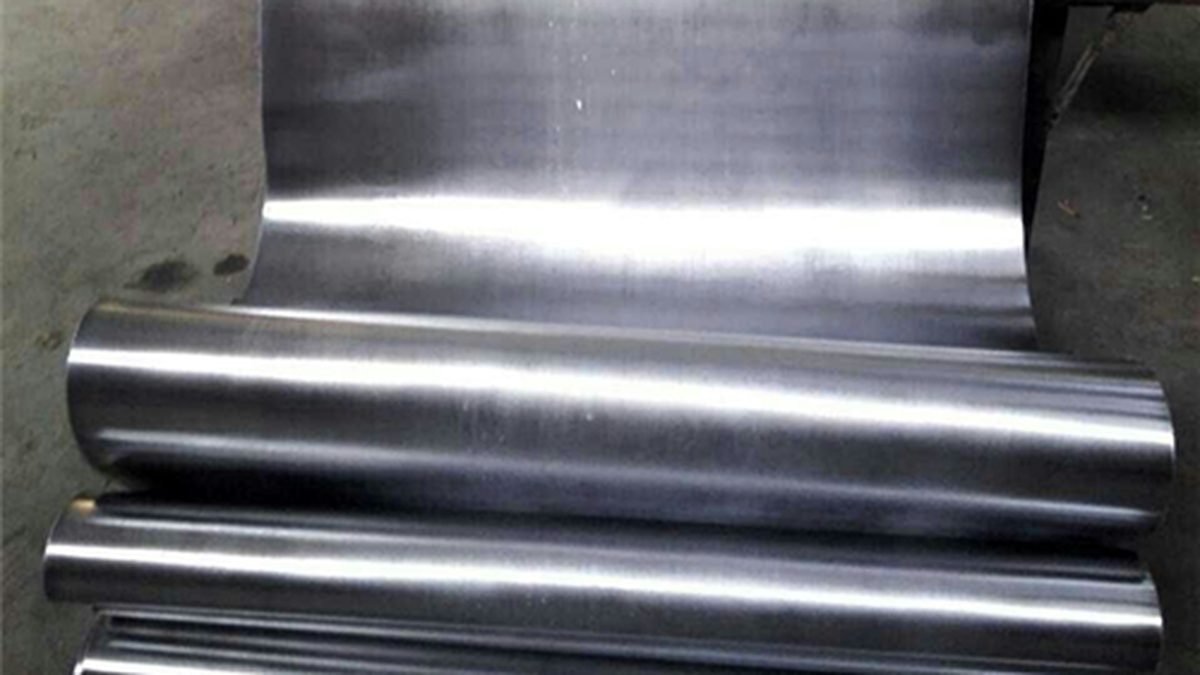
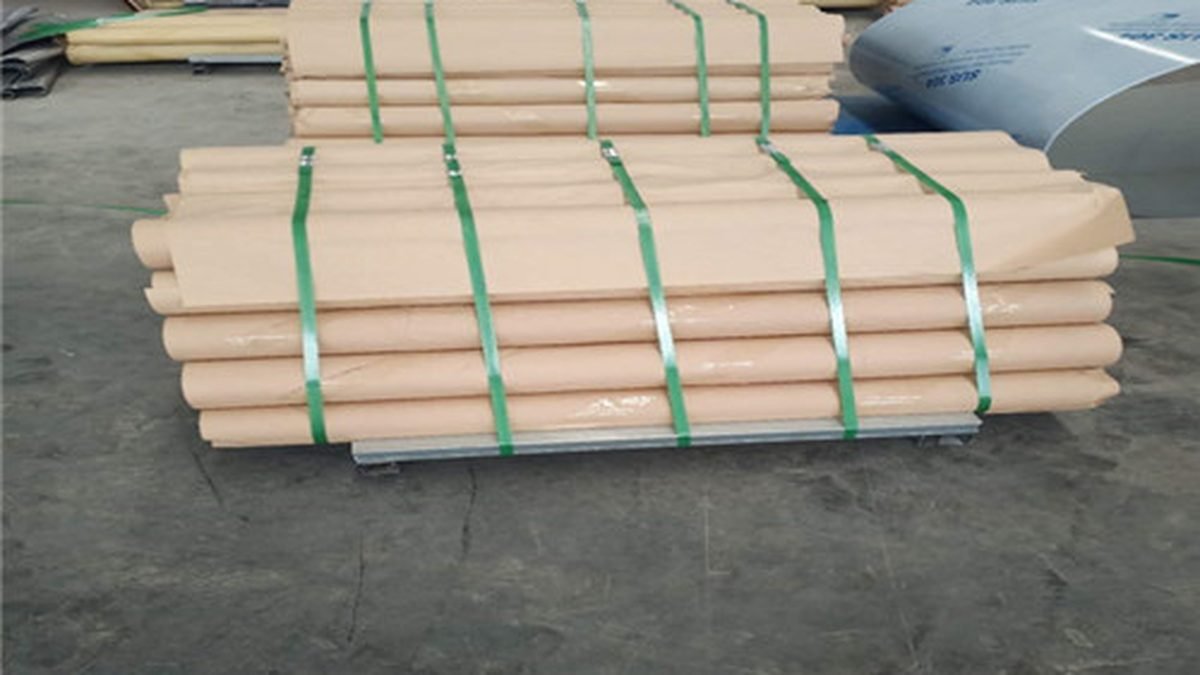
This article deals with one material only, unalloyed lead sheet in the Pb1 purity class, and with the questions that decide whether an installation passes a radiation survey or fails it: how pure the lead has to be, how thickness is specified and checked, how joints are made continuous, and how the sheet is fixed so that it does not sag, crack or corrode over the life of the building. The photographs show mill lead sheet in coil form and the same material delivered as strapped bundles of cut sheets, still wrapped in protective paper.
1. What Lead Sheet Is and What It Is Used For
Lead is a soft, heavy, ductile metal with a face-centred cubic crystal structure, a density of about 11.34 g/cm³ and a melting point of 327.5 °C. Rolled lead sheet is produced by casting and then rolling, so the metal is fully dense and free of the shrinkage cavities that a cast plate can carry. The result is a sheet that can be cut with a knife or a shear, bent around a corner by hand, folded into a duct shape, and joined on site by lead burning.
The dominant use of lead sheet is radiation shielding in medical and industrial facilities. A diagnostic X-ray room needs a barrier that attenuates the primary beam and the scattered radiation; a CT suite needs the same barrier with a larger workload factor; a dental surgery needs a smaller but equally continuous barrier; a nuclear medicine department needs shielding around the hot bench and the dose calibrator; a radiotherapy bunker needs a thick liner plus a maze. In all these cases the shielding material is lead because it provides the required mass per unit area in the smallest possible thickness, which matters when the barrier has to fit inside a normal wall zone.
Lead sheet also appears in non-medical shielding: industrial radiography cabins, baggage scanning tunnels, electron microscope rooms, X-ray fluorescence cabinets, and particle accelerator areas. Outside radiation protection, unalloyed lead sheet is used as a chemical barrier in sulphuric acid plant equipment, as a dampproof membrane in some heritage roofing, and as a vibration and acoustic damping layer, but these uses are secondary and are specified against different standards.
What all shielding uses have in common is that a small defect matters more than the average quality of the sheet. A wall that is 1.5 mm thick over 95 percent of its area and 0.9 mm over a 300 mm strip beside a door frame will leak, and the leak will be found by the survey meter rather than by the installer. Lead sheet is therefore specified, delivered and inspected as a barrier system, not as a commodity roll of metal.
2. Purity Classes and Chemical Composition
Unalloyed lead sheet is graded by lead content and by the residual impurity ceiling. The three grades that dominate the market are Pb1, Pb2 and Pb3, and the difference between them is measured in hundredths and thousandths of a percent. For radiation shielding, the practical consequence of purity is not attenuation, because bismuth, antimony and tin attenuate photons just as well as lead does; the consequence is mechanical behaviour, corrosion behaviour and the consistency of the rolling process.
Pb1 is the highest purity class in normal commercial supply, with a minimum lead content of 99.994 працэнтаў. The residual elements, chiefly copper, bismuth, antimony, arsenic, tin, zinc and iron, are held to very low ceilings. The metal is soft, extremely ductile, and behaves predictably when rolled to thin gauges. This is the grade specified for medical shielding, for lead burning filler wire, and for chemical duty where a coherent protective film has to form and stay intact.
Pb2, у 99.95 percent minimum lead, is the standard industrial grade. It is used for general shielding where the sheet is thick enough that a slight impurity content does not affect formability, and for radiation protection in industrial cabinets and storage containers. Pb3, у 99.90 percent minimum, is the lowest of the three and is normally used for ballast, counterweights, and non-critical chemical work rather than for thin shielding sheet.
| Уласнасць | Pb1 | Pb2 | Pb3 |
|---|---|---|---|
| Lead content, minimum | 99.994 % | 99.95 % | 99.90 % |
| Total impurities, typical ceiling | 0.006 % | 0.05 % | 0.10 % |
| медзь | trace | low | may be present |
| Bismuth, antimony, arsenic | very low | low | higher |
| Formability at thin gauge | лепшы | good | fair |
| Звычайнае выкарыстанне | medical shielding, lead burning, хімічны | industrial shielding, кантэйнеры | ballast, counterweight |
There is a fourth grade that deserves mention because it is often quoted for shielding: chemical lead. This is not a purity class in the Pb1 sense but a controlled composition, typically carrying 0.04 каб 0.08 percent copper. The copper refines the grain structure, raises the creep resistance and improves resistance to sulphuric acid. In ASTM B29 practice, chemical lead and corroding lead are the two grades that a shielding contractor is most likely to be offered, and the mill certificate should state which one is being supplied. A certificate that says only “pure lead” without a grade, a heat number and an analysis is not a certificate for a shielded installation.
Two practical points follow from the chemistry. Першы, a lead sheet that contains an appreciable amount of antimony or bismuth is harder and less ductile, which shows up as cracking at folded corners and at the edges of a lap joint. Па-другое, remelted scrap lead, which is common in low-cost supply, can carry zinc, iron and copper at levels that make the sheet stiff and prone to pinholes. For a barrier that has to be continuous, the certificate and the heat traceability are worth more than the price difference between grades.
3. Mechanical and Physical Properties
Lead is specified by thickness and areal density rather than by strength, because its strength is low and its behaviour under sustained load is dominated by creep. Rolled lead sheet at room temperature is already at a high fraction of its melting point on the absolute scale, so it recrystallises and creeps at ambient temperature. That is why a lead sheet spanning a gap without support will sag over months even though it carried its own weight on the day it was installed. Every shielding sheet must be continuously supported by a substrate: plywood, gypsum board, cement board, a steel liner or a duct wall.
| Уласнасць | Typical value for rolled unalloyed lead sheet |
|---|---|
| Шчыльнасць | 11.34 г/см³ (11,340 кг/м³) |
| Тэмпература плаўлення | 327.5 °C |
| Трываласць на разрыў, annealed sheet | аб 12 каб 20 МПа |
| Elongation at break | аб 30 каб 50 % |
| Brinell hardness | аб 3.5 каб 5.0 HB |
| Цеплаправоднасць | аб 35 ж/(м·К) |
| Linear expansion | аб 3 × 10⁻⁵ per K |
| Удзельнае электрычнае супраціўленне | аб 0.21 Ω·mm²/m |
| Mass per square metre at 1 мм | 11.34 кг/м² |
| Mass per square metre at 2 мм | 22.68 кг/м² |
The areal density figure is the one to keep in mind on site. А 1 mm lead sheet weighs 11.34 kg per square metre, so a 2 mm sheet over a 30 m² CT room wall is about 680 kg of metal, all of it fixed to a substrate and all of it needing to be handled safely. Handling is a real design constraint: sheets above 3 mm are usually supplied as cut plates rather than coils, because a coil of thick lead is too heavy to manipulate by hand and too stiff to bend neatly around a corner.
Because lead creeps, the design of supports and fixings matters as much as the thickness. A sheet that is fixed only at its perimeter will sag in the middle under its own weight within a year or two, and a sagging sheet opens a gap at the joints. The usual detail is a continuous substrate plus a regular grid of fixings at 300 каб 400 mm centres, with the fixings washered so that they do not pull through the soft metal.
4. Таўшчыня, Width and Tolerance
Shielding thickness is set by the radiation protection adviser, not by the supplier, and it is expressed either in millimetres of lead or in millimetres of lead equivalent when a composite barrier is used. Once the thickness is fixed, the sheet has to be supplied within a tolerance that keeps the minimum thickness from falling below the design value. A nominal 2 mm sheet rolled to minus 10 percent is a 1.8 mm barrier, and the survey will show the difference at the highest workload.
Rolled lead sheet for shielding is normally specified against a product standard such as BS EN 12588 for rolled lead, or a national lead sheet standard, and the thickness tolerance in those standards is tight in the thin gauges and proportionally looser in the thick ones. The table below gives the tolerance bands that are commonly quoted in commercial offers; the contract should always name the standard and the class, because two suppliers quoting “2 mm lead sheet” can be quoting two different minimum thicknesses.
| Nominal thickness | Common tolerance | Mass per m² | Typical supply form |
|---|---|---|---|
| 0.5 мм | ± 0.05 мм | 5.7 кг | шпулька |
| 1.0 мм | ± 0.08 мм | 11.3 кг | coil or cut sheet |
| 1.5 мм | ± 0.10 мм | 17.0 кг | coil or cut sheet |
| 2.0 мм | ± 0.10 мм | 22.7 кг | cut sheet |
| 3.0 мм | ± 0.15 мм | 34.0 кг | cut sheet |
| 4.0 мм і вышэй | ± 5 % | 45.4 kg and above | cut plate |
Width follows the same logic. Standard mill widths for shielding sheet are 600, 900 і 1,000 мм, з 1,200 mm available from some mills. Width tolerance is normally plus 5, minus 0 мм, because a sheet that is slightly narrow leaves a gap that has to be bridged on site, while a sheet that is slightly wide can always be trimmed. Lengths are cut to the drawing, with a tolerance of plus 10, minus 0 мм, and squareness of the cut ends should be stated: a sheet cut out of square by 5 mm over a metre produces a lap joint that is tight at one end and open at the other.
Coil supply has its own parameters: internal diameter, outside diameter, вага шпулькі, and whether the coil is wound with interleaving paper. А 1 мм × 600 mm coil weighs about 6.8 kg per metre of length, so a one-tonne coil is roughly 147 m long. That is convenient for a long duct wrap and inconvenient for a room that needs thirty cut sheets, which is why most shielding contractors order cut sheets to a cutting list and keep coil only for the odd-shaped areas.
Thickness verification on receipt is simple and should never be skipped. A calibrated micrometre or a magnetic thickness gauge over a steel substrate gives a reading in seconds; an ultrasonic gauge can be used on sheet that is already fixed. Measure at least five points per sheet, including the corners and the centre, because a rolling mill that is out of level produces a sheet that is thick at one edge and thin at the other. A sheet that measures below the minimum at any point should be rejected, regardless of what the certificate says.
5. How Rolled Lead Sheet Is Made
Production starts with ingots of refined lead that are melted in a kettle and cast into slabs or continuously cast into a strip. The cast strip is then rolled in a series of passes, with the gap between the rolls reduced at each pass, until the target gauge is reached. Rolling refines the grain and closes the casting porosity; the final pass sets the surface finish and the thickness tolerance.
Thickness control during rolling is maintained by gauge meters at the exit of the finishing stand and by adjusting the roll gap and the strip tension. A modern line holds thickness to a few hundredths of a millimetre in the thin gauges, which is why a good mill can supply 1 mm sheet at plus or minus 0.08 мм. The strip is then slit to width, cut to length or coiled, and interleaved with paper where the surface finish has to be preserved.
Two quality points are worth watching in the mill certificate and in the delivery. The first is pinholes. Lead sheet can carry small through-thickness defects from inclusions in the melt or from a damaged roll; a pinhole in a shielding sheet is a leak, and the standard test is a visual inspection over a light box or a spark test for critical barriers. The second is surface contamination: алей, grit or embedded iron from the rolling line will show up later as corrosion or as a patch that will not accept paint. Sheet that is stored flat, dry and clear of the ground keeps its surface; sheet that is stacked on a concrete floor in a damp store does not.
For thick plate, some suppliers cast rather than roll. A cast lead plate of 10 mm or more can be acceptable for a bunker liner if it is proved free of shrinkage porosity, but a rolled plate of the same thickness is denser and more reliable. Where the shielding design calls for very thick sections, the usual solution is to laminate several rolled sheets rather than to buy one cast slab, because laminated sheet is easier to handle, easier to verify and easier to joint.
6. Thickness Selection and the Role of the Physicist
Lead thickness for a diagnostic installation is calculated from the workload, the distance to the occupied area, the barrier type, and the permitted dose behind the barrier. The calculation is a formal radiation protection task and it produces a number in millimetres of lead, often with a build-up and a workload factor that a supplier cannot reproduce. The supplier’s job is to deliver that number, not to guess it.
What a supplier can do is to recognise the typical ranges and to flag an enquiry that looks wrong. The table below lists the thicknesses that are commonly seen in shielding schedules for different rooms. It is a sanity check, not a design table: the actual value for any project comes from the radiation protection report.
| Room or application | Lead thickness commonly scheduled | Notes |
|---|---|---|
| Dental surgery, intraoral unit | 0.5 каб 1.0 мм | small room, short exposures |
| General radiography room | 0.8 каб 1.5 мм | depends on workload and distance |
| CT scanner room | 1.0 каб 2.0 мм | higher workload, thicker primary barrier |
| Fluoroscopy and interventional suite | 2.0 каб 3.0 мм | long screening times |
| Nuclear medicine hot laboratory | 2.0 каб 4.0 мм | gamma sources, bench and sink |
| Radiotherapy bunker liner | 4.0 мм і вышэй, often laminated | maze and door detail separate |
| Industrial radiography cabinet | 3.0 каб 10 мм | depends on source activity |
Two selection rules follow from the physics. The first is that lead thickness is additive when sheets are laminated, but only if the sheets are in intimate contact and the joints are staggered. Two 1 mm sheets with a 2 mm air gap and aligned joints are not a 2 mm barrier. The second is that thickness must be continuous around corners, at door frames, at pipe penetrations and above and below the room, because scatter does not respect the drawing’s intention. Most failed surveys are not caused by an under-thickness wall; they are caused by a gap at a corner, a missing strip above a door, or a duct that passes through the barrier without a lead sleeve.
7. Installation and Jointing
Lead sheet is installed on a continuous substrate, and the substrate has to be in place before the sheet arrives. The usual build-up from the room side is plasterboard or cement board, then the lead sheet, then a second board or a finish. The sheet is fixed with washered screws, lead buttons or proprietary lead fixings at a grid of 300 каб 400 мм, and every fixing is treated as a potential leak point: a screw that penetrates the sheet and the substrate creates a hole in the barrier, so the fixing detail must keep the sheet continuous or restore it.
Joints are the critical detail. There are two accepted methods. The first is a lap joint: the sheets overlap by at least 50 мм, preferably 75 mm in high-workload areas, and the lap is sealed so that the two layers act as one mass. A dry lap is not a joint; it is two sheets that happen to be near each other. The lap is normally closed with a lead-loaded sealant or a mastic that stays flexible, and in critical barriers it is lead burned.
The second method is lead burning, in which the two sheets are fused with an oxy-acetylene flame and lead filler. Lead burning is a skilled trade: the flame has to melt the sheet edge and the filler without oxidising the pool, and the result has to be a seam of the same thickness as the sheet, with no undercut and no pinhole. A burned seam that is thinner than the parent sheet is a weak line in the barrier. On site, burning is done horizontally where possible, with the seam supported, and the finished seam is dressed and inspected.
Vertical and overhead burning is much harder and is best avoided by designing the joint positions so that they fall on horizontal lines. Where a vertical seam is unavoidable, for example around a door frame, the seam is burned in short runs or replaced with a lapped and sealed detail plus a continuous lead flashing.
Penetrations need their own detail. A conduit or a cable tray passing through a shielded wall requires a lead sleeve or a lead-lined box that overlaps the wall barrier on both sides. The overlap should be at least the thickness of the wall barrier and preferably 50 мм. A penetration that is simply sealed with gypsum and paint is a hole in the shielding, and it will be found.
Corners are where most leakage occurs in practice. A sheet that stops 20 mm short of a corner, with the adjacent sheet stopping 20 mm short of the same corner, leaves a 40 mm unshielded strip behind the plasterboard. The correct detail is a folded corner piece, or a lap that turns the corner with a continuous sheet. The same applies at the top and bottom of a wall: the barrier has to continue into the floor slab and the ceiling void, not stop at the finished floor level.
Protection of the lead itself matters. Fresh concrete and mortar are alkaline and will corrode unalloyed lead; where the sheet touches fresh mortar it should be coated with a bituminous paint or separated by a membrane. Lead in contact with timber that has been treated with certain preservatives can also corrode, and lead in contact with copper or steel in a damp environment forms a galvanic couple that attacks the lead. In a hospital wall cavity these contacts are avoidable with a little care at the detailing stage.
Нарэшце, health and safety during installation. Lead is toxic and the dust from cutting and the fumes from burning are both hazardous. Cutting should be done with a knife or shear that produces no dust, or with a saw and local extraction; lead burning requires fume extraction and respiratory protection; hands and face should be washed before eating or drinking; work clothing should not be taken home. Installers who burn lead regularly are usually covered by a blood lead monitoring programme, and a contractor who has never heard of one is not a contractor to use for a shielded installation.
8. Тыповыя памылкі
Buying on thickness alone. “2 мм” from one mill and “2 мм” from another are not the same minimum thickness. Укажыце стандарт, the tolerance class and the acceptance method, and check with a micrometre on receipt.
Accepting a certificate without a heat number. A shielding installation should be traceable from the wall to the mill heat. A certificate that does not identify the heat cannot be linked to the sheets in the wall.
Dry lap joints. Two sheets overlapped and left unsealed are not a continuous barrier; radiation passes through the gap between them at the edges. Seal or burn every lap.
Under-thickness seams. A burned seam that is thinner than the sheet is the weakest line in the wall, and it is exactly where the survey meter will read high.
Fixing through the sheet without restoring it. Every screw that penetrates the lead is a pinhole. Use a fixing detail that keeps the barrier continuous, or seal the penetration with a lead button.
Forgetting the ceiling and the floor. Many rooms are shielded on four walls and left open at the top, on the assumption that the ceiling void is not occupied. If there is a plant room or a corridor above, the barrier has to continue.
Leaving penetrations unlined. Ducts, conduits and cable trays through a barrier need a lead sleeve that overlaps the barrier on both sides.
Installing on an unsupported span. Lead creeps under its own weight. A sheet bridging a gap will sag, and a sagging sheet opens joints and cracks at the folds.
Welding or burning on a wet substrate. Water in the cavity produces steam and blows the pool, leaving porosity in the seam. Dry the substrate before burning.
Treating lead as ordinary scrap on site. Offcuts must be collected and recycled through a licensed route, not thrown into a general skip where they become an exposure and an environmental problem.
9. Часта задаюць пытанні
Is Pb1 necessary for radiation shielding? For thin sheet in medical installations, Pb1 is the grade that rolls most consistently and folds without cracking, and it is what most shielding schedules assume. Pb2 is acceptable for thicker industrial shielding where the sheet is not heavily worked. The certificate should name the grade either way.
How thick is 1 mm lead in lead equivalent? One millimetre of solid lead sheet is 1 mm lead equivalent, by definition. The number only becomes interesting when the barrier is a composite or when the sheet is laminated with an air gap, because an air gap does not attenuate.
Can lead sheet be glued instead of fixed with screws? так, a contact adhesive or a proprietary lead adhesive can be used on a flat substrate, and gluing avoids penetrations. The adhesive has to be compatible with lead and with the substrate, and the sheet still needs a continuous substrate to prevent creep.
Can lead sheet be painted? так, after the surface is cleaned and primed with a suitable primer. Painting is often used to protect lead from alkaline mortar and to give a uniform appearance. Do not paint a surface that has to be inspected for pinholes.
What is the difference between lead sheet and lead plate? Thickness and supply form. Sheet is thin enough to coil and to fold by hand, typically up to 3 мм; plate is thicker, supplied flat, and used for bunkers, counterweights and heavy shielding where the section is not folded.
Can two thin sheets replace one thick sheet? Only if they are in intimate contact with staggered joints and no air gap. Two sheets with an air gap and aligned joints are a leak path. Where lamination is used, the layers should be bonded or pressed together.
How is a lead seam tested? Visually for thickness and undercut, and by a spark or holiday test on critical barriers. Some contracts require a radiation survey of the completed barrier, which is the definitive test.
Does lead sheet corrode indoors? Unalloyed lead is stable in dry indoor air, forming a thin protective film. It corrodes in contact with fresh alkaline mortar, with acids, and with some preservative-treated timbers, which is why the detailing rules matter.
What is the standard delivery length? Cut sheets are usually supplied to the cutting list, з даўжынёй 1 каб 3 m being common. Coils are supplied by weight, and the length per coil depends on thickness and width.
Is recycled lead acceptable for shielding? Recycled lead can meet Pb1 if it is properly refined and certified, and secondary lead is a normal part of the supply chain. What is not acceptable is uncertified remelt with unknown residuals. Ask for the analysis, not the story.
Need lead sheet to a shielding schedule?
Выслаць неабходнай таўшчыні, sheet sizes, joint method, substrate and delivery date. We will confirm the grade, the tolerance class, the mill certificate and the packing, and quote against the actual cutting list rather than an estimated area.
Related reading: Медная пласціна C11000 · 316L stainless plate · 304 2B stainless sheet