 ПРАГРЭС
CCS AH36 Shipbuilding Steel Plate: Impact Test, Thickness and Welding Guide
CCS AH36 is a high-strength hull structural steel plate approved by the China Classification Society, with a minimum yield strength of 355 MPa and a Charpy impact test at 0 °C. It is used for ship hulls, калоды, пераборкі, hatch covers and offshore structures where a higher strength-to-weight ratio than ordinary A-grade ship plate allows a lighter or stronger structure. The grade letters are not decorative: each one states the impact temperature and the strength level.
What CCS AH36 Plate Is and Where It Is Used
Shipbuilding steel is a family of plates and sections classified by strength and toughness. Ordinary strength grades such as A, Б, D and E have a minimum yield of 235 МПа. High-strength grades such as AH32, AH36, DH36 and EH36 raise the yield to 315 MPa or 355 MPa and add a toughness requirement at a specified temperature. The first letter gives the impact test temperature: A is 0 °C, D is -20 °C, E is -40 °C. The H means high strength, і 36 means 355 МПа мінімальны выхад.
CCS AH36 is used for the main hull shell, deck plating, inner bottoms, пераборкі, hatch coamings, foundations and stiffener webs. It is also used in offshore supply vessels, barges, dredgers and some fixed offshore structures. The plate is normally supplied as killed, fine-grain steel made by a class-approved mill, with a class society stamp and a heat number that can be traced to the ladle analysis and the rolling record.
The grade is not the same as ASTM A36. A36 is an ordinary-strength structural steel with a 250 MPa minimum yield and no Charpy requirement at 0 °C. AH36 has a higher yield, a controlled chemistry, a fine-grain practice and a mandatory impact test. Substituting A36 for AH36 because both are “36” plates is a serious error that can lead to a rejection by the class surveyor, a weight penalty or a structural problem.
Абазначэнне гатунку і хімічны склад
CCS AH36 is covered by the society’s rules for materials and welding, which align with the IACS unified requirements for high-strength hull structural steel. The steel is fully killed and fine grained, usually with aluminium or niobium, vanadium and titanium additions. The exact limits depend on the thickness and the manufacturing route, so the mill certificate and the class approval certificate should be read together.
| элемент | Typical CCS AH36 range (%) | Purpose | Purchasing check |
|---|---|---|---|
| С | ≤ 0.18 | Strength and weldability | Higher carbon raises cracking risk |
| І | 0.10–0.50 | Раскісленне | Fully killed steel is required |
| Мн | 0.90–1.60 | Strength and toughness | Manganese above range raises CE |
| П | ≤ 0.035 | Impurity control | Low phosphorus improves toughness |
| С | ≤ 0.035 | Impurity control | Low sulphur reduces inclusion cracking |
| Ал | ≥ 0.015 acid soluble | Fine grain | Aluminium is the common grain refiner |
| Nb | ≤ 0.05 | Grain refinement and strength | Nb+V+Ti usually limited to 0.15 total |
| В | ≤ 0.10 | Сіла | Excess vanadium hurts weld toughness |
| з | ≤ 0.04 | Grain refinement | Check the total microalloy addition |
| Fe | Баланс | Matrix | Residual elements must be reported |
Typical CCS / IACS high-strength hull steel window. The actual limits and any thickness-dependent restrictions must be confirmed against the current class rules and the mill certificate.
Carbon equivalent is the number a shipyard welding engineer looks at first. A common formula is CE = C + Mn/6 + (кр + мо + В)/5 + (У + Cu)/15. AH36 typically lands around 0.36–0.40, which is weldable with ordinary low-hydrogen practice but not with careless, high-heat-input welding. A plate at the high end of the carbon and manganese range is more sensitive to cold cracking, especially in a thick section or a restrained joint.
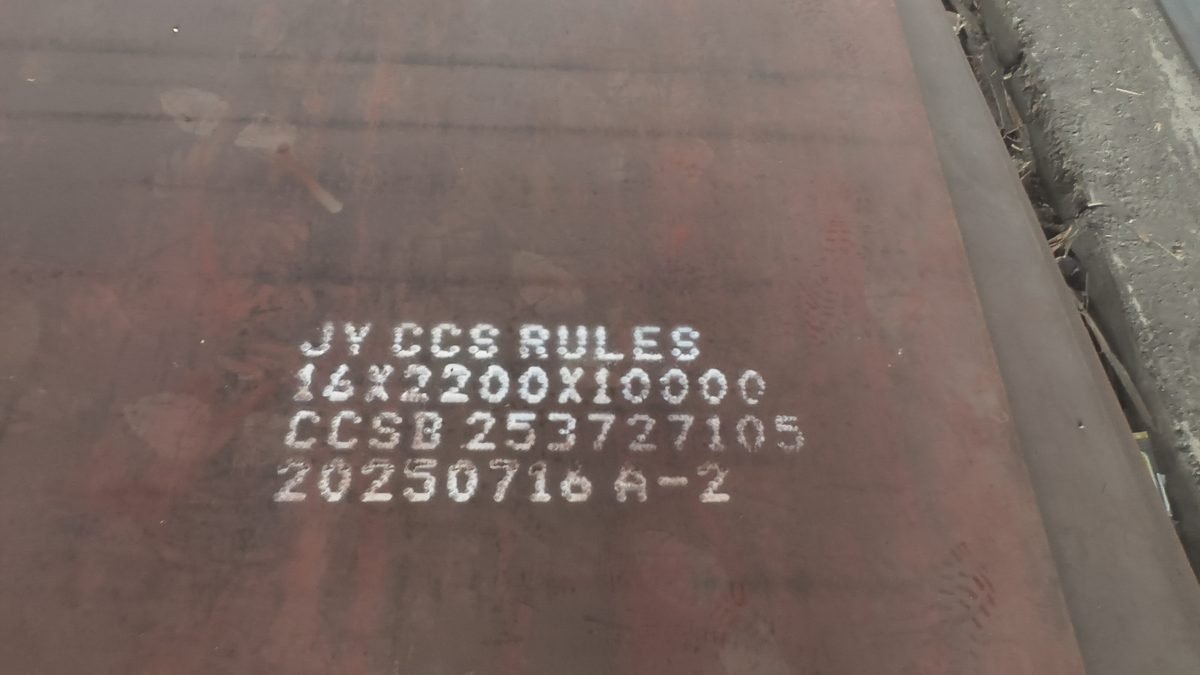
The class stamp matters as much as the chemistry. CCS approval is tied to the mill, the heat treatment route and the product thickness range. A plate with a mill certificate but no class stamp may be chemically correct and still be rejected at the shipyard. The stamp should show the class society, the grade, the heat number, the plate number and the size. If any of these are missing or painted over, the plate should not be released for class work.
Mechanical Properties and Impact Test
AH36 is a 355 MPa yield grade. The tensile strength range is typically 490–620 MPa, with elongation of at least 21% in the longitudinal direction. The impact test is the defining requirement: 34 J average at 0 °C for longitudinal specimens, with a minimum individual value that the class rules specify. The test is not a formality. It proves that the steel has enough toughness to resist a crack at the service temperature and that the grain refinement and cleanliness are under control.
| Уласнасць | CCS AH36 requirement | Typical test piece | Design note |
|---|---|---|---|
| Мяжа цякучасці, ReH | ≥ 355 МПа | Longitudinal tensile | Выкарыстоўвайце 355 MPa for strength checks |
| Трываласць на разрыў, Rm | 490–620 MPa | Longitudinal tensile | Higher strength does not mean higher toughness |
| Падаўжэнне, А | ≥ 21% | 50 mm gauge length | Check the certificate direction |
| Charpy impact at 0 °C | 34 J average, 24 J minimum individual | 10 × 10 мм, longitudinal | Sub-size specimens have adjusted values |
| Thickness range | Typically 6–100 mm | As rolled or TMCP | Impact requirements vary with thickness |
| Паверхня | Як закаталі, shot blasted or primed | — | Primer must be compatible with welding |
| Ultrasonic test | Class-dependent | Plate or edge | Specify the acceptance level |
Typical CCS AH36 values for plate. Confirm the exact impact energy, specimen orientation and sub-size rules in the current class rules.
Specimen orientation is a frequent source of confusion. Longitudinal specimens are cut along the rolling direction; transverse specimens are cut across it. Longitudinal toughness is usually higher, so a certificate that reports only transverse values may not match the class requirement. The certificate should state the direction, the specimen size and the test temperature. A value reported at -20 °C does not make the plate an DH36 plate; the grade is defined by the specified test temperature and the full approval.
Памеры, Tolerances and Plate Data
Shipbuilding plate is ordered by thickness, шырыня, length and edge condition. Thickness tolerance is usually tighter than ordinary structural plate because the hull scantling and the welding procedure depend on it. The class rules and the mill’s approval set the tolerance; a buyer should not assume a generic ±0.5 mm applies to every gauge. Для тоўстай талеркі, the tolerance can be negative or positive depending on the rolling practice, and the shipyard may require a minimum actual thickness at the plate centre.
| Параметр | Агульны дыяпазон | Тыповая талерантнасць | Order description |
|---|---|---|---|
| Таўшчыня | 6–100 mm | Per class rules, often -0.3 / +0.5 мм | Nominal, minimum actual and class rule |
| Шырыня | 1500–3200 mm | 0 / +10 мм | Finished width and edge trim |
| Даўжыня | 6000–12000 mm | 0 / +20 мм | Fixed length and handling limit |
| Пляскатасць | — | ≤ 5 мм на метр | Critical for panel assembly |
| Выпукласць | — | ≤ 3 мм на 5 м | Check before nesting |
| край | Sheared or gas cut | Per order | Gas-cut edge may need grinding before weld |
| Паверхня | Як закаталі, blasted, грунтаваць | Per order | Primer type and dry film thickness |
| Разметка | Stencil or paint | Гатунак, heat, plate no, памер | Must remain visible after cutting |
Typical shipbuilding plate data. The class rules and the mill’s approval take precedence over generic tolerance tables.
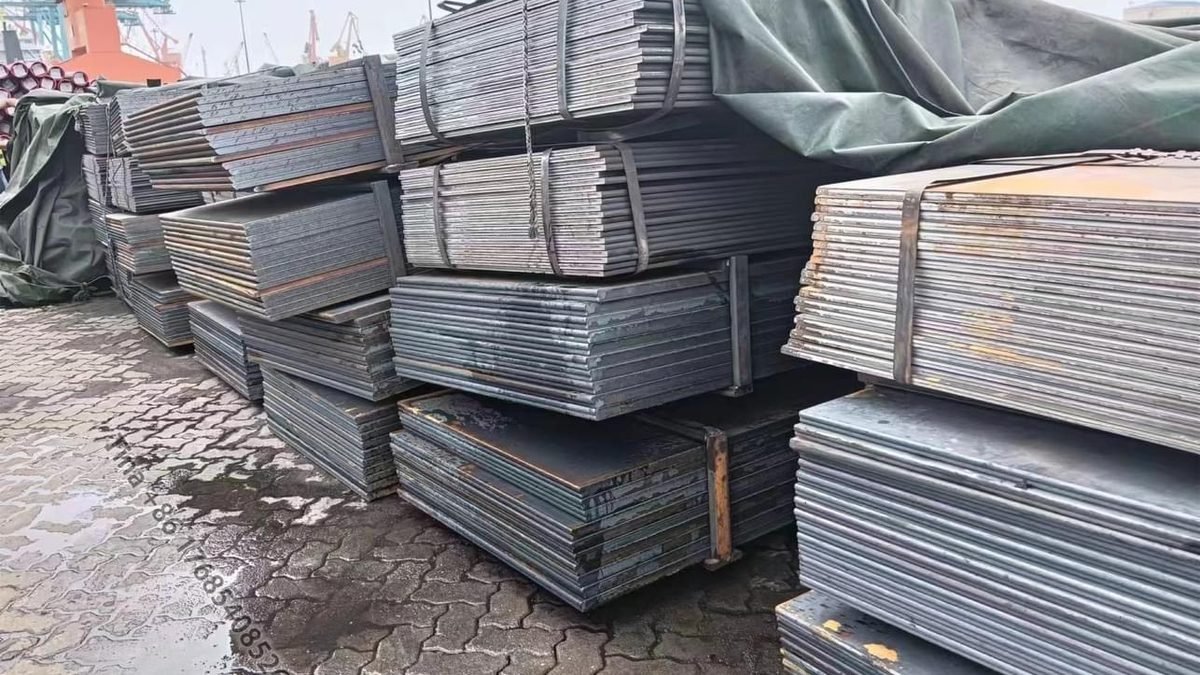
Plate size is a nesting decision. А 12 m plate is efficient for a large hull panel but difficult to handle in a small yard. А 6 m plate is easier to crane and store but produces more butt joints. The shipyard should choose the plate size together with the nesting plan and the welding sequence, not after the steel has arrived. A plate that is 100 mm too short for a nested part becomes scrap or a costly splice.
Edge condition also affects welding. A sheared edge can have a cold-worked rim and a small lip; a gas-cut edge can have a heat-affected zone and a rough profile. For critical butt welds, the edge should be machined or ground to a clean profile before welding. Primer on the plate must be a welding-compatible type; a shop primer that is too thick or too zinc-rich can cause porosity if it is not removed from the weld zone.
How CCS AH36 Plate Is Made
The steel is made in a basic oxygen furnace or electric furnace, fully killed with aluminium or a similar deoxidiser, and continuously cast into slabs. The slab is reheated and rolled to plate on a reversing mill. The finishing temperature and the cooling rate are controlled to refine the grain. AH36 can be supplied as-rolled, normalized, or thermomechanically controlled rolled (TMCP), depending on the thickness and the class approval.
TMCP is common for AH36 because it combines grain refinement with a controlled cooling path and avoids a separate normalizing treatment. The process must be qualified for the mill and the thickness range. A plate that is labelled TMCP but was produced outside the qualified window may have the right chemistry and still fail the impact test. Normalized plate is more forgiving but costs more energy and may have lower strength.
The plate is then cooled, levelled, агледжаны, marked and, if required, ultrasonically tested. Class surveyors may witness the tests or review the mill records. The plate is usually shot blasted and primed before shipment to protect the surface during transport. The primer must be compatible with the shipyard’s welding and painting system; a primer that is not removable can contaminate the weld pool.
Typical defects include laminations, surface cracks, edge cracks, сляды рулонаў, flatness problems and primer runs. Laminations come from inclusions or gas in the slab and are detected by ultrasonic testing. Surface cracks can come from poor cooling or from a slab corner defect. Edge cracks can propagate during rolling. A plate with a lamination near a weld preparation should be rejected or repaired according to the class procedure, not simply ground and painted over.
Welding and Fabrication Rules
AH36 is weldable with shielded metal arc, gas metal arc, flux-cored arc and submerged arc welding. Use low-hydrogen consumables with a strength match and a toughness grade suitable for the service temperature. For AH36, a 3YH or equivalent consumable is common. Store electrodes dry and follow the maker’s rebaking procedure. A damp electrode is a direct route to hydrogen cracking in a thick, restrained joint.
Preheat depends on thickness, carbon equivalent, joint restraint and ambient conditions. Thin plate in a warm shop may need no preheat; тоўстая пласціна, low ambient temperature or a highly restrained joint may need 100–150 °C or more. Measure the preheat at the joint, not at the plate edge. Do not use a torch to “warm the surface” without a thermometer; a black heat is already too hot for some procedures.
Heat input should be controlled within the qualified range. Too little heat input can produce a hard, crack-sensitive heat-affected zone. Too much heat input can coarsen the grain and reduce toughness in the heat-affected zone. For AH36, a common starting window is 10–25 kJ/cm, but the qualified procedure governs. Use a weave width that does not exceed the procedure, and keep the interpass temperature within the qualified maximum.
- Use a qualified welding procedure specification for the grade and thickness.
- Match the consumable strength and toughness to the base plate and service temperature.
- Preheat thick or restrained joints and measure the temperature at the joint.
- Control heat input and interpass temperature; do not let the joint overheat.
- Clean the weld zone of primer, rust, oil and moisture before welding.
- Do not use PWHT unless the procedure or the class rules require it.
- Inspect the weld with visual, ultrasonic or radiographic methods as specified.
Ordering and Selection Rules
Start with the service temperature. AH36 is an A-grade with 0 °C impact. If the structure will operate at -20 °C, use DH36; у -40 °C, use EH36. Do not assume that a thicker AH36 plate has better low-temperature toughness; thickness usually makes the toughness requirement harder to meet, not easier. For a cold climate or a refrigerated cargo, the grade letter must change.
Specify the class society and the certificate. A shipyard order should state “CCS AH36, class approved, з 3.2 certificate, impact test at 0 °C longitudinal, ultrasonic test according to the class rules.” If the plate is for a non-class structure, the buyer may accept a mill certificate, but the grade and impact requirement should still be stated. A generic “high-strength steel plate” order leaves too much to the mill.
Choose the thickness from the structural calculation plus the corrosion allowance plus the rolling tolerance. А 12 mm nominal plate may be 11.7 mm at the thin end; if the design assumes 12 мм, the section modulus is lower than calculated. For hull structures, the class rules give the minimum thickness and the corrosion addition. Do not reduce the thickness because AH36 has a higher yield than A-grade; deflection and buckling are separate checks.
| Ужыванне | Grade choice | Прычына |
|---|---|---|
| Hull shell, deck, general structure at 0 °C | AH36 | 355 MPa yield with 0 °C impact |
| Cold climate or refrigerated cargo | DH36 or EH36 | Impact tested at -20 °C or -40 °C |
| Highly restrained thick joint | AH36 with qualified WPS and preheat | Hydrogen cracking risk rises with thickness |
| Offshore structure with fatigue load | AH36 or higher, with toughness and UT | Fatigue and brittle fracture both matter |
| Non-class structural repair | AH36 with 3.2 certificate | Traceability and toughness still required |
Grade selection is a class and design decision. The table is a starting point, not a substitute for the structural drawings.
Тыповыя памылкі
| Mistake | Consequence | Correct approach |
|---|---|---|
| Using A36 instead of AH36 | Lower yield and no 0 °C impact | Check the grade stamp and certificate |
| Treating AH36 as a low-temperature grade | Brittle fracture risk below 0 °C | Use DH36 or EH36 for colder service |
| Ignoring specimen orientation | Impact values may not meet the class rule | Require longitudinal test results |
| Welding with damp electrodes | Hydrogen cracking in thick joints | Store and rebake electrodes correctly |
| Excessive heat input | Coarse HAZ and lower toughness | Follow the qualified heat input range |
| Grinding over a lamination | Hidden defect remains in service | Reject or repair per class procedure |
| Cutting without checking flatness | Assembly gaps and weld distortion | Check camber and flatness before nesting |
| Losing the heat number after cutting | Traceability is broken | Transfer the stamp to the cut part |
Most AH36 problems are grade substitution, toughness misunderstanding or welding procedure errors, not chemistry failures.
Inspection and Acceptance
Receiving inspection starts with the stamp and the certificate. Check the class society, гатунак, лік цяпла, plate number, памер, impact temperature and test results. Measure thickness at several points, check width and length, and inspect the surface for cracks, laminations, roll marks and primer defects. If the plate is for a critical joint, require ultrasonic testing before cutting, because a lamination that is outside the cut part may still be a problem if the nesting changes.
Пасля выразання, transfer the heat number to the part. A plate that loses its stamp in the nesting process cannot be traced to the certificate. For a classed vessel, the surveyor may ask for the plate record at any stage. Keep a plate map that shows the original plate number and the parts cut from it. This is a documentation task, but it is part of the steel quality.
- Verify the class stamp, гатунак, heat number and plate number.
- Check the 3.2 certificate and the impact test direction and temperature.
- Measure thickness, шырыня, length and flatness.
- Inspect for laminations, cracks, roll marks and primer defects.
- Confirm the ultrasonic test level if required.
- Transfer the heat number to every cut part and keep a nesting map.
FAQ
What does AH36 mean?
A means Charpy impact tested at 0 °C, H means high strength, і 36 азначае мінімальны мяжа цякучасці 355 МПа. The grade is a hull structural steel, not a generic structural plate.
Is AH36 the same as ASTM A36?
няма. A36 has a lower yield and no 0 °C impact requirement. AH36 is a class-approved higher-strength hull steel with controlled chemistry and toughness.
Can AH36 be used at -20 °C?
Not as a rule. AH36 is qualified at 0 °C. Для -20 °C service, use DH36; для -40 °C, use EH36. Check the class rules for the specific application.
What is the impact requirement?
Typically 34 J average and 24 J minimum individual at 0 °C for longitudinal specimens, with sub-size adjustments. Confirm the exact values in the current class rules.
Does AH36 need preheat?
It depends on thickness, carbon equivalent, restraint and ambient temperature. Thin plate in a warm shop may not; thick or restrained joints usually do. Follow the qualified WPS.
Can AH36 be welded to A36?
Yes with a qualified procedure and a consumable that suits both grades. The weld strength and toughness should be checked, especially for a thick or critical joint.
Why does the plate have a primer?
Shop primer protects the surface during transport and storage. It must be compatible with the shipyard’s welding and painting system; otherwise it must be removed from the weld zone.
Is TMCP better than normalized?
TMCP can give excellent strength and toughness with less energy, but it must be produced within the qualified window. Normalized plate is more forgiving but may cost more. Both can meet AH36 if approved.
Need CCS AH36 plate with a class certificate and impact test report?
QIDAMT supplies carbon steel plate, bar and structural sections from Liaocheng. Адправіць адзнаку, таўшчыня, памер, class society, certificate and destination for a quotation. Email sales@qidamt.com or call +86 139 6951 8618 during working hours (GMT+8).